
NORCET 2 -2021 (Shift-2)
Nursing Foundation
Easy
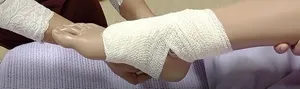
Which types of bandages are used on injury of ankle joints?
Appeared in: NORCET 2 -2021 (Shift-2)
Explanation
- The figure-of-eight technique is specifically designed to support joints.
- Its crisscross pattern effectively immobilizes the ankle, providing stability and reducing the risk of further injury.
- This method conforms well to the contours of the ankle, ensuring even pressure to help control swelling (edema).
- Unlike other methods, it allows for some controlled movement, which is beneficial for healing and preventing joint stiffness.
Why Other Options Were Wrong
- Option A: A spiral bandage is used for body parts with a uniform circumference, like an arm or a finger. The ankle joint has a varying shape and circumference, making a spiral bandage less effective for providing stable support.
- Option B: Circular turns are primarily used to anchor a bandage at the start and end of wrapping or to cover a small area. Applying only circular turns around the ankle would not provide adequate support and could constrict blood flow if applied too tightly.
- Option D: The reverse spiral technique is a modification of the spiral turn used for conical body parts (e.g., forearm, calf) to ensure the bandage lies flat without gaps. It is not the primary technique for securing a joint like the ankle.
Related Visual

- Visual 1: Diagram - Step-by-step illustration of how to apply a figure-of-eight bandage to an ankle. This would clarify the crisscross pattern and anchor points.
- Visual 2: Infographic - Comparison of different bandage turns (circular, spiral, figure-of-eight) with images showing their application on different body parts. This helps differentiate their uses.
Clinical Relevance
- Nursing practice connection: Knowing Bandaging techniques for joint injuries helps nurses interpret findings accurately and avoid errors in routine assessment, medication administration, and patient teaching.
- Correctly applying a figure-of-eight bandage is a fundamental nursing skill for managing sprains and strains, promoting healing, and providing patient comfort.
- Improper bandaging can lead to complications such as impaired circulation, skin breakdown, or inadequate joint support, potentially worsening the injury.
- What if? If the patient reports numbness, tingling, or increased pain after the bandage is applied, the nurse must immediately assess the circulation (e.g., check capillary refill, color, and temperature of the toes) and loosen the bandage as it may be too tight and compromising blood flow.
How to Approach the Question
- First, identify the core of the question, which is asking for the specific bandage type for an 'ankle joint'.
- Analyze the image provided. Observe the distinct crisscross pattern of the bandage as it wraps around the foot and ankle.
- Recall the different types of bandaging techniques and their primary purposes. Associate joints with the figure-of-eight method.
- Evaluate the options: 'Spiral' and 'Reverse Spiral' are for cylindrical/conical parts, and 'Circular' is for anchoring. 'Figure of 8' is specifically for joints.
- Confirm that the visual evidence from the image matches the description of a figure-of-eight bandage, making it the most appropriate choice.
Concept Tested & Keywords
- Concept Tested: Bandaging techniques for joint injuries
- Stem keywords: bandages, injury, ankle joints
- Lead-in keywords: Which types
- Clinical cues: The image shows a bandage being applied to an ankle, which is a hinge joint requiring specific support.
Question ID
QO8HJ8Gtb8eaCJiGJEWFZF
Practise the full NORCET 2 -2021 (Shift-2)
Attempt every question from this paper in a timed mock, then review the full solution for each one.
More Nursing Care & Specific Procedures Questions
- Identify the procedure done in the given image:
- Match the following:
- Look at the image and tell which of the following is incorrect combination:
- Identify the airway used in emergency in the following image:
- According to hospital's protocol during emergency situation "code pink" is used for which condition?
- Which is the appropriate nursing action by nursing officer after taking ABG sample from radial artery?
- The common veins used for placement of central line are all; EXCEPT:
- Who discovered Catgut suture?
- The sutures used to close deep, multi-layer lacerations are:
- You are preparing to suction a patient who is intubated with a 4.5 mm endotracheal tube (ETT). What size suction catheter would you choose to minimiz…
More NORCET 2 -2021 (Shift-2) Questions
- Preferred route of tranexamic acid drug administration is?
- Parts of the fallopian tube, except?
- After thyroidectomy the patient complains for hoarseness of voice that occurs due to injury in?
- Highest source of vitamin-C?
- After the RTA, a patient was brought to the emergency department. After Massive blood transfusion, which electrolyte imbalance occurs in the patient?
- A patient suffering from shock is receiving normal saline (NS). What is the normal osmolarity of Na\ in NS?
- A patient is unconscious nurse is going to take the sterile urine sample for culture from the urinary catheter. What technique is to be used by the n…
- Covid face shield is sterilized by?
- Which reflex should check when death of the brain stem occurs, except?
- Which is an example of a tocolytic agent?