
NORCET 2 -2021 (Shift-2)
Pharmacology
Easy
A patient suffering from shock is receiving normal saline (NS). What is the normal osmolarity of Na* in NS?
Appeared in: NORCET 2 -2021 (Shift-2)
Explanation
- Normal Saline (NS) is a 0.9% solution of sodium chloride (NaCl), a standard intravenous fluid.
- It is classified as an isotonic crystalloid, meaning its concentration of solutes is similar to that of blood plasma.
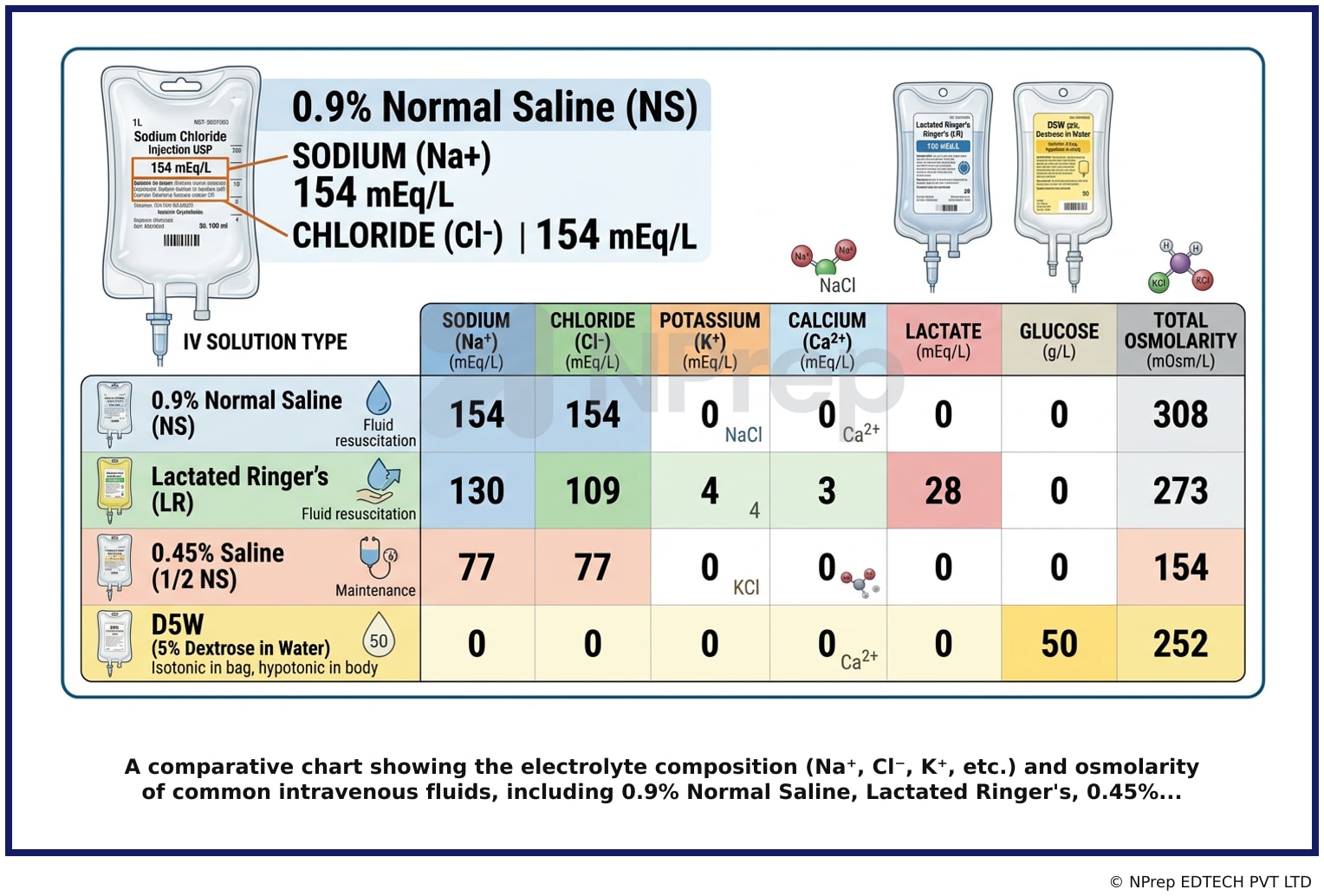
- By definition, each liter of 0.9% Normal Saline contains 154 mEq of sodium (Na+) and 154 mEq of chloride (Cl−).
- This composition makes it a primary choice for fluid resuscitation in hypovolemic states like shock, as it effectively expands the extracellular fluid volume.
Why Other Options Were Wrong
- Option B: This value does not correspond to the sodium concentration in any standard IV resuscitation fluid. A serum sodium level of 100 mEq/L in a patient would indicate severe, life-threatening hyponatremia.
- Option C: This is the concentration of sodium (Na+) in Lactated Ringer's (LR) solution, not Normal Saline.
- Option D: This value is incorrect. A serum sodium level of 126 mEq/L would be classified as mild hyponatremia in a patient. It is not the concentration of sodium in Normal Saline.
Related Visual
Clinical Relevance
- Nursing practice connection: Prioritize focused assessment, early escalation, and real-time monitoring when managing Composition and Osmolarity of Normal Saline (0.9% NaCl) in acute care settings.
- Nurses must know the composition of IV fluids to administer the correct solution based on the patient's condition. Using an isotonic fluid like NS in a shock patient helps to rapidly restore circulating blood volume without causing major fluid shifts between cells and the bloodstream.
- Administering large volumes of NS can lead to hyperchloremic metabolic acidosis because it provides more chloride (154 mEq/L) than plasma (about 103 mEq/L). Nurses should monitor lab values and the patient's acid-base status during prolonged resuscitation.
- What if the patient had a traumatic brain injury? In that case, NS would be preferred over Lactated Ringer's. LR is slightly hypotonic relative to plasma and could potentially worsen cerebral edema and increase intracranial pressure.
How to Approach the Question
- This is a factual recall question testing foundational knowledge of common intravenous fluids.
- First, identify the key terms in the question: 'normal saline (NS)' and 'osmolarity of Na+' (which refers to the sodium concentration).
- Recall the standard composition of 0.9% Normal Saline, which is one of the most frequently used IV fluids.
- The standard concentration of sodium in 0.9% NS is 154 mEq/L.
- Compare this known value to the given options to select the correct answer.
Concept Tested & Keywords
- Concept Tested: Composition and Osmolarity of Normal Saline (0.9% NaCl)
- Stem keywords: shock, normal saline (NS), osmolarity, Na+
- Lead-in keywords: What is
- Clinical cues: The patient is in shock, indicating a need for volume expansion, for which Normal Saline is a first-line treatment.
- Negative lead-in flag: false
Question ID
QaFKhUwiMwxiMp0aSzfBy
Reference Book
E6 Nursing Brunner Adult Health 3SA Vol 1 Part 1 p. 142-144
E6 Pharmacology Nursing Lilley 11e Part 2 p. 161-163
Practise the full NORCET 2 -2021 (Shift-2)
Attempt every question from this paper in a timed mock, then review the full solution for each one.
More Miscellaneous Questions
- These agents decreases intestinal muscle tone to slow passage of feces:
- Lactated Ringer's solution is contraindicated in:
- When designing a web page that should appeal to both males and females, a good choice of background color is:
- Adrenaline dose in anaphylactic shock is:
- A patient came to ED unconscious with pinpoint pupil, lacrimation and history of substance abuse. Which of the drug will be administered?
- In rehabilitation center, which of the following drug is used as opioid substitute in substance abuse patient?
- 0.45% NS is?
- Which of the following component is not present in normal saline?
- What is the antidote of narcotics?
- Antidote for heparin is:
More NORCET 2 -2021 (Shift-2) Questions
- Preferred route of tranexamic acid drug administration is?
- Parts of the fallopian tube, except?
- After thyroidectomy the patient complains for hoarseness of voice that occurs due to injury in?
- Highest source of vitamin-C?
- After the RTA, a patient was brought to the emergency department. After Massive blood transfusion, which electrolyte imbalance occurs in the patient?
- A patient is unconscious nurse is going to take the sterile urine sample for culture from the urinary catheter. What technique is to be used by the n…
- Covid face shield is sterilized by?
- Which reflex should check when death of the brain stem occurs, except?
- Which is an example of a tocolytic agent?
- Most common catheter size in adult females?