
AIIMS Delhi NO- 2019
Nursing Foundation
Easy
Identify the airway used in emergency in the following image:
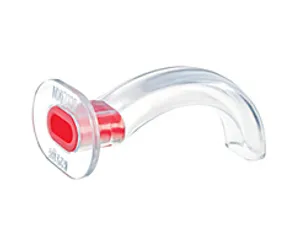
Appeared in: AIIMS Delhi NO- 2019
Explanation
- The device shown in the image is an oropharyngeal airway (OPA), also known as a Guedel airway.
- It is a rigid, curved plastic tube designed to be inserted into the mouth to maintain an open airway.
- Its primary function is to prevent the tongue of an unconscious patient from falling back and obstructing the epiglottis.
- The visible features—flange, curved body, and color-coded bite block—are characteristic of an OPA.
Why Other Options Were Wrong
- Option B: A nasopharyngeal airway (NPA) is a soft, flexible tube inserted through the nose, not the mouth. The device in the image is rigid and designed for oral insertion.
- Option C: A nasogastric (NG) tube is a much thinner, longer, and more flexible tube used for enteral feeding or gastric suctioning. It is not designed for airway management.
- Option D: This option is incorrect because the device is clearly identifiable as an oropharyngeal airway, which is one of the listed options.
Related Visual

Clinical Relevance
- Nursing practice connection: This is primarily an exam-oriented knowledge point with limited direct bedside application, so retain Identification and purpose of airway adjuncts as background academic context rather than a clinical decision trigger.
- Correct sizing of an OPA is critical for patient safety. An OPA that is too large can obstruct the larynx, while one that is too small can push the tongue back and worsen the obstruction. The correct size is measured from the corner of the patient's mouth to the angle of the jaw.
- The primary contraindication for an OPA is the presence of a gag reflex. Inserting an OPA in a patient with a gag reflex can cause vomiting and aspiration.
- What if? If the patient in an emergency situation was semi-conscious and resisting the OPA insertion with a gag reflex, the nurse should immediately remove the OPA and prepare to insert a nasopharyngeal airway (NPA) instead, as it is better tolerated.
How to Approach the Question
- First, carefully examine the image provided. Note the key features of the device: its rigid, curved 'J' shape, the flange at one end, and the material (clear plastic with a colored insert).
- Next, read the question, which asks to identify the airway for emergency use.
- Evaluate each option against your visual analysis. 'Oropharyngeal airway' describes a device inserted through the mouth to maintain the airway.
- Consider the other options. A 'nasopharyngeal airway' is inserted through the nose and is typically softer. A 'nasogastric tube' is for feeding/decompression and looks very different (long and thin).
- Based on the visual evidence, the device is an oropharyngeal airway. Select this option as it directly matches the item in the image.
Concept Tested & Keywords
- Concept Tested: Identification and purpose of airway adjuncts.
- Stem keywords: airway, emergency, image
- Lead-in keywords: Identify
- Clinical cues: The care setting changes urgency, monitoring level, and the expected nursing action.
- Negative lead-in flag: false
Question ID
QrreNwosynoqdkeqeeTo8H
Reference Book
E6 Nursing Fundamentals Potter Perry 12e Part 4 p. 254-255
E6 Nursing Fundamentals Taylor p. 734-736
Practise the full AIIMS Delhi NO- 2019
Attempt every question from this paper in a timed mock, then review the full solution for each one.
More Nursing Care & Specific Procedures Questions
- Identify the procedure done in the given image:
- Match the following:
- Look at the image and tell which of the following is incorrect combination:
- According to hospital's protocol during emergency situation "code pink" is used for which condition?
- Which is the appropriate nursing action by nursing officer after taking ABG sample from radial artery?
- The common veins used for placement of central line are all; EXCEPT:
- Who discovered Catgut suture?
- The sutures used to close deep, multi-layer lacerations are:
- You are preparing to suction a patient who is intubated with a 4.5 mm endotracheal tube (ETT). What size suction catheter would you choose to minimiz…
- Which types of bandages are used on injury of ankle joints?
More AIIMS Delhi NO- 2019 Questions
- A nurse is preparing to give bath to admitted patient with perineal problem. Which of the following will help the patient?
- In the absence of nurse from floor, patient falls from bed. This type of injury belongs to:
- Patient's Medical record with all essential information is responsibility of:
- Post-partum women having bleeding within 24 hrs after delivery is called:
- In which condition, distal pulse is preferred rather than apical pulse?
- A pre-eclampsia woman's baby is lying with her mother. Neonate is born in 37 weeks. After 57 hours, when nurse is monitoring vital signs of baby, tem…
- A woman with 3rd day postpartum has complaint of engorgement in both breasts. What is cut off temperature for fever in postpartum women?
- Universal blood donor?
- WHO hand wash time with soap?
- Why it is necessary to remove dark coloured nail paint before surgery?