
KPSC Staff Nurse - 2018
Nursing Research & Statistics
Medium
Which among the following is not a fact about EBP (evidence based practice)?
Appeared in: KPSC Staff Nurse - 2018
Explanation
- This statement is incorrect because Evidence-Based Practice (EBP) is a much broader concept than Research Utilization (RU).
- RU refers specifically to the use of findings from a research study in a practical application.
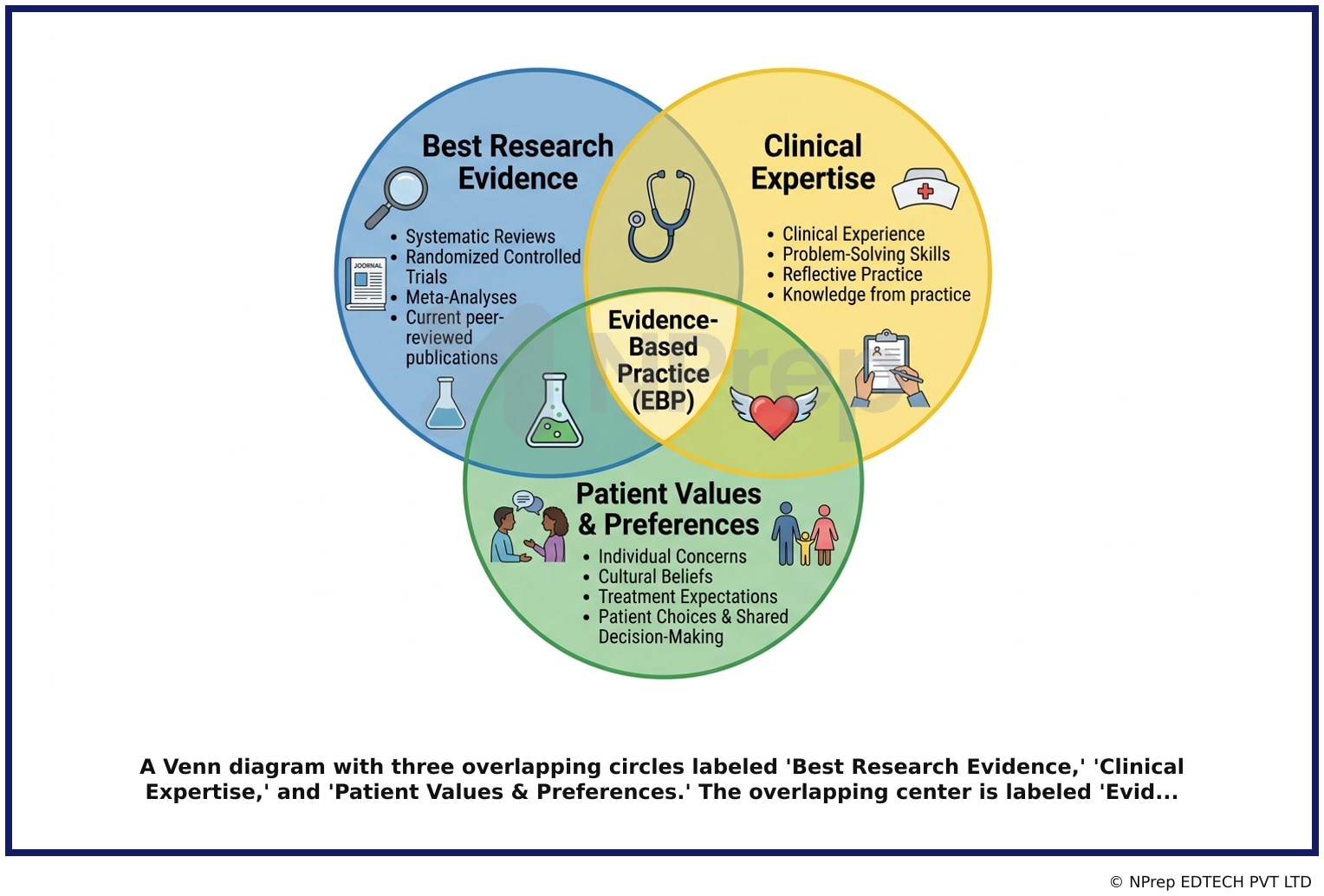
- EBP, in contrast, is a problem-solving approach that integrates the best available research evidence with a clinician's expertise and the patient's individual preferences and values.
- Therefore, EBP is not just another term for RU; RU is only one part of the larger EBP framework.
Why Other Options Were Wrong
- Option A: This statement is a core principle of EBP. The process begins with a clinical question and involves finding and using the best current evidence to guide decisions about patient care.
- Option B: This is a valid outcome of EBP. By systematically questioning current practices and seeking better evidence, EBP identifies gaps in knowledge, which stimulates new research and ultimately expands the profession's knowledge base.
- Option C: This statement is one of the three essential pillars of EBP. Patient-centered care, which respects and responds to individual patient preferences, needs, and values, is a central feature of the EBP model.
Related Visual
Clinical Relevance
- Nursing practice connection: This is primarily an exam-oriented knowledge point with limited direct bedside application, so retain Evidence-Based Practice (EBP) vs. Research Utilization as background academic context rather than a clinical decision trigger.
- Embracing EBP allows nurses to move beyond tradition-based care ('this is how we've always done it') to practices proven to be safer and more effective, leading to improved patient outcomes.
- EBP empowers nurses to be active participants in shared decision-making with patients, ensuring that care aligns with the patient's personal, cultural, and spiritual values.
- What if? If a nurse only applies a research finding (RU) without considering a patient's financial constraints or personal beliefs about a treatment, the patient is less likely to adhere to the plan. EBP requires the nurse to integrate all factors for a successful outcome.
How to Approach the Question
- First, identify the negative keyword 'not' in the question. This means you are looking for the false statement among the options.
- Recall the definition of Evidence-Based Practice (EBP). It is a three-part model: (1) Best research evidence, (2) Clinical expertise, and (3) Patient values and preferences.
- Evaluate each option against this three-part definition.
- Option A ('best evidence') and Option C ('patient preferences') are explicitly part of the definition.
- Option B ('expand knowledge base') is a logical outcome of applying EBP.
- Option D presents EBP as being the same as 'research utilization'. Consider if this is true. EBP is a broad, three-part model, while research utilization is a narrower concept. This makes the statement a likely candidate for the incorrect fact.
Concept Tested & Keywords
- Concept Tested: Evidence-Based Practice (EBP) vs. Research Utilization
- Stem keywords: EBP, evidence based practice, fact
- Lead-in keywords: not
- Negative lead-in flag: The question asks for the statement that is NOT a fact about EBP.
Question ID
QDj04Oe3jytHucdrHDH4py
Reference Book
E6 NursingResearch Polit 11e Part 1 pp. 36-38, 37-39
Practise the full KPSC Staff Nurse - 2018
Attempt every question from this paper in a timed mock, then review the full solution for each one.
More Foundation of Nursing Research Questions
- Which one of the following statements is not applicable to using an evidence-base in nursing practice?
- How does audit differ from research?
- Using precise methods to investigate problems and arrive at solutions is called:
- The foundation of research is based on which of the following?
- What is the most reliable means of obtaining nursing knowledge?
- The primary task of nursing research is?
- Incubation period is measured by which central tendency?
- Freedom from bias in a tool stands for its?
- A systematic inquiry that uses disciplined methods to answer questions or solve problems is called?
- The average of 20 numbers is 48. If two numbers, namely, 53 and 70 are discarded, what is the average of the remaining numbers?
More KPSC Staff Nurse - 2018 Questions
- Which Article of Indian Constitution abolishes untouchability?
- The 73rd and 74th Amendments to the Indian Constitution were related with. $\qquad$ $?$
- Name the program launched by the Department of Women and Child Development, MHRD in 1988 to boost up women's health, education and political particip…
- Which social reformer of Kerala authored a book titled "Pracheena Malayalam"?
- "Awake, remember the Lord Almighty, Get up at once and fight injustice". Which social reform organization of 20th century Kerala put forth the above…
- ....................is considered as the "father of political movements in modern Thiruvithamkur"?
- Who among the following women social reformer and activist of 20th century Kerala actively participated in the Paliyam Satyagraha of 1947?
- Which compound is known as inorganic benzene?
- The designation of an orbital with $\mathbf{n}=4$ and $\mathbf{l}=2$ is?
- The element with highest electronegativity is?