
DSSSB 13 August 2024
Medical & Surgical Nursing
Easy
Which therapy is being shown in the given image?
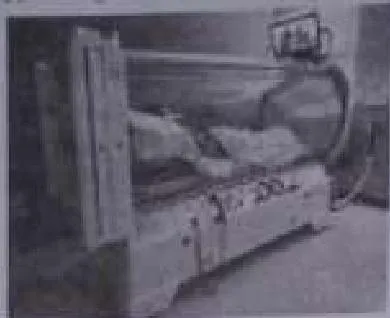
Appeared in: DSSSB 13 August 2024
Explanation
- The image shows a patient fully enclosed in a transparent, cylindrical chamber, which is a monoplace hyperbaric oxygen therapy (HBOT) unit.
- Hyperbaric oxygen therapy involves breathing 100% pure oxygen in a chamber where the air pressure is increased up to three times higher than normal.
- This high-pressure environment allows the lungs to gather more oxygen than would be possible at normal air pressure, which helps fight bacteria and stimulate the release of substances called growth factors and stem cells, which promote healing.
- It is used to treat a variety of medical conditions, including serious infections, bubbles of air in blood vessels (air embolism), and wounds that won't heal as a result of diabetes or radiation injury.
Why Other Options Were Wrong
- Option A: Vacuum-assisted wound closure, also known as Negative Pressure Wound Therapy (NPWT), is a localized treatment. It uses a foam dressing, a suction tube, and a pump to apply negative pressure directly to a wound bed, not a full-body chamber.
- Option B: Negative pressure wound therapy (NPWT) is the same as vacuum-assisted wound closure. It is a localized therapy applied directly to a wound and does not involve enclosing the patient in a chamber.
- Option C: Maplex Ag (a brand name for Mepilex Ag) is a type of antimicrobial wound dressing containing silver. It is applied topically to the wound surface and is not a form of chamber-based therapy.
Related Visual

Clinical Relevance
- Nursing practice connection: Use the key finding related to Identification of Therapeutic Medical Equipment to guide bedside assessment, documentation, and the next nursing action.
- Nurses must be able to differentiate between systemic therapies like HBOT and localized wound care like NPWT to ensure correct patient preparation and monitoring. For HBOT, this includes assessing for contraindications (e.g., untreated pneumothorax) and monitoring for side effects like ear barotrauma and confinement anxiety.
- Patient education is crucial. A patient scheduled for HBOT needs to understand they will be in an enclosed space to manage potential anxiety (claustrophobia), a key adverse effect.
- What if? If the patient in the image had a heavily exudating diabetic foot ulcer but no signs of systemic infection or ischemia requiring HBOT, the primary treatment might instead be Negative Pressure Wound Therapy (NPWT) to manage the local wound environment.
How to Approach the Question
- First, analyze the image to identify the key features of the equipment. Observe that the patient is entirely inside a large, sealed, transparent tube.
- Recognize this as a systemic treatment, as it involves the whole body, not just a localized area.
- Evaluate the options based on this observation. 'Vacuum-assisted wound closure' and 'Negative pressure wound therapy' are localized suction treatments applied directly to a wound.
- 'Maplex Ag closure therapy' refers to a specific type of wound dressing, which is also a local treatment.
- Conclude that 'Hyperbaric oxygen therapy' is the only option that involves placing a patient inside a pressurized chamber to deliver a systemic treatment.
Concept Tested & Keywords
- Concept Tested: Identification of Therapeutic Medical Equipment
- Stem keywords: therapy, image
- Lead-in keywords: Which therapy
Question ID
Q5jOboidfBJEBZ2JNhcWsi
Reference Book
E6 Nursing Brunner Adult Health 3SA Vol 1 Part 3 p. 84-86
E6 Nursing Fundamentals Potter Perry 12e Part 6 p. 98-100
Practise the full DSSSB 13 August 2024
Attempt every question from this paper in a timed mock, then review the full solution for each one.
More Perioperative Concepts and Nursing Management Questions
- The nurse is informed that a client with a large surgical incision is being transferred from the intensive care unit to the surgical unit. What medic…
- Why it is necessary to remove dark coloured nail paint before surgery?
- A patient planned for surgery advised to remove Jewellery because:
- Vicryl 3-0 is:
- All of the following are correct regarding stoma formation; EXCEPT:
- A surgeon is going to give a skin incision on patient. Which of the following is to be done?
- Following is the picture of sterile sponge used in emergency. It has a blue colour thread. What is the purpose of this colour thread?
- How many items are included in the WHO surgical safety checklist: SITOSO?
- In operation theater during cauterization, the electric current passing from a single electrode is called:
- Which position is given to a client by nursing officer, who has been brought from OT after craniotomy surgery?
More DSSSB 13 August 2024 Questions
- Which of the following is NOT a component of mental status examination?
- Which of the following correctly describes esotropia?
- The tablet Arkaminis used in the management of:
- A patient was brought to the emergency department and a blood sample was sent for serum electrolyte level. The report shows that the serum potassium…
- The concept of therapeutic community was first developed by:
- The superego functions based on:
- Reed-Sternberg cells are distinctive, giant cells have light microscopy in biopsies from individuals with the following diseases?
- Which of the following intakes is usually associated with "Flashback phenomenon"?
- Which of the following drugs is commonly used to treat vertigo?
- What is the therapeutic serum level of phenytoin in treatment of seizures?