
AIIMS Delhi NO- 2019
Obstetrics & Gynaecology
Easy
Identify the instrument used by a nurse in the following image:
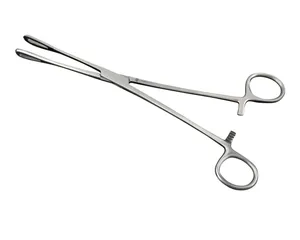
Appeared in: AIIMS Delhi NO- 2019
Explanation
- The instrument in the image is a Sponge Holder, identified by its long shanks, ring handles, and a ratchet lock.
- Its most distinct feature is the pair of oval, fenestrated (windowed) jaws with serrations, designed to securely grip surgical sponges or gauze.
- This design is ideal for tasks like applying antiseptic solutions to the skin ('painting') or for dabbing fluids in deep surgical sites, as confirmed in nursing textbooks.
Why Other Options Were Wrong
- Option A: Cheattle forceps are large, heavy forceps used for transferring sterile instruments and supplies. They are not used on patients and typically lack a ratchet lock.
- Option B: Ovum forceps have fenestrated tips but critically lack a ratchet lock. This is a deliberate design choice to prevent crushing the delicate products of conception during removal.
- Option D: Kocher forceps are hemostatic clamps characterized by a 1x2 tooth at the tip, designed for aggressively gripping tough tissue like fascia or bone. The instrument in the image does not have these teeth.
Related Visual

Clinical Relevance
- Nursing practice connection: Use the key finding related to Surgical Instrument Identification to guide bedside assessment, documentation, and the next nursing action.
- Correct instrument identification is a fundamental nursing skill in the operating room, crucial for patient safety and procedural efficiency. Handing the wrong instrument can cause delays or lead to patient injury.
- A nurse's ability to anticipate the surgeon's needs by preparing the correct instruments, such as a sponge holder for skin prep, demonstrates competence and contributes to a smooth workflow.
- What if the instrument was used to clamp an artery? Using a sponge holder instead of a proper hemostat like a Kelly or Kocher forceps would be ineffective and unsafe, as its design is for holding sponges, not occluding vessels. This highlights the importance of using instruments only for their intended purpose.
How to Approach the Question
- First, carefully examine the image of the instrument, paying close attention to its key parts: the tip (jaws), the shanks (body), and the handles.
- Note the specific features of the jaws: Are they sharp, blunt, serrated, toothed, or fenestrated (windowed)? The instrument in the image has fenestrated, oval jaws with serrations.
- Observe the shanks and handles: Note the length and shape. Look for a locking mechanism, such as a ratchet. This instrument has long shanks, ring handles, and a ratchet lock.
- Synthesize these observations: The combination of fenestrated/looped jaws, a long shank, and a ratchet lock is characteristic of an instrument designed to hold something, like a sponge.
- Evaluate the given options based on your visual analysis and knowledge of surgical instruments to select the best match.
Concept Tested & Keywords
- Concept Tested: Surgical Instrument Identification
- Stem keywords: instrument, nurse, image
- Lead-in keywords: Identify
Question ID
QExYTamZDft3IBn_L2TcKR
Reference Book
E6 Nursing Brunner Adult Health 3SA Vol 1 Part 1 p. 78-80
E6 Midwifery Obstetrics and Gynecology Nursing Sandeep Kaur p. 50-58
Practise the full AIIMS Delhi NO- 2019
Attempt every question from this paper in a timed mock, then review the full solution for each one.
More Practical Obstetrics Questions
- Identify the following instrument:
- Identify the blade used:
- Match the following
- Identify, which of the following retractor is used in abdominal surgery?
- The instrument used for measuring fetal heart rate (FHR):
- What is the name of this retractor?
- Identify the following instrument?
- Identify the image showing in the picture?& x20;
- Green Armytage forceps is used to arrest bleeding in?
- Identify the following instrument?
More AIIMS Delhi NO- 2019 Questions
- A nurse is preparing to give bath to admitted patient with perineal problem. Which of the following will help the patient?
- In the absence of nurse from floor, patient falls from bed. This type of injury belongs to:
- Patient's Medical record with all essential information is responsibility of:
- Post-partum women having bleeding within 24 hrs after delivery is called:
- In which condition, distal pulse is preferred rather than apical pulse?
- A pre-eclampsia woman's baby is lying with her mother. Neonate is born in 37 weeks. After 57 hours, when nurse is monitoring vital signs of baby, tem…
- A woman with 3rd day postpartum has complaint of engorgement in both breasts. What is cut off temperature for fever in postpartum women?
- Universal blood donor?
- WHO hand wash time with soap?
- Why it is necessary to remove dark coloured nail paint before surgery?