
DSSSB October 2024
Medical & Surgical Nursing
Medium
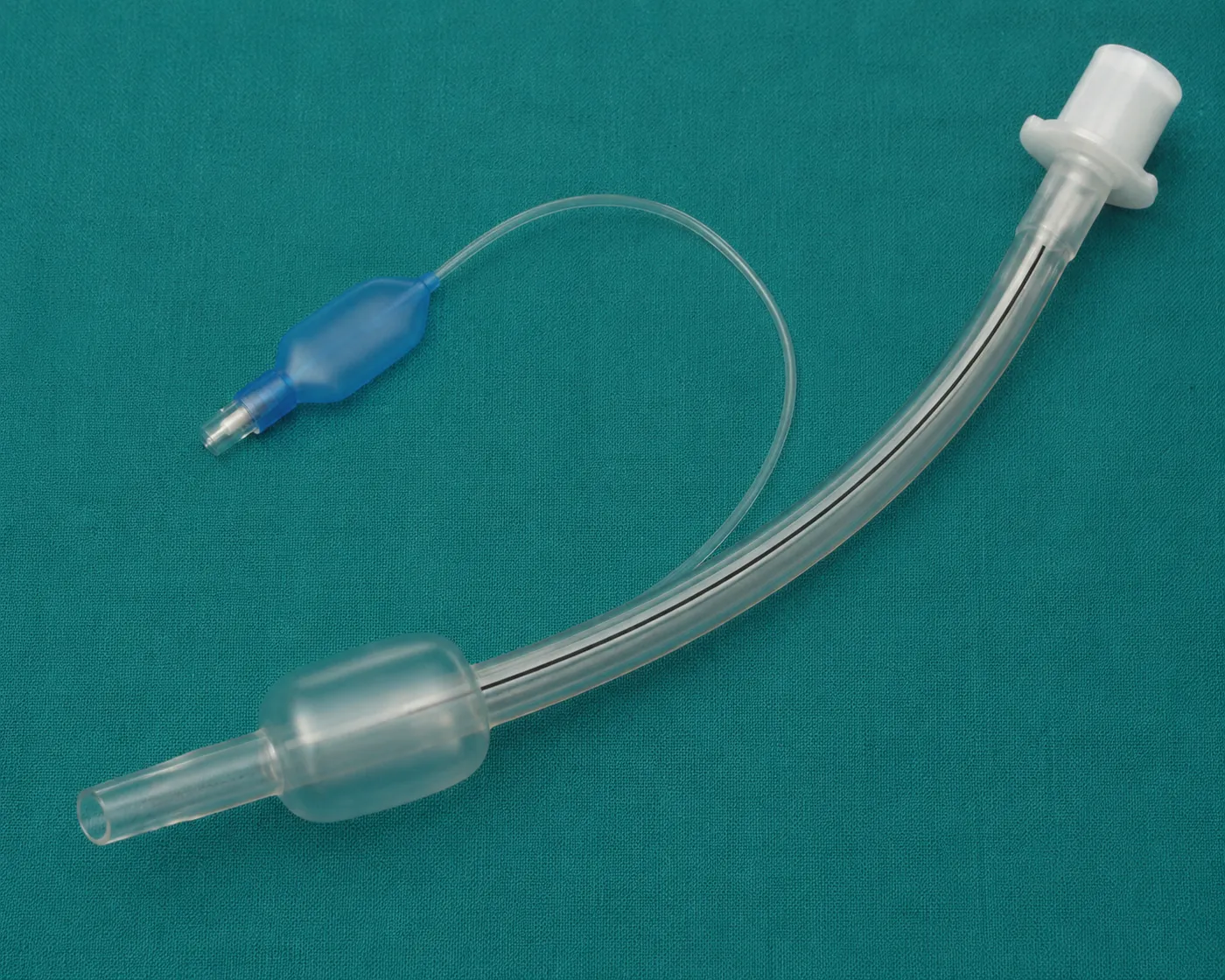
Which article is shown in the given image?
Appeared in: DSSSB October 2024
Explanation
- The device in the image is a Cuffed Endotracheal (ET) Tube.
- The key identifying feature is the presence of an inflatable cuff near the distal tip, along with its corresponding inflation line and pilot balloon.
- This type of tube is used to secure an airway, provide positive pressure ventilation, and prevent aspiration of secretions.
- The length and curvature are characteristic of an endotracheal tube, which is inserted via the mouth or nose, as opposed to a shorter tracheostomy tube.
Why Other Options Were Wrong
- Option B: This option is incorrect because the image clearly shows an inflatable cuff, an inflation line, and a pilot balloon, which are absent in an uncuffed ET tube.
- Option C: This is incorrect for two reasons: the tube has a cuff, and it is an endotracheal (ET) tube, not a tracheostomy (TT) tube. TT tubes are shorter, more sharply angled, and have a neck flange for securing it.
- Option D: While this option correctly identifies that the tube is cuffed, it incorrectly identifies it as a tracheostomy (TT) tube. The length, gentle curvature, and lack of a neck flange confirm it is an endotracheal (ET) tube.
Related Visual

Clinical Relevance
- Nursing practice connection: This is primarily an exam-oriented knowledge point with limited direct bedside application, so retain Identification of airway management equipment as background academic context rather than a clinical decision trigger.
- A nurse's primary responsibility for a patient with a cuffed ET tube is to monitor cuff pressure regularly (typically every 8-12 hours). Over-inflation can cause tracheal ischemia and necrosis, while under-inflation can lead to ventilator-associated pneumonia (VAP) due to aspiration.
- The standard safe cuff pressure range is 20-30 cm H2O (or 15-25 mmHg). Nurses use a manometer to check and adjust this pressure.
- What if? If the pilot balloon is cut or the valve is damaged, the cuff will deflate, leading to an air leak and loss of airway protection. The nurse must immediately notify the respiratory therapist and physician for probable re-intubation with a new tube.
How to Approach the Question
- This is a visual identification question. First, carefully examine the object in the image.
- Identify its key components. Note the long, curved tube, the balloon-like structure near the tip (cuff), the thin line running alongside it (inflation line), and the small balloon at the end (pilot balloon).
- Consider the overall shape. Is it long and gently curved, or short with a sharp angle and a flange?
- Evaluate the options based on your observations. The presence of a cuff eliminates 'uncuffed' options. The length and lack of a flange eliminate 'tracheostomy tube' options.
- Select the option that perfectly matches all the observed features.
Concept Tested & Keywords
- Concept Tested: Identification of airway management equipment
- Stem keywords: image, article, airway tube
- Lead-in keywords: Which
- Negative lead-in flag: false
Question ID
qdBmjZixguKVBOvVXgJHI
Reference Book
E6 Nursing Fundamentals Taylor pp. 734-736, 736-738
Practise the full DSSSB October 2024
Attempt every question from this paper in a timed mock, then review the full solution for each one.
More Gas Exchange and Respiratory Function Questions
- Which is the most relevant knowledge about oxygen administration to a client with COPD?
- Patient in emergency department diagnosed to have fluid and air present in lung. What is the above-mentioned condition known as?
- Patient is suffering from dyspnea. Which position will you provide for patient to relieve?
- Which of the following is not involved in chest physiotherapy?
- Respiration which is abnormally shallow for two or three breaths followed by irregular period of apnea is termed:
- Identify the following instrument which is used in diagnostic procedures:
- Identify the instrument shown in the following image:
- Identify the tube in the following image:
- A patient suddenly develops respiratory difficulties such as dyspnea, what is the first priority of the nursing officer?
- Which of the following method is used for high flow oxygen administration:
More DSSSB October 2024 Questions
- What is the main indication of the flooding therapy?
- Which of the following is the correct sequence of general anaesthesia?
- Identify the article in the following image.
- A schizophrenic patient was asked how many members were there in his family. He replied, "Oh, maybe seven-since many people tell me because it is too…
- What is the size of the pink colour-coded IV cannula?
- Which is a chronic, progressive and degenerative disorder that occurs due to the destruction of myelin sheath?
- Which of the following programmes is known as the National Programme of Nutritional Support to Primary Education?
- Which of the following stages of psychosexual development is commonly characterised by the Electra complex and Oedipus complex?
- All of the following are the features of Reiter's syndrome, EXCEPT:
- During psychotherapy, the therapist asks a patient to say whatever comes to his mind, in response to a word the therapist gave. Which technique is us…