
AIIMS Delhi NO- 2019
Medical & Surgical Nursing
Easy
Identify the instrument shown in the following image:
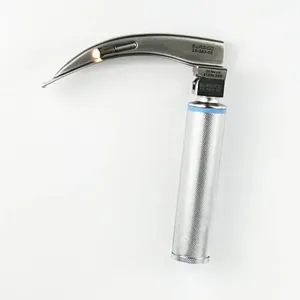
Appeared in: AIIMS Delhi NO- 2019
Explanation
- The instrument in the image is a laryngoscope, characterized by its distinct handle and blade structure.
- It is used to directly visualize the larynx and facilitate the insertion of an endotracheal tube.
- The blade shown is a curved Macintosh blade, which is inserted into the vallecula to lift the epiglottis and expose the vocal cords.
- The handle contains batteries that power the light source at the tip of the blade, essential for illuminating the airway.
Why Other Options Were Wrong
- Option B: A bronchoscope is a longer, typically flexible instrument used to examine the lower airways (trachea and bronchi), not just the larynx. It has a different structure, resembling a long, thin tube with controls at the handle.
- Option C: Videoscope is a general term for any scope that uses a video camera. While video laryngoscopes exist, the instrument shown is a conventional direct-view laryngoscope without a screen or camera attached. 'Laryngoscope' is more specific.
- Option D: Endoscope is a very broad category for any instrument used to look inside the body. While a laryngoscope is a type of endoscope, it is not the most specific or accurate name for the instrument shown.
Related Visual

Clinical Relevance
- Nursing practice connection: This is primarily an exam-oriented knowledge point with limited direct bedside application, so retain Identification of common medical instruments used for airway management as background academic context rather than a clinical decision trigger.
- Mastering laryngoscopy is a critical skill for nurses, especially those in critical care, emergency, and anesthesia, as it is fundamental to securing a patient's airway.
- Nurses must be able to quickly identify and assemble a laryngoscope, checking that the light source is functional ('white, bright, and tight') before an intubation procedure.
- What if? If the patient were a small infant, a straight blade (Miller blade) would typically be preferred over the curved Macintosh blade. The Miller blade is designed to directly lift the infant's large, floppy epiglottis to view the vocal cords.
How to Approach the Question
- First, carefully examine the image provided, paying attention to the key features of the instrument: its shape, parts, and any unique characteristics.
- Identify the main components: a handle and a blade. Note the blade is curved and has a light source.
- Recall the functions of different airway instruments. A laryngoscope is used for viewing the larynx.
- Evaluate the given options. 'Laryngoscope' specifically describes the instrument shown.
- Eliminate the other options. A 'Bronchoscope' is for lower airways. 'Videoscope' and 'Endoscope' are too general; 'Laryngoscope' is the most precise term for this device.
- Confirm your choice based on the visual evidence matching the specific definition of a laryngoscope.
Concept Tested & Keywords
- Concept Tested: Identification of common medical instruments used for airway management.
- Stem keywords: instrument, image
- Lead-in keywords: Identify
Question ID
QOsuM3Jv5p7guhkbYwugtj
Reference Book
E6 Nelson Textbook of Pediatrics(2024) — Volume 2 pp. 308-310, 309-311
Practise the full AIIMS Delhi NO- 2019
Attempt every question from this paper in a timed mock, then review the full solution for each one.
More Gas Exchange and Respiratory Function Questions
- Which is the most relevant knowledge about oxygen administration to a client with COPD?
- Patient in emergency department diagnosed to have fluid and air present in lung. What is the above-mentioned condition known as?
- Patient is suffering from dyspnea. Which position will you provide for patient to relieve?
- Which of the following is not involved in chest physiotherapy?
- Respiration which is abnormally shallow for two or three breaths followed by irregular period of apnea is termed:
- Identify the following instrument which is used in diagnostic procedures:
- Identify the tube in the following image:
- A patient suddenly develops respiratory difficulties such as dyspnea, what is the first priority of the nursing officer?
- Which of the following method is used for high flow oxygen administration:
- Which of the following is the cardinal sign of pulmonary edema?
More AIIMS Delhi NO- 2019 Questions
- A nurse is preparing to give bath to admitted patient with perineal problem. Which of the following will help the patient?
- In the absence of nurse from floor, patient falls from bed. This type of injury belongs to:
- Patient's Medical record with all essential information is responsibility of:
- Post-partum women having bleeding within 24 hrs after delivery is called:
- In which condition, distal pulse is preferred rather than apical pulse?
- A pre-eclampsia woman's baby is lying with her mother. Neonate is born in 37 weeks. After 57 hours, when nurse is monitoring vital signs of baby, tem…
- A woman with 3rd day postpartum has complaint of engorgement in both breasts. What is cut off temperature for fever in postpartum women?
- Universal blood donor?
- WHO hand wash time with soap?
- Why it is necessary to remove dark coloured nail paint before surgery?