
AIIMS Delhi NO- 2019
Medical & Surgical Nursing
Easy
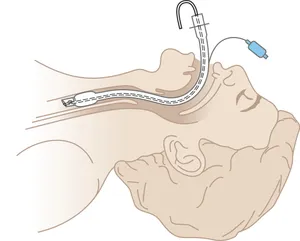
What is the procedure shown in the image?
Appeared in: AIIMS Delhi NO- 2019
Explanation
- The image displays a tube inserted through the mouth and into the trachea, which is the defining characteristic of endotracheal intubation.
- An inflatable cuff is shown securing the tube within the trachea, which prevents air leaks and aspiration, a key feature of an endotracheal tube.
- This procedure establishes a definitive airway for mechanical ventilation or to bypass an upper airway obstruction.
Why Other Options Were Wrong
- Option B: An oropharyngeal airway is a device that sits in the mouth to prevent the tongue from falling back and obstructing the airway. It does not enter the trachea as shown in the image.
- Option C: A Combi-tube is a dual-lumen, dual-cuffed tube inserted blindly into the pharynx. Its structure is different from the single-lumen tube shown, which is clearly positioned in the trachea.
- Option D: Bronchoscopy is a diagnostic or therapeutic procedure that uses a flexible or rigid scope with a camera to visualize the inside of the airways. The image shows the placement of a breathing tube, not the use of a camera scope.
Related Visual

Clinical Relevance
- Nursing practice connection: This is primarily an exam-oriented knowledge point with limited direct bedside application, so retain Identification of Airway Management Procedures as background academic context rather than a clinical decision trigger.
- Endotracheal intubation is a critical, life-saving skill used in emergencies, anesthesia, and intensive care to manage patients with respiratory failure or compromised airways.
- Nurses play a vital role in assisting with the intubation procedure, securing the tube, monitoring the patient's vital signs and oxygenation, and providing ongoing care for the intubated patient, including suctioning and oral hygiene.
- What if the patient had a suspected cervical spine injury? The intubation procedure would need to be modified. A jaw-thrust maneuver, rather than a head-tilt/chin-lift, would be used to open the airway to avoid moving the neck, and in-line stabilization would be maintained throughout the procedure.
How to Approach the Question
- First, carefully examine the image provided, paying close attention to the anatomical structures and the placement of the medical device.
- Identify the key features: a tube is inserted through the mouth, it passes the vocal cords, and its tip is located in the trachea. Note the presence of an inflated cuff.
- Next, read each option and recall the definition and purpose of each procedure.
- Compare the visual evidence from the image with the description of each option. 'Endotracheal intubation' perfectly matches the depiction of a tube in the trachea.
- Eliminate the other options by identifying how they differ. An oropharyngeal airway doesn't enter the trachea, a Combi-tube has a different structure, and bronchoscopy involves a camera.
Concept Tested & Keywords
- Concept Tested: Identification of Airway Management Procedures
- Stem keywords: procedure, image
- Lead-in keywords: What is
Question ID
QBJz7Yk7ctoHiz-vZapgxz
Reference Book
E6 Nursing Brunner Adult Health 3SA Vol 2 Part 3 p. 115-117
E6 Nursing Fundamentals Taylor pp. 734-736, 736-738
Practise the full AIIMS Delhi NO- 2019
Attempt every question from this paper in a timed mock, then review the full solution for each one.
More Gas Exchange and Respiratory Function Questions
- Which is the most relevant knowledge about oxygen administration to a client with COPD?
- Patient in emergency department diagnosed to have fluid and air present in lung. What is the above-mentioned condition known as?
- Patient is suffering from dyspnea. Which position will you provide for patient to relieve?
- Which of the following is not involved in chest physiotherapy?
- Respiration which is abnormally shallow for two or three breaths followed by irregular period of apnea is termed:
- Identify the following instrument which is used in diagnostic procedures:
- Identify the instrument shown in the following image:
- Identify the tube in the following image:
- The device used to maintain the patency of the oral airways:
- A patient suddenly develops respiratory difficulties such as dyspnea, what is the first priority of the nursing officer?
More AIIMS Delhi NO- 2019 Questions
- A nurse is preparing to give bath to admitted patient with perineal problem. Which of the following will help the patient?
- In the absence of nurse from floor, patient falls from bed. This type of injury belongs to:
- Patient's Medical record with all essential information is responsibility of:
- Post-partum women having bleeding within 24 hrs after delivery is called:
- In which condition, distal pulse is preferred rather than apical pulse?
- A pre-eclampsia woman's baby is lying with her mother. Neonate is born in 37 weeks. After 57 hours, when nurse is monitoring vital signs of baby, tem…
- A woman with 3rd day postpartum has complaint of engorgement in both breasts. What is cut off temperature for fever in postpartum women?
- Universal blood donor?
- WHO hand wash time with soap?
- Why it is necessary to remove dark coloured nail paint before surgery?