
RRB Staff Nurse Ahmedabad-2015
General Knowledge
Easy
Lord Dalhousie introduced the first railways in 1853 which ran between
Appeared in: RRB Staff Nurse Ahmedabad-2015
Explanation
- The first passenger railway line in India was inaugurated on April 16, 1853.
- The route connected Bori Bunder in Bombay (now Mumbai) with the nearby town of Thane.
- This project was initiated during the governorship of Lord Dalhousie.
- The train, carrying 400 passengers in 14 carriages, was pulled by three steam locomotives: Sahib, Sindh, and Sultan.
- This event marked the beginning of the railway era in India, which would revolutionize travel and trade across the subcontinent.
Why Other Options Were Wrong
- Option A: The railway line connecting Calcutta and Bombay was a much longer and later development. The first line was a short, local route.
- Option B: Agra and Madras were not connected by the first railway line. These cities were integrated into the network much later.
- Option D: While Calcutta was the capital of British India and Agra was a significant city, the first railway line was not established between them. The first telegraph line, however, was laid between Calcutta and Agra.
Related Visual
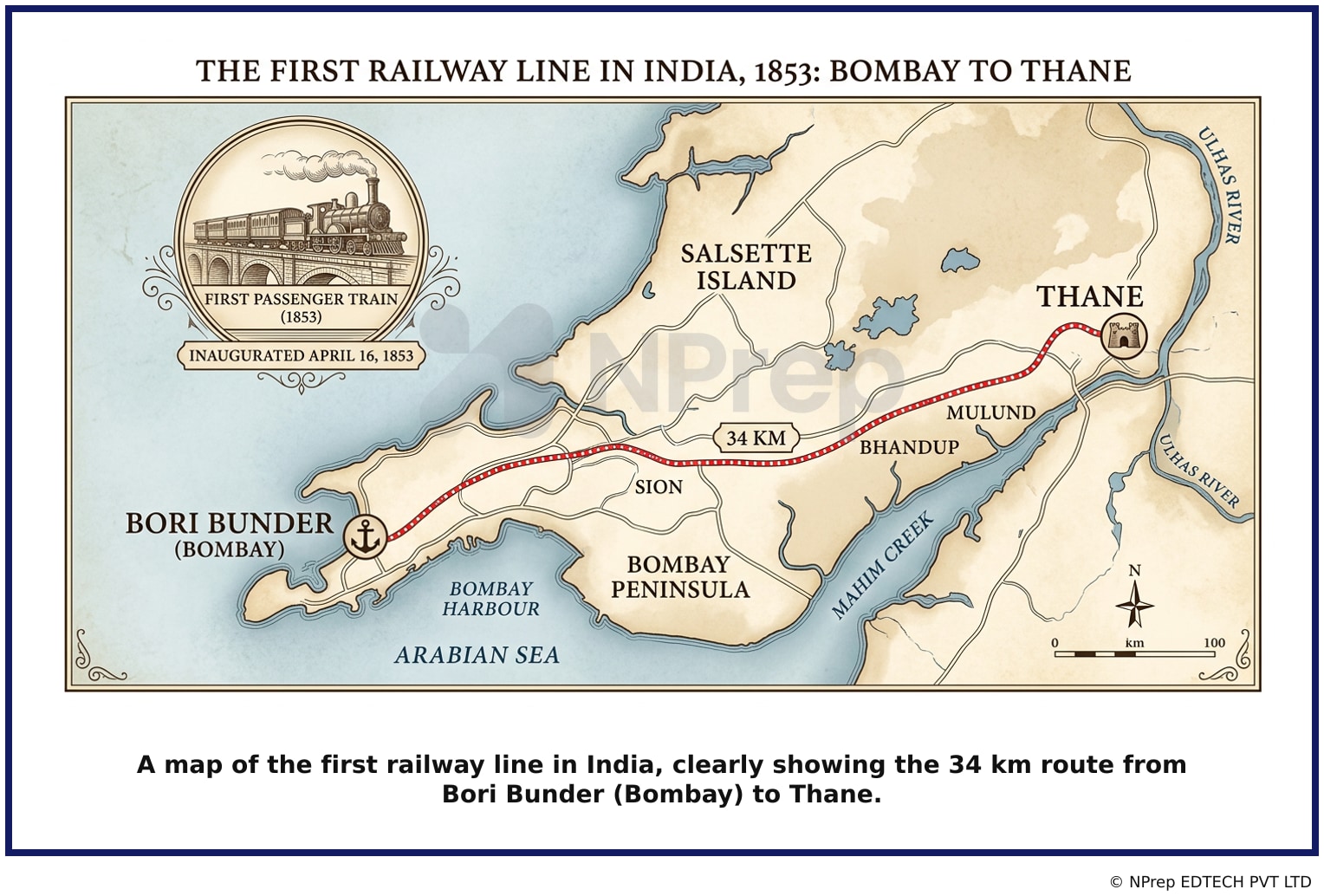
- Visual 1: Map - A map of the first railway line in India, clearly showing the 34 km route from Bori Bunder (Bombay) to Thane.
- Visual 2: Illustration - A historical illustration or photograph of the first passenger train in India, highlighting the 'Sahib', 'Sindh', and 'Sultan' locomotives.
Clinical Relevance
- Nursing practice connection: This is primarily an exam-oriented knowledge point with limited direct bedside application, so retain History of Indian Railways and British India as background academic context rather than a clinical decision trigger.
- General knowledge, including key events in Indian history, is often a component of nursing entrance examinations.
- Understanding major infrastructure developments like the railways provides context for the modernization of India and the subsequent development of its public services, including healthcare.
- What if the question asked about the first telegraph line? The answer would change to Calcutta and Agra, another key infrastructure project initiated by Lord Dalhousie, highlighting the importance of distinguishing between these historical firsts.
How to Approach the Question
- Identify the key elements in the question: 'first railways', '1853', and 'Lord Dalhousie'.
- Recognize this as a factual recall question from modern Indian history.
- Access your knowledge about major infrastructure projects during the British Raj.
- Recall that the first passenger line was a short, local route established near a major port city to test the technology and its commercial viability.
- Evaluate the options. Bombay to Thane is the historically correct short-distance route that was inaugurated in 1853.
- Differentiate this from other projects by the same administrator; for instance, the first telegraph line was between Calcutta and Agra.
Concept Tested & Keywords
- Concept Tested: History of Indian Railways and British India
- Stem keywords: Lord Dalhousie, first railways, 1853
- Lead-in keywords: ran between
Question ID
QYzbx1WW4R-5j7QUfXeXGb
Practise the full RRB Staff Nurse Ahmedabad-2015
Attempt every question from this paper in a timed mock, then review the full solution for each one.
More Indian history Questions
- Who amongst the following repudiated his knighthood in protest against the Jallianwala Bagh tragedy?
- Gayatri mantra, the highly revered mantra is from which of the following?
- First Indian who beat computer?
- "A cherry that would drop into our mouth one day" who has given above statement about the princely state of Awadh?
- Match the following leaders of Rajasthan with their place of activities during the Noncooperation Movement: List I a. Bhanwarlal Saraf b. Jamnalal Ba…
- Mahatma Gandhi's first Satyagraha movement is?
- Who was the first ruler of Khilji Dynasty?
- Who is the father of green revolution?
- First woman chief minister of Delhi?
- When was the Battle of Buxar fought?
More RRB Staff Nurse Ahmedabad-2015 Questions
- The battle of Plassey was fought between
- The normal term of a State Assembly (other than J & K) is
- How long can a presidential ordinance remain in force?
- Black soil is ideal for cultivation of cotton as
- Railways Passenger Coaches are manufactured at
- 'Operation Flood' is related to
- The term "Bull Run" is related to
- Match Col X (Sports trophy) and Col Y (Related sports) | Col X | | Col Y | | | ----- | -------------------- | ----- | --------- | | P. | Durand Cup |…
- Record of highest individual score in One Day International Cricket matches is in the name of
- What is common amongst Mary Kom, Vijender Singh, and Abhinav Bindra?