
RRB Staff Nurse Ahmedabad-2015
Forensic Nursing & Indian laws
Easy
How long can a presidential ordinance remain in force?
Appeared in: RRB Staff Nurse Ahmedabad-2015
Explanation
- Under Article 123 of the Indian Constitution, the President can issue an ordinance when Parliament is not in session.
- An ordinance must be approved by Parliament within six weeks of its reassembly.
- The maximum gap between two parliamentary sessions is six months.
- Therefore, the maximum life of an ordinance can be six months and six weeks.
- Among the given choices, 'Six months' is the most appropriate answer representing the maximum period an ordinance can exist without parliamentary reassembly.
Why Other Options Were Wrong
- Option A: An ordinance cannot remain in force for a full year without being passed as a law by the Parliament. Its maximum life is constitutionally limited to six months and six weeks.
- Option B: Two months is incorrect. The period for parliamentary approval after reassembly is six weeks (approximately 1.5 months), not two months, and this does not account for the time between sessions.
- Option C: While the President has the power to withdraw an ordinance at any time, this is not what determines its maximum duration. An ordinance has a fixed lifespan and will automatically expire if not approved by Parliament, even if the President does not revoke it.
Related Visual
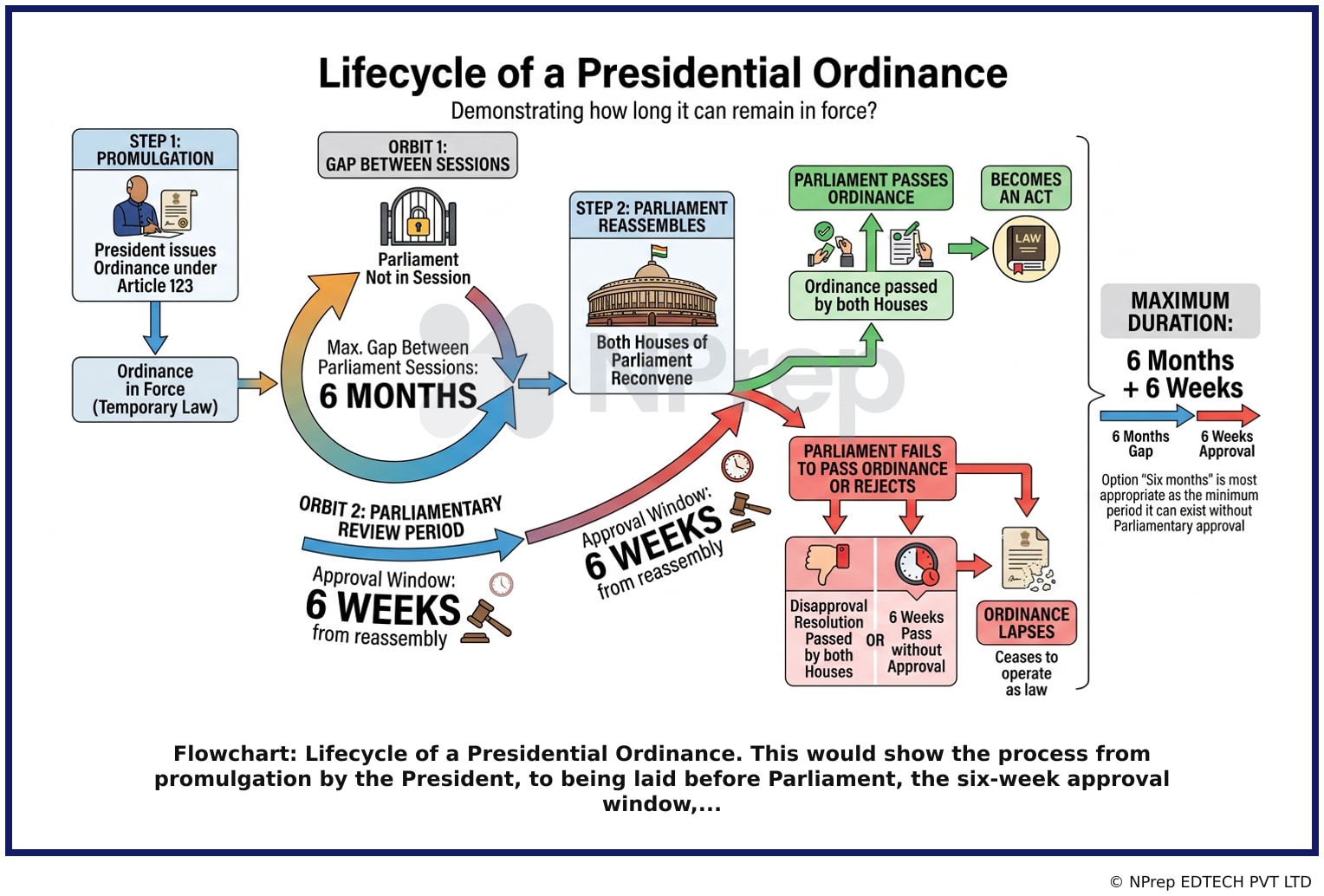
- Visual 1: Flowchart: Lifecycle of a Presidential Ordinance. This would show the process from promulgation by the President, to being laid before Parliament, the six-week approval window, and the conditions for its lapse or passage into an Act.
Clinical Relevance
- Nursing practice connection: This is primarily an exam-oriented knowledge point with limited direct bedside application, so retain Constitutional provisions regarding the duration of a presidential ordinance in India as background academic context rather than a clinical decision trigger.
- Understanding the legislative process, including temporary measures like ordinances, is crucial for informed citizenship and for professionals who may be affected by sudden changes in law (e.g., healthcare regulations, public health acts).
- Knowledge of the separation of powers and the checks and balances between the executive (President) and legislature (Parliament) is a fundamental aspect of civics.
- What if the question was about a Governor's ordinance? The principle is similar. Under Article 213, a Governor's ordinance has a maximum life of six months and six weeks, contingent on the reassembly of the state legislature.
How to Approach the Question
- Identify the core subject of the question: It's about the Indian Constitution, specifically presidential ordinances.
- Recall or look up the specific constitutional article related to this power. This is Article 123.
- Analyze the rules for the duration of an ordinance as specified in the Constitution.
- Break down the duration into two parts: the maximum time between parliamentary sessions (six months) and the time for approval after reassembly (six weeks).
- Calculate the maximum possible lifespan (six months + six weeks).
- Compare this with the given options and select the one that is most accurate or the best fit. 'Six months' represents the primary component of this duration.
Concept Tested & Keywords
- Concept Tested: Constitutional provisions regarding the duration of a presidential ordinance in India.
- Stem keywords: presidential ordinance, remain in force, how long
- Lead-in keywords: How long
- Negative lead-in flag: false
Question ID
Q-vyjkB33HNBSYoAJL0J4C
Practise the full RRB Staff Nurse Ahmedabad-2015
Attempt every question from this paper in a timed mock, then review the full solution for each one.
More Indian Judicial System and Laws Questions
- The minimum age for marriage of girls in India according to the National Population Policy is?
- By when must a birth be registered in India?
- What is the legal working age for a child?
- What is the legal age for a girl's marriage according to Indian law?
- In which of the following years did the Right to Information (RTI) Act come into force?
- In which year did the Government of India pass the Dowry Prohibition Act?
- According to the Constitution of India, what is the minimum age required to become a member of a State Legislative Assembly in India?
- निम्नलिखित में से कौन सा विषय भारतीय संविधान की 12वीं अनुसूची में शामिल नहीं है?
- The normal term of a State Assembly (other than J & K) is?
- Time limit for registering births is within:?
More RRB Staff Nurse Ahmedabad-2015 Questions
- The battle of Plassey was fought between
- Lord Dalhousie introduced the first railways in 1853 which ran between
- The normal term of a State Assembly (other than J & K) is
- Black soil is ideal for cultivation of cotton as
- Railways Passenger Coaches are manufactured at
- 'Operation Flood' is related to
- The term "Bull Run" is related to
- Match Col X (Sports trophy) and Col Y (Related sports) | Col X | | Col Y | | | ----- | -------------------- | ----- | --------- | | P. | Durand Cup |…
- Record of highest individual score in One Day International Cricket matches is in the name of
- What is common amongst Mary Kom, Vijender Singh, and Abhinav Bindra?