
AIIMS Delhi NO- 2019
Medical & Surgical Nursing
Medium
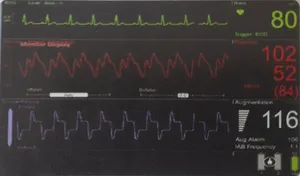
Identify the red wave forms in the following image:
Appeared in: AIIMS Delhi NO- 2019
Explanation
- The red waveform is an arterial pressure tracing, indicated by its characteristic shape and the systolic/diastolic pressure reading of 102/52 mmHg.
- The presence of labels like 'Augmentation' and 'IAB Frequency' on the monitor screen confirms that the patient is undergoing Intra-Aortic Balloon Pump (IABP) therapy.
- IABP is a form of mechanical circulatory support where a balloon in the aorta inflates during diastole and deflates during systole.
- The red waveform, therefore, represents the patient's arterial pressure as it is being monitored and influenced by the IABP.
Why Other Options Were Wrong
- Option B: A Central Venous Pressure (CVP) waveform has a completely different morphology (a, c, v waves) and measures much lower pressures (typically 2-8 mmHg). The waveform shown is clearly arterial with high pressures.
- Option C: Non-Invasive Blood Pressure (NIBP) is measured intermittently using an inflatable cuff and does not produce a continuous, beat-to-beat waveform. The image shows a continuous waveform.
- Option D: This option is incorrect because the waveform is clearly identifiable as an arterial pressure tracing within the context of IABP therapy based on the visual evidence and monitor labels.
Related Visual

Clinical Relevance
- Nursing practice connection: This is primarily an exam-oriented knowledge point with limited direct bedside application, so retain Interpretation of waveforms on a patient monitor, specifically identifying an arterial pressure waveform in the context of Intra-Aortic Balloon Pump (IABP) therapy as background academic context rather than a clinical decision trigger.
- Nurses in critical care settings must be able to rapidly interpret monitor waveforms to assess a patient's hemodynamic status and the effectiveness of therapies like IABP.
- Correct identification of an IABP waveform is crucial for troubleshooting. For example, loss of diastolic augmentation can indicate balloon malfunction or incorrect timing, requiring immediate intervention.
- Patient safety during IABP therapy involves regular monitoring of the insertion site for bleeding or signs of limb ischemia (e.g., diminished pulses, cool skin, pallor) in the cannulated leg.
How to Approach the Question
- First, systematically analyze the image provided. Identify all the different components visible on the monitor screen.
- Focus on the specific waveform mentioned in the question (the red one). Note its shape, peaks, troughs, and any associated numerical values.
- Broaden your scan to look for other contextual clues on the monitor. In this case, the labels 'Augmentation', 'Aug Alarm', and 'IAB Frequency' are critical.
- Correlate the visual information with the provided options. The red waveform is arterial, and the labels point directly to IABP.
- Eliminate the other options based on your knowledge. CVP has a different waveform and pressure. NIBP is not a continuous waveform.
- Select the option that best fits all the evidence. The combination of an arterial waveform and IABP-specific labels makes 'IABP' the correct answer.
Concept Tested & Keywords
- Concept Tested: Interpretation of waveforms on a patient monitor, specifically identifying an arterial pressure waveform in the context of Intra-Aortic Balloon Pump (IABP) therapy.
- Stem keywords: red wave forms, image
- Lead-in keywords: Identify
- Clinical cues: Red waveform with a reading of 102/52 (84) mmHg, which is typical for arterial blood pressure.
- Clinical cues: Monitor labels such as 'Augmentation' and 'IAB Frequency', which are specific to IABP systems.
Question ID
QvBbN7IXcxFAQrR_emXSzS
Reference Book
E6 Medicine Harrison 22e Part 1 p. 1902-1904
E6 Medicine Macleod Clinical Examination 15e p. 64-66
Practise the full AIIMS Delhi NO- 2019
Attempt every question from this paper in a timed mock, then review the full solution for each one.
More Cardiovascular, Circulatory, and Hematologic Function Questions
- A patient was brought to ED with complaint of chest pain from last 1 hour. Which test is done to detect myocardial infarction?
- A patient is undergoing blood transfusion and suddenly shows complaints of transfusion reaction. What will be the priority nursing intervention?
- Normal hemoglobin level in adult is:
- The following all are blood transfusion complications from; EXCEPT:
- An obstruction of blood flowing from the left atrium into the left ventricle is known as:
- 'Sequestration crisis' is related to:
- Calculate the pulse pressure from the below image of cardiac monitor:
- Identify the use of following machine used in pneumatic compression device:
- Identify the catheter in the following image:
- In iron deficiency anemia, the fingernails become spoon shaped, this condition is referred to as:
More AIIMS Delhi NO- 2019 Questions
- A nurse is preparing to give bath to admitted patient with perineal problem. Which of the following will help the patient?
- In the absence of nurse from floor, patient falls from bed. This type of injury belongs to:
- Patient's Medical record with all essential information is responsibility of:
- Post-partum women having bleeding within 24 hrs after delivery is called:
- In which condition, distal pulse is preferred rather than apical pulse?
- A pre-eclampsia woman's baby is lying with her mother. Neonate is born in 37 weeks. After 57 hours, when nurse is monitoring vital signs of baby, tem…
- A woman with 3rd day postpartum has complaint of engorgement in both breasts. What is cut off temperature for fever in postpartum women?
- Universal blood donor?
- WHO hand wash time with soap?
- Why it is necessary to remove dark coloured nail paint before surgery?