
AIIMS Delhi NO- 2019
Medical & Surgical Nursing
Medium
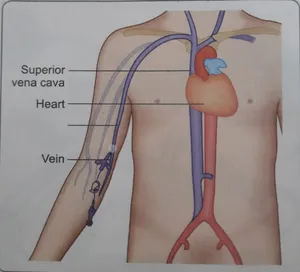
Identify the catheter in the following image:
Appeared in: AIIMS Delhi NO- 2019
Explanation
- The image clearly shows a catheter inserted into a peripheral vein in the arm.
- The catheter is long and is threaded upwards until its tip rests in a large central vein, the superior vena cava, which is located near the heart.
- This specific placement—peripheral insertion with a central termination point—is the defining characteristic of a Peripherally Inserted Central Catheter (PICC).
Why Other Options Were Wrong
- Option A: A traditional central venous line (or CVC) is inserted directly into a large, central vein, such as the internal jugular (neck) or subclavian (chest), not a peripheral vein in the arm.
- Option B: An intra-arterial line is placed in an artery (most commonly the radial artery in the wrist), not a vein. Its purpose is for blood pressure monitoring and drawing arterial blood samples, not for administering medications or fluids centrally.
- Option D: This option is incorrect because the device shown in the image is clearly identifiable as a specific type of catheter based on its insertion site and path.
Related Visual

Clinical Relevance
- Nursing practice connection: This is primarily an exam-oriented knowledge point with limited direct bedside application, so retain Identification of vascular access devices based on anatomical placement as background academic context rather than a clinical decision trigger.
- Nurses are primarily responsible for the care and maintenance of PICC lines, which includes performing sterile dressing changes, flushing the line to maintain patency, and administering medications.
- It is crucial for nurses to monitor for potential complications such as catheter-related bloodstream infections (CRBSI), thrombosis (blood clots), phlebitis (vein inflammation), and catheter migration.
- What if? If the patient reports pain, tenderness, and redness along the vein above the PICC insertion site, the nurse should suspect phlebitis or thrombosis. The infusion should be stopped, and the healthcare provider must be notified immediately for further assessment and intervention, which may include line removal.
How to Approach the Question
- First, carefully examine the provided image, paying close attention to the labels and the path of the catheter.
- Identify the insertion site of the catheter, which is shown in a vein in the arm (a peripheral site).
- Trace the path of the catheter to its termination point, which is labeled as the 'Superior vena cava' (a central site).
- Synthesize these two facts: the catheter is 'Peripherally Inserted' and it is a 'Central Catheter' because its tip is in a central vein.
- Review the options and select the one that matches this description.
- Eliminate other options: 'Central venous line' has a central insertion site, and 'Intra-arterial line' is in an artery, not a vein.
Concept Tested & Keywords
- Concept Tested: Identification of vascular access devices based on anatomical placement.
- Stem keywords: catheter, image, identify
- Lead-in keywords: Identify
- Clinical cues: Catheter insertion in arm vein
- Clinical cues: Catheter tip in superior vena cava
Question ID
Q51McPtxqhBFkvOTLrBmfd
Reference Book
E6 Nursing Fundamentals Taylor p. 796-798
E6 Nursing Brunner Adult Health 3SA Vol 1 Part 2 p. 105-107
Practise the full AIIMS Delhi NO- 2019
Attempt every question from this paper in a timed mock, then review the full solution for each one.
More Cardiovascular, Circulatory, and Hematologic Function Questions
- A patient was brought to ED with complaint of chest pain from last 1 hour. Which test is done to detect myocardial infarction?
- A patient is undergoing blood transfusion and suddenly shows complaints of transfusion reaction. What will be the priority nursing intervention?
- Normal hemoglobin level in adult is:
- The following all are blood transfusion complications from; EXCEPT:
- An obstruction of blood flowing from the left atrium into the left ventricle is known as:
- 'Sequestration crisis' is related to:
- Calculate the pulse pressure from the below image of cardiac monitor:
- Identify the use of following machine used in pneumatic compression device:
- Identify the red wave forms in the following image:
- In iron deficiency anemia, the fingernails become spoon shaped, this condition is referred to as:
More AIIMS Delhi NO- 2019 Questions
- A nurse is preparing to give bath to admitted patient with perineal problem. Which of the following will help the patient?
- In the absence of nurse from floor, patient falls from bed. This type of injury belongs to:
- Patient's Medical record with all essential information is responsibility of:
- Post-partum women having bleeding within 24 hrs after delivery is called:
- In which condition, distal pulse is preferred rather than apical pulse?
- A pre-eclampsia woman's baby is lying with her mother. Neonate is born in 37 weeks. After 57 hours, when nurse is monitoring vital signs of baby, tem…
- A woman with 3rd day postpartum has complaint of engorgement in both breasts. What is cut off temperature for fever in postpartum women?
- Universal blood donor?
- WHO hand wash time with soap?
- Why it is necessary to remove dark coloured nail paint before surgery?