
AIIMS Delhi NO- 2019
Medical & Surgical Nursing
Medium
Calculate the pulse pressure from the below image of cardiac monitor:
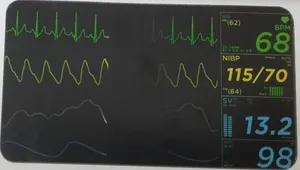
Appeared in: AIIMS Delhi NO- 2019
Explanation
- Pulse pressure is defined as the difference between the systolic and diastolic blood pressure.
- The standard formula is: Pulse Pressure = Systolic BP – Diastolic BP.
- The cardiac monitor in the image displays a Non-Invasive Blood Pressure (NIBP) of 115/70 mmHg.
- The systolic pressure (the higher value) is 115 mmHg, and the diastolic pressure (the lower value) is 70 mmHg.
- Substituting these values into the formula gives: 115 mmHg - 70 mmHg = 45 mmHg.
Why Other Options Were Wrong
- Option A: This value is an incorrect result of the subtraction (115 - 70).
- Option C: This value is an incorrect result of the subtraction (115 - 70).
- Option D: Although a pulse pressure of 40 mmHg is considered normal, it is not the correct calculated value from the data provided in the image (115/70 mmHg).
Related Visual

Clinical Relevance
- Nursing practice connection: This is primarily an exam-oriented knowledge point with limited direct bedside application, so retain Calculation of pulse pressure from a cardiac monitor as background academic context rather than a clinical decision trigger.
- Nurses monitor pulse pressure as it provides important information about a patient's cardiovascular health, including stroke volume and arterial stiffness.
- A normal pulse pressure in adults is between 30 and 50 mmHg. A consistently wide pulse pressure (greater than 60 mmHg) can be a predictor of heart attacks or other cardiovascular diseases.
- A narrow pulse pressure (less than 25% of the systolic value) is a cause for concern as it can indicate poor heart function, such as in congestive heart failure or shock.
How to Approach the Question
- Identify the question's objective: to calculate the pulse pressure.
- Carefully examine the provided image of the cardiac monitor to locate the blood pressure reading.
- Identify the systolic (top number) and diastolic (bottom number) values from the NIBP reading, which is 115/70 mmHg.
- Recall the standard formula for pulse pressure: Systolic Blood Pressure - Diastolic Blood Pressure.
- Substitute the values into the formula: 115 - 70.
- Perform the subtraction to get the result (45) and match it with the given options.
Concept Tested & Keywords
- Concept Tested: Calculation of pulse pressure from a cardiac monitor.
- Stem keywords: Calculate, pulse pressure, cardiac monitor
- Lead-in keywords: Calculate
- Clinical cues: NIBP reading of 115/70 mmHg
Question ID
QbPqGVcY1uNVSRpSM1KBBn
Reference Book
E6 Nursing Vital Signs pp. 81-83, 80-82
Practise the full AIIMS Delhi NO- 2019
Attempt every question from this paper in a timed mock, then review the full solution for each one.
More Cardiovascular, Circulatory, and Hematologic Function Questions
- A patient was brought to ED with complaint of chest pain from last 1 hour. Which test is done to detect myocardial infarction?
- A patient is undergoing blood transfusion and suddenly shows complaints of transfusion reaction. What will be the priority nursing intervention?
- Normal hemoglobin level in adult is:
- The following all are blood transfusion complications from; EXCEPT:
- An obstruction of blood flowing from the left atrium into the left ventricle is known as:
- 'Sequestration crisis' is related to:
- Identify the use of following machine used in pneumatic compression device:
- Identify the red wave forms in the following image:
- Identify the catheter in the following image:
- In iron deficiency anemia, the fingernails become spoon shaped, this condition is referred to as:
More AIIMS Delhi NO- 2019 Questions
- A nurse is preparing to give bath to admitted patient with perineal problem. Which of the following will help the patient?
- In the absence of nurse from floor, patient falls from bed. This type of injury belongs to:
- Patient's Medical record with all essential information is responsibility of:
- Post-partum women having bleeding within 24 hrs after delivery is called:
- In which condition, distal pulse is preferred rather than apical pulse?
- A pre-eclampsia woman's baby is lying with her mother. Neonate is born in 37 weeks. After 57 hours, when nurse is monitoring vital signs of baby, tem…
- A woman with 3rd day postpartum has complaint of engorgement in both breasts. What is cut off temperature for fever in postpartum women?
- Universal blood donor?
- WHO hand wash time with soap?
- Why it is necessary to remove dark coloured nail paint before surgery?