
AIIMS Delhi NO- 2019
Medical & Surgical Nursing
Easy
Identify the use of following machine used in pneumatic compression device:
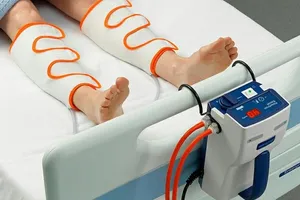
Appeared in: AIIMS Delhi NO- 2019
Explanation
- The device shown is a Sequential Compression Device (SCD), a form of intermittent pneumatic compression used for mechanical prophylaxis against Deep Vein Thrombosis (DVT).
- It works by sequentially inflating and deflating sleeves wrapped around the legs, an action that mimics the natural muscle pump.
- This mechanical squeezing enhances venous blood flow and prevents venous stasis, which is a major contributing factor to clot formation as described in Virchow's triad.
- It is a standard intervention for immobile patients, particularly after surgery, to reduce the risk of DVT.
Why Other Options Were Wrong
- Option B: Pulmonary Embolism (PE) is a potential complication of DVT, not the primary condition the device is used to prevent. The device's direct action is on the leg veins to stop the initial clot from forming.
- Option C: SCDs are used for acute DVT prophylaxis in high-risk, immobile patients. They are not the standard treatment for managing chronic varicose veins.
- Option D: The device is not an analgesic and is not indicated for treating leg pain. In fact, the compression cycles can sometimes cause discomfort.
Related Visual

Clinical Relevance
- Nursing practice connection: This is primarily an exam-oriented knowledge point with limited direct bedside application, so retain Prophylaxis of Deep Vein Thrombosis (DVT) using mechanical devices as background academic context rather than a clinical decision trigger.
- SCDs are a cornerstone of DVT prevention in high-risk, immobile patients, such as post-operative, critical care, or stroke patients.
- Nurses are responsible for applying the device correctly, ensuring proper fit, monitoring for complications, and educating the patient.
- What if? If a patient develops signs of an active DVT (e.g., unilateral swelling, pain, redness, warmth), the SCD must be removed immediately from the affected leg, and the physician must be notified. Using the device on a leg with an existing clot could dislodge it, causing a life-threatening pulmonary embolism.
How to Approach the Question
- First, identify the equipment shown in the image. The inflatable leg sleeves connected to a pump are characteristic of a Sequential Compression Device (SCD) or Intermittent Pneumatic Compression (IPC) device.
- Second, recall the primary medical indication for this specific piece of equipment. Its main purpose is mechanical prophylaxis.
- Third, analyze the options in the context of the device's function. The device mechanically promotes blood flow in the legs to prevent stasis.
- Fourth, evaluate which option directly relates to preventing complications from blood stasis in the legs. This leads to the prevention of Deep Vein Thrombosis (DVT).
- Finally, rule out the other options. PE is an indirect consequence, while varicose veins and leg pain are incorrect indications for this device.
Concept Tested & Keywords
- Concept Tested: Prophylaxis of Deep Vein Thrombosis (DVT) using mechanical devices.
- Stem keywords: pneumatic compression device, use, machine
- Lead-in keywords: Identify
- Clinical cues: Image of a patient with leg sleeves and a pump, indicating a hospitalized, likely immobile patient at risk for venous stasis.
- Negative lead-in flag: false
Question ID
Qe5RSkasItXmewfVfYdbuB
Reference Book
E6 Nursing Brunner Adult Health 3SA Vol 1 Part 3 p. 80-82
Practise the full AIIMS Delhi NO- 2019
Attempt every question from this paper in a timed mock, then review the full solution for each one.
More Cardiovascular, Circulatory, and Hematologic Function Questions
- A patient is undergoing blood transfusion and suddenly shows complaints of transfusion reaction. What will be the priority nursing intervention?
- The following all are blood transfusion complications from; EXCEPT:
- In iron deficiency anemia, the fingernails become spoon shaped, this condition is referred to as:
- Which gauze cannula is commonly used for blood transfusion?
- If 'P' wave is absent in ECG rhythm, it is an indication of:
- Normal compression to ventilation ratio:
- Trans-illumination procedure is done with:
- A patient in the ward experiences sudden cardiac arrest. What is the most appropriate technique for opening the airway to facilitate endotracheal int…
- A patient experiences complications after a blood transfusion. Which of the following signs and symptoms is indicative of circulatory overload?
- A patient requires a blood transfusion, and the blood component has just been retrieved from the blood bank. What is the critical timeframe for initi…
More AIIMS Delhi NO- 2019 Questions
- A nurse is preparing to give bath to admitted patient with perineal problem. Which of the following will help the patient?
- In the absence of nurse from floor, patient falls from bed. This type of injury belongs to:
- Patient's Medical record with all essential information is responsibility of:
- Post-partum women having bleeding within 24 hrs after delivery is called:
- In which condition, distal pulse is preferred rather than apical pulse?
- A pre-eclampsia woman's baby is lying with her mother. Neonate is born in 37 weeks. After 57 hours, when nurse is monitoring vital signs of baby, tem…
- A woman with 3rd day postpartum has complaint of engorgement in both breasts. What is cut off temperature for fever in postpartum women?
- Universal blood donor?
- WHO hand wash time with soap?
- Why it is necessary to remove dark coloured nail paint before surgery?