
NORCET 1 - 2020
Medical Surgical Nursing
Easy
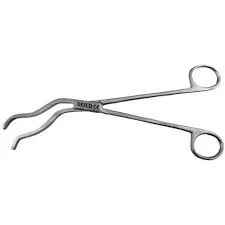
Identify the instrument?
Appeared in: NORCET 1 - 2020
Explanation
- The instrument in the image is identified as Cheatle forceps based on its distinct morphological features.
- It possesses long handles which are crucial for maintaining sterility by keeping the user's hands away from the sterile field or hot sterilizers.
- The jaws are characteristically long, curved (S-shaped), and blunt, designed specifically for grasping and transferring sterile items without damaging them.
- Unlike hemostatic forceps, Cheatle forceps do not have a locking mechanism, as their function is transferring, not clamping.
Why Other Options Were Wrong
- Option A: Episiotomy scissors are cutting instruments with angled blades, used for making a surgical incision. The instrument shown is a grasping forceps with blunt jaws.
- Option B: Artery forceps (hemostats) are smaller instruments with serrated jaws and a locking ratchet, designed for clamping blood vessels. The instrument in the image is larger, lacks a ratchet, and has smooth, curved jaws.
- Option C: Allis forceps are tissue-grasping instruments characterized by sharp, interlocking teeth at the tips, used to hold tough tissues. The instrument in the image has smooth, non-toothed jaws.
Related Visual

- Visual 1: Comparison Chart - An infographic comparing the visual features (jaws, lock, handle length) and uses of Cheatle forceps, Allis forceps, Artery forceps, and Episiotomy scissors.
- Visual 2: Diagram - A labeled diagram of a Cheatle forceps highlighting its parts: finger rings, shanks, box lock, and curved jaws.
Clinical Relevance
- Nursing practice connection: This is primarily an exam-oriented knowledge point with limited direct bedside application, so retain Surgical Instrument Identification as background academic context rather than a clinical decision trigger.
- Maintaining sterility is a fundamental principle of nursing and surgical practice to prevent healthcare-associated infections (HAIs).
- Using Cheatle forceps correctly is a key skill for nurses in operating rooms and sterile processing departments to transfer items without contaminating the sterile field.
- Improper handling of sterile instruments can lead to surgical site infections, increasing patient morbidity, mortality, and healthcare costs.
How to Approach the Question
- First, carefully examine the image of the instrument, paying close attention to its key features: the overall shape, the type of tips/jaws (sharp, blunt, toothed, smooth), the presence of a lock, and the length of the handles.
- The instrument shown is long, has finger rings, a joint, and distinctively curved, blunt jaws.
- Next, consider the function implied by these features. The long handles suggest a need for distance, and the blunt, grasping jaws suggest handling objects rather than cutting or clamping tissue.
- Evaluate each option against your visual analysis.
- Option A (Episiotomy scissors) is incorrect because the instrument is not scissors.
- Option B (Artery forceps) is incorrect because it lacks the typical locking ratchet and serrated jaws of a hemostat.
Concept Tested & Keywords
- Concept Tested: Surgical Instrument Identification
- Stem keywords: instrument, forceps
- Lead-in keywords: Identify
Question ID
Qlq2e7degJE2xlDz0ksufn
Practise the full NORCET 1 - 2020
Attempt every question from this paper in a timed mock, then review the full solution for each one.
More Surgical Instrumentation Questions
- The following instrument is used in which surgery?
- Identify the following image? & x20;
- Identify the following instrument?& x20;
- Identify the size of the surgical blade? (NORCET-2021)& x20;
- Identify the following instrument?
- Number of Yantras:
- Identify this instrument.
- Identify the following instrument?
- The instrument used to grasp and hold the uterus or cervix during vaginal examinations, intrauterine devices placement or removal, and cervical dilat…
More NORCET 1 - 2020 Questions
- The relation between the fetal presenting part and maternal pelvis is known as?
- Which vaccine can be frozen?
- Which vaccine, after administration, forms blisters, heals by itself, and forms a permanent scar mark?
- Identify the conjugate measured in the picture?& x20;
- A post LSCS woman passes 400 ml urine in the past 24 hours. This condition is known as?
- Red color urine is caused by which anti-tubercular drug?
- Visualization of bone occurs in which stage of burn?
- The given retractor is used in which of the following surgeries?
- Identify the size of IV Cannula in the image?
- What will you do if you have a needle stick injury from an HIV patient?