
AIIMS Rishikesh NO - 2019
Medical & Surgical Nursing
Easy
Identify the following instrument? 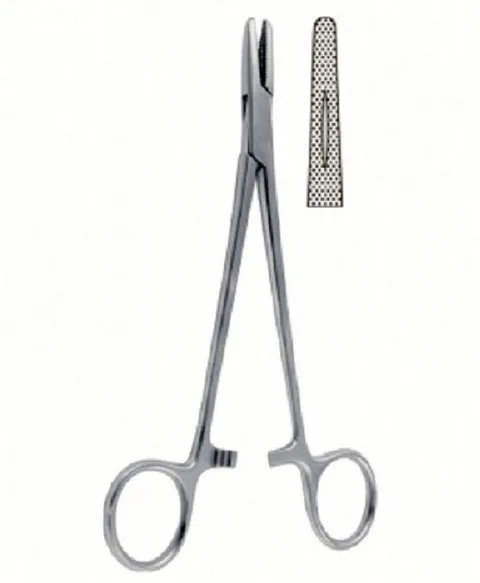
Appeared in: AIIMS Rishikesh NO - 2019
Explanation
- The instrument shown is a needle holder, identified by its distinct short, strong jaws.
- The inner surface of the jaws has a cross-hatched or crisscross pattern, which is specifically designed to securely grip a suture needle without slippage.
- It features a ratchet locking mechanism to hold the needle firmly in place, allowing for precise control during suturing.
- This combination of features is unique to needle holders and distinguishes them from other forceps.
Why Other Options Were Wrong
- Option A: Artery forceps are used for clamping blood vessels to control bleeding (hemostasis). Their jaws have transverse (horizontal) serrations, not the cross-hatched pattern needed to hold a needle securely.
- Option B: Tooth forceps are designed for grasping dense tissues, such as fascia or skin. They have interlocking teeth at the tips for a firm grip on tissue, a feature not present on the instrument shown.
- Option D: Mosquito forceps are a smaller, more delicate type of artery forceps used for clamping small blood vessels. Like larger artery forceps, they have fine, transverse serrations, not a cross-hatched pattern.
Related Visual

Clinical Relevance
- Nursing practice connection: This is primarily an exam-oriented knowledge point with limited direct bedside application, so retain Identification of common surgical instruments based on their morphological features as background academic context rather than a clinical decision trigger.
- Using the correct instrument is paramount for patient safety and surgical success. A needle holder ensures precise needle control, leading to accurate suture placement and better wound healing.
- Attempting to use an artery forceps to hold a needle can damage both the instrument and the needle, and more importantly, can cause the needle to slip, potentially injuring the patient or a member of the surgical team.
- What if? If a surgeon used an artery forceps instead of a needle holder, the needle could easily twist or slip from the jaws. This would make suturing difficult and imprecise, increase tissue trauma, and raise the risk of a needlestick injury.
How to Approach the Question
- First, observe the overall shape of the instrument, including the handles, lock, and shanks.
- Next, focus on the most critical distinguishing part: the tip or jaws of the instrument.
- Examine the inner surface of the jaws closely. Note the pattern: is it smooth, toothed, serrated horizontally (transverse), or serrated in a crisscross (cross-hatched) pattern?
- A cross-hatched pattern is the definitive sign of a needle holder, designed for gripping a needle.
- Compare this key feature to the functions of the other options to confirm the correct identification.
Concept Tested & Keywords
- Concept Tested: Identification of common surgical instruments based on their morphological features.
- Stem keywords: instrument, identify
- Lead-in keywords: Identify
Question ID
QaRSis2SUIQrLFlzKs9y5t
Reference Book
E6 Nursing Brunner Adult Health 3SA Vol 1 Part 1 p. 78-80
E6 Gynecology Williams p. 429-436
Practise the full AIIMS Rishikesh NO - 2019
Attempt every question from this paper in a timed mock, then review the full solution for each one.
More Surgical Instrumentation Questions
- The following instrument is used in which surgery?
- Identify the following image? & x20;
- Identify the following instrument?& x20;
- Identify the size of the surgical blade? (NORCET-2021)& x20;
- Identify the instrument?& x20;
- Number of Yantras:
- Identify this instrument.
- Identify the following instrument?
- The instrument used to grasp and hold the uterus or cervix during vaginal examinations, intrauterine devices placement or removal, and cervical dilat…
More AIIMS Rishikesh NO - 2019 Questions
- Identify the following instrument?& x20;
- Which procedure is being performed in the following image?
- Prolonged nasogastric suctioning may cause?
- Which position is given to a child after lumbar Puncture?
- What are the urine specific gravity and color of urine in a 6-year-old child?
- Dengue fever is caused by which mosquito?
- What is the maximum dose of an Intramuscular injection?
- Aspirin can be given with which fluid?
- What are the ECG changes in Hyperkalemia?
- What is the mechanism of action of pilocarpine in acute closed-angle glaucoma?