
NORCET 1 - 2020
Obstetrics & Gynaecology
Medium
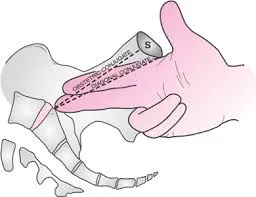
Identify the conjugate measured in the picture?
Appeared in: NORCET 1 - 2020
Explanation
- The image demonstrates the manual procedure for measuring the diagonal conjugate, which is a key component of clinical pelvimetry.
- This diameter is measured from the lower margin of the symphysis pubis to the sacral promontory.
- The diagonal conjugate is the only anteroposterior diameter of the pelvic inlet that can be measured directly via a vaginal examination.
- Its measurement is clinically crucial because the obstetric conjugate, the shortest and most important diameter for childbirth, is estimated by subtracting 1.5-2 cm from the diagonal conjugate's length.
Why Other Options Were Wrong
- Option A: The obstetric conjugate is the shortest anteroposterior diameter of the pelvic inlet, but it cannot be measured directly through a clinical examination because the pubic bone is in the way.
- Option C: The true conjugate (or anatomical conjugate) is the distance from the upper margin of the symphysis pubis to the sacral promontory. It is an anatomical measurement and is not assessed during a clinical vaginal examination.
- Option D: This option is incorrect because the procedure shown in the image correctly depicts the measurement of the diagonal conjugate, which is listed as option B.
Related Visual

- Visual 1: Diagram: A clear sagittal view of the female pelvis illustrating the anatomical relationships and distinct lines for the True, Obstetric, and Diagonal conjugates.
- Visual 2: Infographic: A step-by-step visual guide on how to perform clinical pelvimetry to measure the diagonal conjugate and then calculate the obstetric conjugate.
Clinical Relevance
- Nursing practice connection: This is primarily an exam-oriented knowledge point with limited direct bedside application, so retain Clinical assessment of pelvic diameters (pelvimetry) as background academic context rather than a clinical decision trigger.
- Measuring the diagonal conjugate is a fundamental skill in clinical pelvimetry, used to assess the adequacy of the maternal pelvis for a safe vaginal delivery.
- A diagonal conjugate measurement of less than 11.5 cm may suggest a contracted pelvis, increasing the risk of cephalopelvic disproportion (CPD) and the potential need for a Cesarean section.
- What if? If the examiner cannot reach the sacral promontory during the vaginal exam, it is generally considered a positive sign, indicating that the pelvic inlet is likely spacious and adequate for childbirth.
How to Approach the Question
- Step 1: Analyze the image to identify the anatomical landmarks involved in the measurement: the examiner's hand, the sacral promontory, and the symphysis pubis.
- Step 2: Observe the specific points between which the distance is being measured. The image shows the measurement from the lower border of the symphysis pubis to the sacral promontory.
- Step 3: Recall the definitions of the three main anteroposterior pelvic diameters: True, Obstetric, and Diagonal conjugates.
- Step 4: Match the procedure shown in the image to its correct definition. The measurement from the lower border of the symphysis pubis to the sacral promontory defines the diagonal conjugate.
- Step 5: Select the option that corresponds to this identification.
Concept Tested & Keywords
- Concept Tested: Clinical assessment of pelvic diameters (pelvimetry)
- Stem keywords: conjugate, measured, picture
- Lead-in keywords: Identify
- Clinical cues: Image of clinical pelvimetry
Question ID
Q4_8OlMRdr6k-ndL5C72mP
Practise the full NORCET 1 - 2020
Attempt every question from this paper in a timed mock, then review the full solution for each one.
More Fetal Skull and Maternal Pelvis Questions
- What type of pelvis is good for child bearing?
- The smallest diameter of the true pelvis is?
- A client is admitted to the labor unit. On vaginal examination, the presenting part in a cephalic presentation was at station plus two. Station +2 me…
- The type of pelvis most suited for delivery is?
- Incidence of gynecoid pelvis in females is about?
- Identify the conjugate denoted in the image?& x20;
- Which of the following is a heart-shaped pelvis?
- A nurse is assessing the fetal position of a pregnant woman in labor. The fetal heart tones are best heard in the left lower quadrant of the abdomen.…
- The relation between the fetal presenting part and maternal pelvis is known as?
- Which pelvis shape has the poorest prognosis for vaginal delivery?
More NORCET 1 - 2020 Questions
- Which vaccine can be frozen?
- Which vaccine, after administration, forms blisters, heals by itself, and forms a permanent scar mark?
- A post LSCS woman passes 400 ml urine in the past 24 hours. This condition is known as?
- Red color urine is caused by which anti-tubercular drug?
- Visualization of bone occurs in which stage of burn?
- The given retractor is used in which of the following surgeries?
- Identify the size of IV Cannula in the image?
- What will you do if you have a needle stick injury from an HIV patient?
- A 28-year-old primigravida comes to the ANC OPD. How many additional Kcal will you recommend?