
AIIMS Delhi NO - 2017
Obstetrics & Gynaecology
Easy
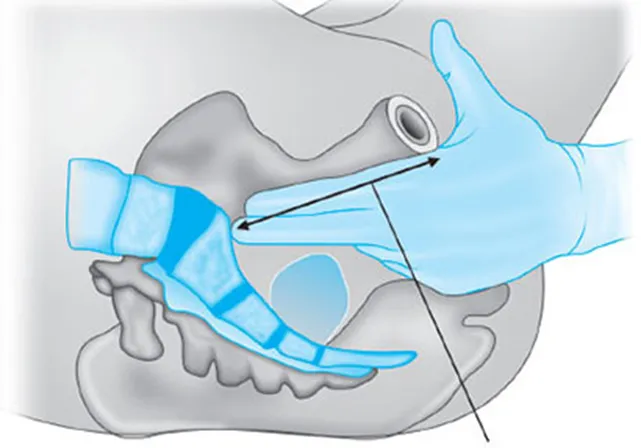
Identify the conjugate denoted in the image?
Appeared in: AIIMS Delhi NO - 2017
Explanation
- The image correctly illustrates the diagonal conjugate, which is the distance measured from the lower border of the pubic symphysis to the sacral promontory.
- This is a critical measurement in obstetrics because it is the only anteroposterior (AP) diameter of the pelvic inlet that can be assessed clinically through a vaginal examination.
- The length of the diagonal conjugate is used to estimate the length of the obstetric conjugate, which is the shortest and most important diameter for the passage of the fetal head.
- A normal diagonal conjugate measures approximately 12 cm.
Why Other Options Were Wrong
- Option B: The true conjugate (or anatomical conjugate) is measured from the upper border of the pubic symphysis to the sacral promontory. The image clearly shows the measurement starting from the lower border.
- Option C: The term 'false conjugate' is not a standard anatomical or obstetrical term for a pelvic diameter. The pelvis is divided into a 'true pelvis' and a 'false pelvis', but this does not refer to a specific conjugate measurement.
- Option D: The obstetric conjugate is the shortest AP diameter, measured from the posterior surface of the pubic symphysis to the sacral promontory. It cannot be measured directly but is estimated from the diagonal conjugate. The image shows a direct measurement from the lower border, not the posterior surface.
Related Visual

Clinical Relevance
- Nursing practice connection: This is primarily an exam-oriented knowledge point with limited direct bedside application, so retain This question tests the knowledge of the different anteroposterior diameters of the female pelvis, specifically the ability to identify the diagonal conjugate from an anatomical illustration as background academic context rather than a clinical decision trigger.
- Measuring the diagonal conjugate is a key component of clinical pelvimetry to assess the adequacy of the maternal pelvis for vaginal delivery.
- A diagonal conjugate of less than 11.5 cm is considered contracted and may indicate potential difficulty for the fetal head to pass through the pelvic inlet, a condition known as cephalopelvic disproportion (CPD).
- This assessment helps in anticipating potential labor dystocia and in planning the mode of delivery, thereby contributing to maternal and fetal safety.
How to Approach the Question
- First, carefully examine the provided image, which shows a sagittal view of the female pelvis.
- Identify the key anatomical landmarks indicated: the pubic symphysis (anteriorly) and the sacral promontory (posteriorly).
- Observe the line representing the measurement. Note its specific origin and termination points. In this image, the line extends from the lower border of the pubic symphysis to the sacral promontory.
- Recall the definitions of the different anteroposterior (AP) pelvic conjugates: True, Obstetric, and Diagonal.
- Match the measurement shown in the image to its correct definition. The distance from the lower border of the symphysis pubis to the sacral promontory defines the diagonal conjugate.
- Select the option that corresponds to this identification.
Concept Tested & Keywords
- Concept Tested: This question tests the knowledge of the different anteroposterior diameters of the female pelvis, specifically the ability to identify the diagonal conjugate from an anatomical illustration.
- Stem keywords: conjugate, image, pelvis
- Lead-in keywords: Identify
- Clinical cues: The image shows a sagittal view of the pelvis with a line indicating a specific diameter, which is a common method for testing knowledge of pelvimetry.
Question ID
QVtMhxw6Sq3vlKC0yEHTdx
Reference Book
E6 Obstetrics Williams p. 15-32
E6 Midwifery Obstetrics and Gynecology Nursing Sandeep Kaur p. 36-44
Practise the full AIIMS Delhi NO - 2017
Attempt every question from this paper in a timed mock, then review the full solution for each one.
More Fetal Skull and Maternal Pelvis Questions
- What type of pelvis is good for child bearing?
- The smallest diameter of the true pelvis is?
- A client is admitted to the labor unit. On vaginal examination, the presenting part in a cephalic presentation was at station plus two. Station +2 me…
- The type of pelvis most suited for delivery is?
- Incidence of gynecoid pelvis in females is about?
- Which of the following is a heart-shaped pelvis?
- A nurse is assessing the fetal position of a pregnant woman in labor. The fetal heart tones are best heard in the left lower quadrant of the abdomen.…
- The relation between the fetal presenting part and maternal pelvis is known as?
- Identify the conjugate measured in the picture?& x20;
- Which pelvis shape has the poorest prognosis for vaginal delivery?
More AIIMS Delhi NO - 2017 Questions
- Which is a live attenuated vaccine?
- The injection haloperidol is given intramuscularly by which technique?
- One of the most initial things that should be done by a nurse while going to a home visit?
- Most common type of shock in a trauma patient?
- Most common cause of hypotension in trauma patients?
- CSF draining from the nose and ear occurs in which type of skull fracture?
- Allen test should be performed before?
- See the following image and identify this?& x20;
- Identify the appropriate action based on the Vaccine Vial Monitor (VVM) shown in the image.
- Identify the following image?