
JIPMER Pondicherry NO - 2022
Medical Surgical Nursing
Hard
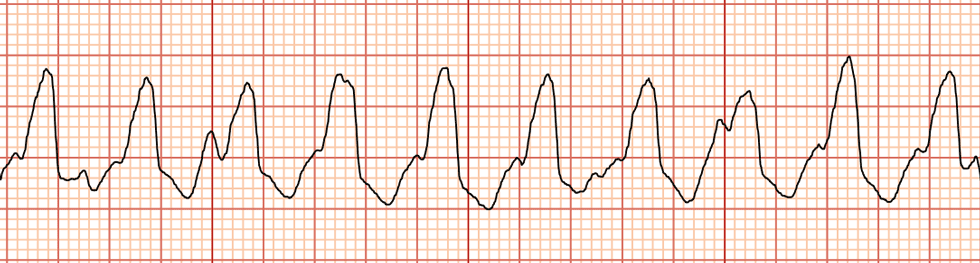
Identify the abnormality in ECG paper in the given image?
Appeared in: JIPMER Pondicherry NO - 2022
Explanation
- The ECG shows a rapid heart rate (tachycardia), which is a key feature.
- The rhythm is regular, as indicated by the consistent distance between the peaks of the QRS complexes (R-R interval).
- The QRS complexes are wide (greater than 3 small squares or 0.12 seconds) and have an abnormal shape, which is the hallmark of a ventricular origin.
- There are no visible P waves preceding the QRS complexes, indicating the atria are not controlling the ventricular rhythm (AV dissociation).
Why Other Options Were Wrong
- Option A: Atrial fibrillation is characterized by an 'irregularly irregular' rhythm and typically narrow QRS complexes. The ECG in the image shows a regular rhythm with wide complexes.
- Option B: Ventricular fibrillation appears as a chaotic, disorganized, wavy line with no discernible QRS complexes. The ECG in the image has clear, repeating, wide QRS complexes.
- Option D: Atrial tachycardia originates above the ventricles, so it typically produces a narrow QRS complex (unless there is a pre-existing bundle branch block). The ECG in the image clearly shows wide QRS complexes.
Related Visual

Clinical Relevance
- Nursing practice connection: This is primarily an exam-oriented knowledge point with limited direct bedside application, so retain ECG interpretation of ventricular arrhythmias as background academic context rather than a clinical decision trigger.
- Ventricular Tachycardia is a medical emergency as it can severely compromise cardiac output, leading to hypotension, loss of consciousness, and can quickly deteriorate into Ventricular Fibrillation and cardiac arrest.
- A nurse's first action upon seeing this rhythm on a monitor is to immediately assess the patient for a pulse and check their level of consciousness and blood pressure. Treatment depends on whether the patient is stable (has a pulse and is conscious) or unstable (pulseless or unconscious).
- What if? If the patient with this rhythm was found to be pulseless, the correct immediate action would be to call for help (activate the emergency response system), start high-quality CPR, and prepare for immediate defibrillation. This is a shockable rhythm in a pulseless patient.
How to Approach the Question
- First, analyze the provided image which is an ECG strip. Use a systematic approach.
- Step 1: Assess the Rhythm. Are the R-R intervals (distance between peaks) regular or irregular? In this image, they are regular.
- Step 2: Determine the Rate. The rate is clearly fast (more than 100 bpm), so it is a tachycardia.
- Step 3: Examine the QRS Complexes. Are they narrow (less than 0.12s) or wide (greater than 0.12s)? In this image, they are wide and bizarrely shaped.
- Step 4: Look for P waves. Are there P waves? Is there one for every QRS? In this image, P waves are not visible.
- Step 5: Synthesize the findings. A regular, fast rhythm with wide QRS complexes and no clear P waves is the classic presentation of Ventricular Tachycardia. Compare this with the characteristics of the other options to confirm the diagnosis.
Concept Tested & Keywords
- Concept Tested: ECG interpretation of ventricular arrhythmias
- Stem keywords: ECG, abnormality, image
- Lead-in keywords: Identify
- Clinical cues: The visual ECG data is the primary cue, showing a rapid, regular, wide-complex tachycardia.
Question ID
QGdsokb9CtQBn4nhysiHqh
Reference Book
E6 Nursing Fundamentals Potter Perry 12e Part 4 p. 234-236
E6 Robert Boland, Marcia L. Verduin - Kaplan and Sadock's Comprehensive Text of Psychiatry-Wolters Kluwer Health (2024) (pp 1-16525 of 16525) p. 7321-7323
E6 Pharmacology Nursing Lilley 11e Part 2 p. 86-88
Practise the full JIPMER Pondicherry NO - 2022
Attempt every question from this paper in a timed mock, then review the full solution for each one.
More ECG Questions
More JIPMER Pondicherry NO - 2022 Questions
- Uterus forward due to decreased muscle tone and pendulous abdomen known as?
- After undergoing a thyroidectomy, a client is monitored for signs of damage to the parathyroid glands postoperatively. The nurse would determine whic…
- A nurse working in ICU and caring for a renal failure client. She noticed on cardiac monitor that the ECG wave is a tall peaked wave, shortened QT in…
- Which among the following is the most common cause of acute infective endocarditis?
- The priority nursing intervention for a patient during the immediate post-operative period is?
- A breast cancer patient admitted in ICU and is getting opioid analgesic Inj. morphine to manage pain. What would be the priority nursing assessment?
- The low-pressure alarm sounds on the ventilator. The nurse checks the client and then attempts to determine the cause of the alarm but is unsuccessfu…
- A nurse just enters a client's room and finds a client lying on the floor. Which action should the nurse perform first?
- While 2 rescuers providing CPR, after providing 2 minutes CPR, rescuers should change their position every?
- Drug of choice for hypertensive crisis?