
RUHS, Jaipur, M.Sc Nursing Entrance Exam-2021
Medical & Surgical Nursing
Hard
All are true about tracheostomy suctioning except?
Appeared in: RUHS, Jaipur, M.Sc Nursing Entrance Exam-2021
Explanation
- The statement that tracheostomy suctioning is a 'non-touch technique' is false because it is an oversimplification.
- Tracheostomy suctioning is a sterile procedure, a higher standard of asepsis than a simple non-touch technique.
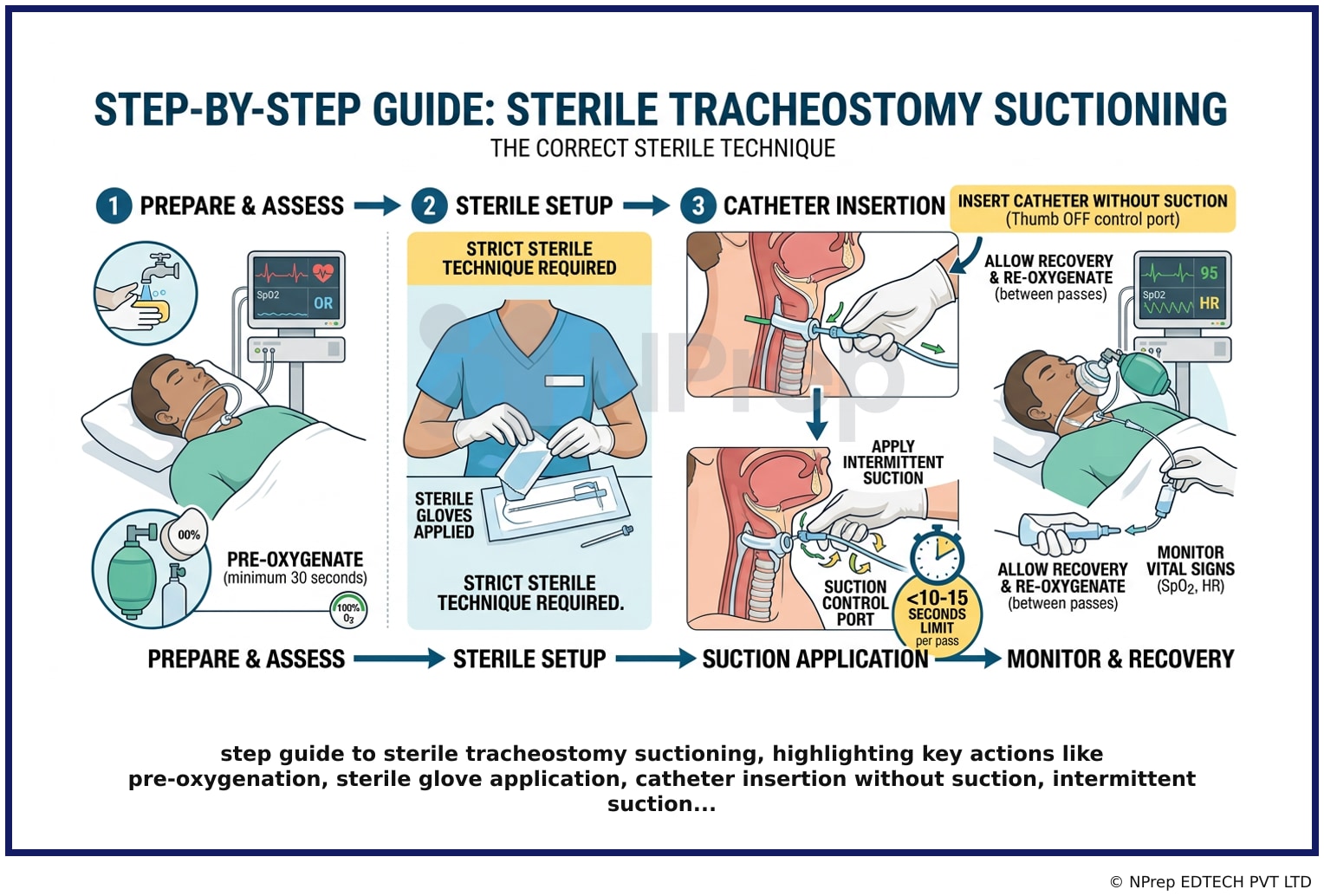
- The lower airway is a sterile environment, and direct access via a tracheostomy tube requires strict sterile technique (sterile gloves, sterile catheter) to prevent healthcare-associated infections like pneumonia.
Why Other Options Were Wrong
- Option B: This statement is a correct and essential part of the procedure. Applying the thumb to the suction control port creates the negative pressure needed to aspirate secretions.
- Option C: This statement describes a correct and important safety measure. Rotating the catheter during withdrawal prevents the tip from adhering to the tracheal mucosa, which minimizes tissue trauma.
- Option D: This statement is a critical safety guideline. Limiting each suction pass to 10-15 seconds is vital to prevent complications like hypoxia, bradycardia, and mucosal damage.
Related Visual
Clinical Relevance
- Nursing practice connection: This is primarily an exam-oriented knowledge point with limited direct bedside application, so retain Aseptic technique and safety protocols for tracheostomy suctioning as background academic context rather than a clinical decision trigger.
- Breaching sterile technique during tracheostomy suctioning can introduce pathogens directly into the lower respiratory tract, leading to serious infections like ventilator-associated pneumonia (VAP), which increases patient morbidity and mortality.
- Always pre-oxygenate the patient before suctioning (unless contraindicated) to build an oxygen reserve and minimize the risk of hypoxemia during the procedure.
- Continuously monitor the patient's heart rate, oxygen saturation (SpO2), and general condition during suctioning. Immediately stop the procedure if the patient shows signs of distress, such as a significant drop in SpO2 or a change in heart rate of more than 20 beats/min.
How to Approach the Question
- First, identify that the question is a negative-framing question ('except'). This means you are looking for the one statement that is FALSE or incorrect.
- Review each option by mentally walking through the standard, evidence-based procedure for tracheostomy suctioning.
- Evaluate Option A: Is 'non-touch technique' the correct term? Compare it to 'sterile technique'. Recognize that the lower airway is sterile, requiring a higher level of asepsis.
- Evaluate Option B: Is applying a finger to the hole how suction is activated? Recall that this occludes the vent to create negative pressure.
- Evaluate Option C: Is rotating the catheter correct? Think about the purpose: to prevent mucosal damage.
- Evaluate Option D: Is there a time limit? Recall the critical safety guideline to prevent hypoxia. The statement that is the least accurate or incorrect description of the standard procedure is the answer.
Concept Tested & Keywords
- Concept Tested: Aseptic technique and safety protocols for tracheostomy suctioning.
- Stem keywords: tracheostomy suctioning, suction catheter
- Lead-in keywords: All are true, except
- Negative lead-in flag: The question asks for the exception among the given statements.
Question ID
QyQs31Drh-y0VhiPlpAas3
Reference Book
E6 Nursing Fundamentals Potter Perry 12e Part 5 pp. 19-21, 16-18
Practise the full RUHS, Jaipur, M.Sc Nursing Entrance Exam-2021
Attempt every question from this paper in a timed mock, then review the full solution for each one.
More Gas Exchange and Respiratory Function Questions
- Which is the most relevant knowledge about oxygen administration to a client with COPD?
- Patient in emergency department diagnosed to have fluid and air present in lung. What is the above-mentioned condition known as?
- Patient is suffering from dyspnea. Which position will you provide for patient to relieve?
- Which of the following is not involved in chest physiotherapy?
- Respiration which is abnormally shallow for two or three breaths followed by irregular period of apnea is termed:
- Identify the following instrument which is used in diagnostic procedures:
- Identify the instrument shown in the following image:
- Identify the tube in the following image:
- A patient suddenly develops respiratory difficulties such as dyspnea, what is the first priority of the nursing officer?
- Which of the following method is used for high flow oxygen administration:
More RUHS, Jaipur, M.Sc Nursing Entrance Exam-2021 Questions
- Pouch of Douglas is situated between?
- Axillary nerve supplies?
- Largest branch of brachial plexus is?
- The normal range for White Blood Cells is
- Cholesterol is needed for formation of all except?
- Protamine sulphate is the antidote for?
- All are spread by feco-oral route except?
- Most common cause of diarrhoea in children is?
- Priority nursing care need of an unconscious patient?
- A patient with increased intracranial pressure should be placed in?