

The line everyone quotes
He was already in. He wanted to go home.
The real problem: fear of negative marking
The day split into three
Why he rates the analysis feature
The master notebook
Theory first, always
What to take from AIR 47
Frequently asked questions
NORCET 11 AIR 47: He Scrolled NPrep Instead of Instagram
Already posted at AIIMS Delhi, Rihan Rahim did 14,000 questions in the gaps around hospital duty to get a posting closer to home. His fix was not more theory.
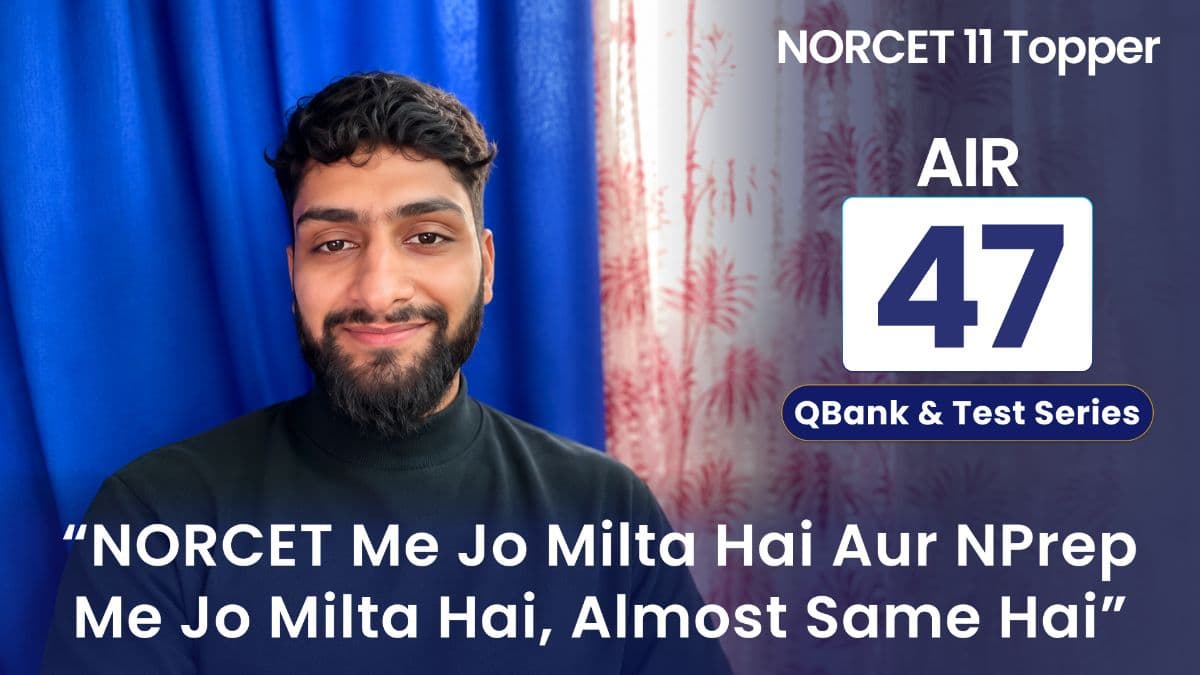
Quick answer: Rihan Rahim secured All India Rank 47 in NORCET 11 Mains 2026, improving on rank 191 in NORCET 10. He is a 2024 pass-out of Adarsh College of Nursing, Patiala, already working at AIIMS Delhi, and prepared again only to transfer to the AIIMS near his hometown in Jammu and Kashmir. He practised 14,000 questions with no daily quota, by opening NPrep instead of Instagram whenever he picked up his phone.
The line everyone quotes
Asked how he found time around AIIMS Delhi duty, his answer was not a schedule. It was a substitution:
Whenever I sat down and picked up the phone, instead of scrolling Instagram I would scroll NPrep, and solve however many questions I found.
No fixed number. No fixed time. He is explicit that he set no daily quota and no limit, because the AIIMS Delhi roster makes any fixed plan unworkable — you cannot predict when you will be hectic and when you will be sitting idle.
The total came to 14,000 questions alongside a full-time hospital job. His own comment on that figure is worth keeping:
14,000 is just a number. NPrep has more than that. The constraint was time, not available questions.
He was already in. He wanted to go home.
Like Muzzamil Ahmad at AIR 19, Rihan was not preparing out of necessity. He had secured AIIMS Delhi off the back of rank 191 in NORCET 10. The second attempt was purely about proximity to family.
His position on how hard to go the second time is a useful corrective to the grind narrative:
Once you have prepared properly once, you do not need the same intensity again. You need consistency, plus focus on whatever you previously missed.
The real problem: fear of negative marking
This is the most transferable part of his story, because the problem is extremely common and rarely named directly.
His accuracy after NORCET 10 was already good. His attempts were not. He describes a settled belief — he calls it a stigma — that attempting more questions would simply produce more negatives. So he capped himself.
The fix was not a technique. It was removing the cause:
- Question practice, at volume
- Improved theory
- Updating newer data and changes in theory
Once accuracy rose far enough, attempting more stopped being a risk. Negatives went down, accuracy went up, attempts went up, and the rank went up with them.
That fear ended. Whatever exam I give going forward, I will make sure it is the same as this one.
If you are leaving questions blank that you half-know, the problem is upstream of exam technique. It is accuracy.
The day split into three
When he had a full day, he divided it into three parts:
| Part | What he did |
|---|---|
| First | Theory revision |
| Second | Question Bank — deliberately on a phone or screen, never a book |
| Third | Minimum one test, then analysing it |
The screen choice is deliberate and worth copying. He preferred phone, desktop or laptop over a book because it matches the screen he would actually face in the exam. Solving on paper trains a different motion than solving on a CBT interface.
In the third block he was not just taking the test. He analysed which subject was generating negatives and which subject he was leaving unattempted — two different problems with two different fixes.
Why he rates the analysis feature
Asked what NPrep does that others do not, his answer was specific and slightly contrarian:
Tests are available everywhere. Nothing else tells you which subject you are performing well in.
His claim is that the post-test subject-level breakdown is the actual differentiator, not the questions themselves. Given how many candidates give mocks from multiple sources without ever aggregating their weak subjects, that is a fair point.
The master notebook
One notebook, filled with everything he got wrong and the gaps behind it.
The payoff is in how he uses it now. Before any exam, he reads that notebook instead of the whole theory, and says it feels like the entire theory has been covered.
He also pre-loads the stress deliberately — making sure the notebook is fully revised beforehand so that he does not have to strain in the hall itself. The interviewer's summary of the approach:
Grind yourself so hard in advance that exam day feels lighter than a normal day.
Theory first, always
His single piece of advice for aspirants is the opposite of what the question-volume story might suggest:
Put the most focus on theory. Once the core is complete, question practice becomes easy by itself.
The failure mode he describes is precise: candidates who focus on questions while theory is still incomplete end up with poor accuracy and no understanding of where the mistake is happening. They attempt, they get it wrong, and they cannot diagnose why.
Note that Arbaz at AIR 50 disagrees with waiting for complete theory and starts MCQs on the same day as the topic. The two positions are reconcilable: both say theory and questions must move together. They differ on how far ahead theory should run.
What to take from AIR 47
- Substitute, do not schedule. Replacing Instagram with NPrep needs no willpower budget and no timetable.
- If you are under-attempting, fix accuracy, not courage. The fear of negatives is a symptom.
- Practise on a screen, because that is what the exam is.
- Keep one notebook you can read instead of the whole syllabus before an exam.
- A second attempt from inside a post is legitimate. Rank 191 to 47, for a posting closer to home.
Frequently asked questions
What rank did Rihan Rahim get in NORCET 11? All India Rank 47 in NORCET 11 Mains 2026, improving from rank 191 in NORCET 10.
How did he prepare while working at AIIMS Delhi? He set no daily quota. Whenever he picked up his phone he opened NPrep instead of Instagram and solved whatever questions he found, accumulating roughly 14,000 questions across the cycle.
How do you stop being afraid of negative marking in NORCET? Rihan Rahim's fear of attempting more questions came from low accuracy, not from the marking scheme. He raised accuracy through question practice and improved theory until attempting more stopped carrying a penalty, which lowered negatives and raised attempts at the same time.
Should you practise NORCET questions on paper or on screen? He deliberately preferred a phone, laptop or desktop over books, because it matches the computer-based screen used in the actual exam.
Is theory or question practice more important for NORCET? His position is theory first: once the core is complete, question practice becomes easy by itself, whereas practising questions on incomplete theory produces poor accuracy and no way to diagnose mistakes.
Read the full list of NORCET 11 toppers who prepared with NPrep — 1 in 5 NORCET 11 Mains qualifiers came from NPrep: 2,178+ students qualified, 38 of them in the All-India top 100.
About the Author

Dr. Prince Kaushik
Founder, NPrep
AIIMS Jodhpur | NPrep Founder He combines his medical background with advanced technology to design high-yield preparation frameworks for competitive nursing exams like AIIMS NORCET, RRB & Staff nurse exams.
Similar Blogs For You

NORCET 11 AIR 19: How Muzzamil Ahmad Went From 38.8% to 82.7%
7 min Read • Oct 16, 2026

NORCET 9 Notification Out: Application Process & Key Details
5 min Read • Aug 5, 2025

NORCET 10 (2026) Notification: Eligibility, Dates & Details
3 min Read • Oct 30, 2025

NORCET-10 Exam Dates Announced - Mark Your Calendar! | NPrep
3 min Read • Oct 30, 2025

Best NORCET Test Series: Why NPrep NASHTA Leads
5 min Read • Jan 6, 2026