
RML 2023
Child Health Nursing (Pediatrics)
Easy
What is the most common fracture encountered in a baby during delivery?
Appeared in: RML 2023
Explanation
- The clavicle (collarbone) is the most frequently fractured bone in newborns during the process of labor and delivery.
- This injury is common, with an incidence of approximately 5 per 1000 live births, and is often an unavoidable complication of vaginal birth.
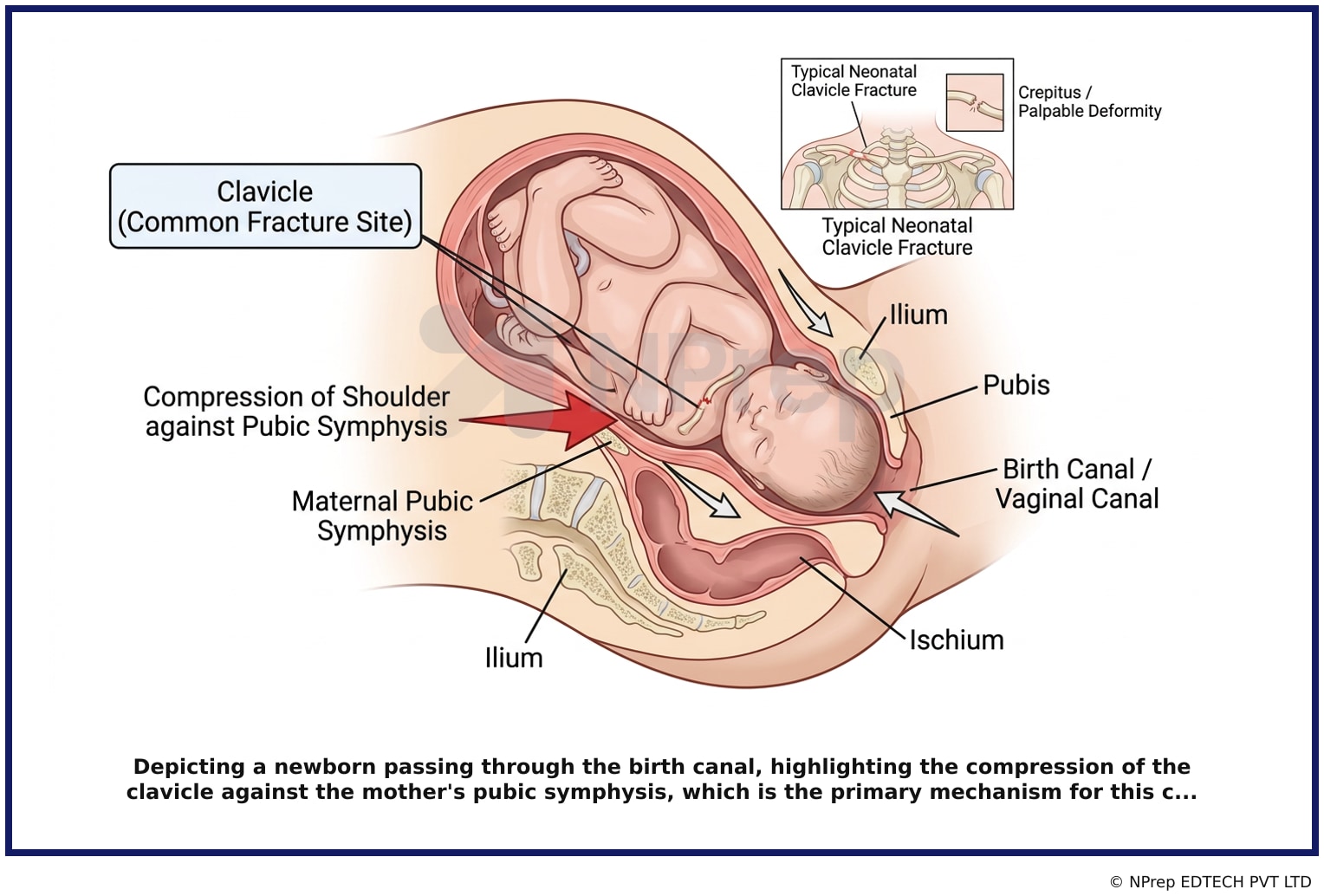
- The primary cause is compression of the clavicle against the maternal pubic bone, especially when the baby's shoulders have difficulty passing through the birth canal (shoulder dystocia).
- Other significant risk factors include a large birth weight (macrosomia) and breech delivery.
Why Other Options Were Wrong
- Option A: Fractures of the humerus are rare in newborns.
- Option C: Fractures of the ulna, a bone in the forearm, are extremely rare during delivery.
- Option D: Femur fractures are also rare birth injuries.
Related Visual
Clinical Relevance
- Nursing practice connection: This is primarily an exam-oriented knowledge point with limited direct bedside application, so retain Common neonatal fractures during childbirth as background academic context rather than a clinical decision trigger.
- Nurses must perform a thorough newborn assessment, including checking for signs of a clavicle fracture. Key signs include crepitus (a crackling feeling over the bone), a palpable deformity, and an asymmetrical Moro reflex where the infant does not move the affected arm.
- Management is typically conservative. It involves careful handling of the infant to minimize pain and may include immobilizing the arm by pinning the infant's sleeve to their shirt. The fracture usually heals rapidly within a few weeks.
- What if the delivery was an elective Cesarean section? The risk of a clavicle fracture would be dramatically reduced, as it is primarily a complication of the mechanical forces during vaginal passage, especially shoulder dystocia.
How to Approach the Question
- First, identify the keyword in the question: "most common". This indicates you need to recall the relative frequency of different birth injuries.
- Analyze the options provided: Humerus, Clavicle, Ulna, and Femur are all long bones.
- Think about the mechanics of a vaginal delivery. The baby must navigate a narrow passage. Consider which bone is most exposed to compressive forces.
- The clavicle is located at the shoulder and is one of the first bones to ossify. It is highly susceptible to compression against the mother's pubic bone, especially in cases of a large baby or shoulder dystocia.
- Contrast this with the other bones. The humerus and femur are larger and more protected within the limbs. They are typically only fractured during specific, less frequent obstetric maneuvers like breech extraction.
- Based on this anatomical and mechanical reasoning, conclude that the clavicle is the most vulnerable and therefore the most commonly fractured bone during birth.
Concept Tested & Keywords
- Concept Tested: Common neonatal fractures during childbirth.
- Stem keywords: most common fracture, baby, delivery
- Lead-in keywords: What is
Question ID
QNb8BftZkCXVwOx0v70q7K
Reference Book
E6 Obstetrics Williams p. 20-38
E6 Nelson Textbook of Pediatrics(2024) — Volume 2 p. 2090-2092
Practise the full RML 2023
Attempt every question from this paper in a timed mock, then review the full solution for each one.
More Newborn Infants Questions
- When palpating the abdomen of hypertrophic pyloric stenosis infant, the Nurse finds:
- A pre-eclampsia woman's baby is lying with her mother. Neonate is born in 37 weeks. After 57 hours, when nurse is monitoring vital signs of baby, tem…
- Normally enteral feedings are flushed with water to open blocked tube and ease feeding. In which area it is done with air?
- A nurse is advised to give injection vitamin K for new born baby. The route and dose of Vitamin K is:
- Identify the following instrument used in hyperbilirubinemia monitoring based on the image:
- Which of the following equipment is used in Neonatal Resuscitation program?
- All of the following are the benefits of KMC (Kangaroo mother care); EXCEPT:
- Waxy or cheese like white substance found coating the skin of newborn human baby is known as:
- Identify 'at risk' infants from the following:-
- What is the normal length of the neonate body?
More RML 2023 Questions
- A 65 year old man collapsed while climbing stairs. You found the patient. You checked the pulse and found that pulse is felt simultaneously, you scan…
- A 65 years old male presents in the emergency with severe chest pain for the last 2 hours. An acute myocardial infarction is diagnosed. What would be…
- A nurse is taking care of an immune-compromised patient. Which of the following measures can be taken?
- What is the thorough cleaning and disinfection after the death or discharge of a patient called?
- What will be the number of zeros in the square of 70?
- A 40-year-old lady came into the hospital with fever and rashes for a few days and is suspected to have Dengue. Which test would show that her fever…
- Which is a correct statement regarding autoclaving?
- While conducting a developmental assessment, a nurse notes that a baby is able to produce sounds like 'Mama', 'dada', etc. What is the likely age of…
- Who is known as the father of the green revolution in India?
- What are the components of the APGAR Score?