
AIIMS Delhi NO- 2019
Child Health Nursing (Pediatrics)
Medium
Which of the following equipment is used in Neonatal Resuscitation program?
Appeared in: AIIMS Delhi NO- 2019
Explanation
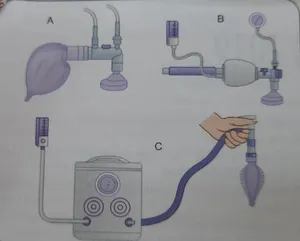
- All three devices shown are standard and essential equipment used in the Neonatal Resuscitation Program (NRP).
- Device A (Self-inflating bag) and Device B (T-piece resuscitator) are both used to provide positive pressure ventilation (PPV) to assist the newborn's breathing.
- The T-piece resuscitator (B) offers more controlled pressure delivery, which is beneficial for fragile preterm lungs.
- Device C (Suction apparatus) is crucial for clearing the airway of obstructions like secretions or meconium, which is often the first step in resuscitation.
Why Other Options Were Wrong
- Option A: This option is incomplete. While the self-inflating bag (A) is used, the T-piece resuscitator (B) and suction apparatus (C) are also standard equipment in NRP.
- Option B: This option is incomplete. It correctly identifies both ventilation devices (A and B) but omits the suction apparatus (C), which is critical for clearing the airway.
- Option C: This option is incomplete. It includes the bag-mask and suction but excludes the T-piece resuscitator (B), which is another primary device for providing PPV, especially in hospital settings.
Related Visual

Clinical Relevance
- Nursing practice connection: This is primarily an exam-oriented knowledge point with limited direct bedside application, so retain Identification of standard equipment for the Neonatal Resuscitation Program (NRP) as background academic context rather than a clinical decision trigger.
- Nurses in labor, delivery, and neonatal units must be able to rapidly identify, set up, and use all three pieces of equipment, as the need for resuscitation can arise unexpectedly.
- The choice between a self-inflating bag (A) and a T-piece resuscitator (B) often depends on the clinical setting, available resources, and the specific needs of the infant (e.g., T-piece is often preferred for preterm infants).
- What if? If an infant is born through thick meconium-stained fluid and is not vigorous (limp, not breathing), the priority action changes. The team would first use the suction catheter (part of Device C) to clear the trachea of meconium before initiating positive pressure ventilation with Device A or B to prevent meconium aspiration syndrome.
How to Approach the Question
- First, carefully examine the image and identify each piece of equipment labeled A, B, and C.
- Identify A as a self-inflating bag-valve-mask (Ambu bag), B as a T-piece resuscitator, and C as a suction unit.
- Recall the core principles and steps of the Neonatal Resuscitation Program (NRP). The acronym TABC (Temperature, Airway, Breathing, Circulation) is helpful.
- Connect each device to its function within NRP: Suction (C) is for 'Airway,' while the BVM (A) and T-piece (B) are for 'Breathing' (Positive Pressure Ventilation).
- Since airway clearance and breathing support are both fundamental to NRP, conclude that all three devices are necessary components.
- Evaluate the options and select the one that correctly includes all identified equipment (A, B, and C).
Concept Tested & Keywords
- Concept Tested: Identification of standard equipment for the Neonatal Resuscitation Program (NRP).
- Stem keywords: equipment, Neonatal Resuscitation program
- Lead-in keywords: Which of the following
Question ID
QbsKT2QPGBAHDVpD-Fd1DL
Reference Book
E6 Ghai Essential Pediatrics(pp 26-904 of 913) p. 118-120
E6 Text Book Of Pediatric Nursing 3rd Panchali Pal — Part 1 (pp 36-238 of 713) p. 164-166
Practise the full AIIMS Delhi NO- 2019
Attempt every question from this paper in a timed mock, then review the full solution for each one.
More Newborn Infants Questions
- When palpating the abdomen of hypertrophic pyloric stenosis infant, the Nurse finds:
- A pre-eclampsia woman's baby is lying with her mother. Neonate is born in 37 weeks. After 57 hours, when nurse is monitoring vital signs of baby, tem…
- Normally enteral feedings are flushed with water to open blocked tube and ease feeding. In which area it is done with air?
- A nurse is advised to give injection vitamin K for new born baby. The route and dose of Vitamin K is:
- Identify the following instrument used in hyperbilirubinemia monitoring based on the image:
- All of the following are the benefits of KMC (Kangaroo mother care); EXCEPT:
- Waxy or cheese like white substance found coating the skin of newborn human baby is known as:
- Identify 'at risk' infants from the following:-
- What is the normal length of the neonate body?
- A child with recurrent upper respiratory infection. Which complication may be seen?
More AIIMS Delhi NO- 2019 Questions
- A nurse is preparing to give bath to admitted patient with perineal problem. Which of the following will help the patient?
- In the absence of nurse from floor, patient falls from bed. This type of injury belongs to:
- Patient's Medical record with all essential information is responsibility of:
- Post-partum women having bleeding within 24 hrs after delivery is called:
- In which condition, distal pulse is preferred rather than apical pulse?
- A woman with 3rd day postpartum has complaint of engorgement in both breasts. What is cut off temperature for fever in postpartum women?
- Universal blood donor?
- WHO hand wash time with soap?
- Why it is necessary to remove dark coloured nail paint before surgery?