
KPSC Staff Nurse - 2018
Applied Microbiology & Infection control
Easy
Injection of diphtheria antitoxin gives?
Appeared in: KPSC Staff Nurse - 2018
Explanation
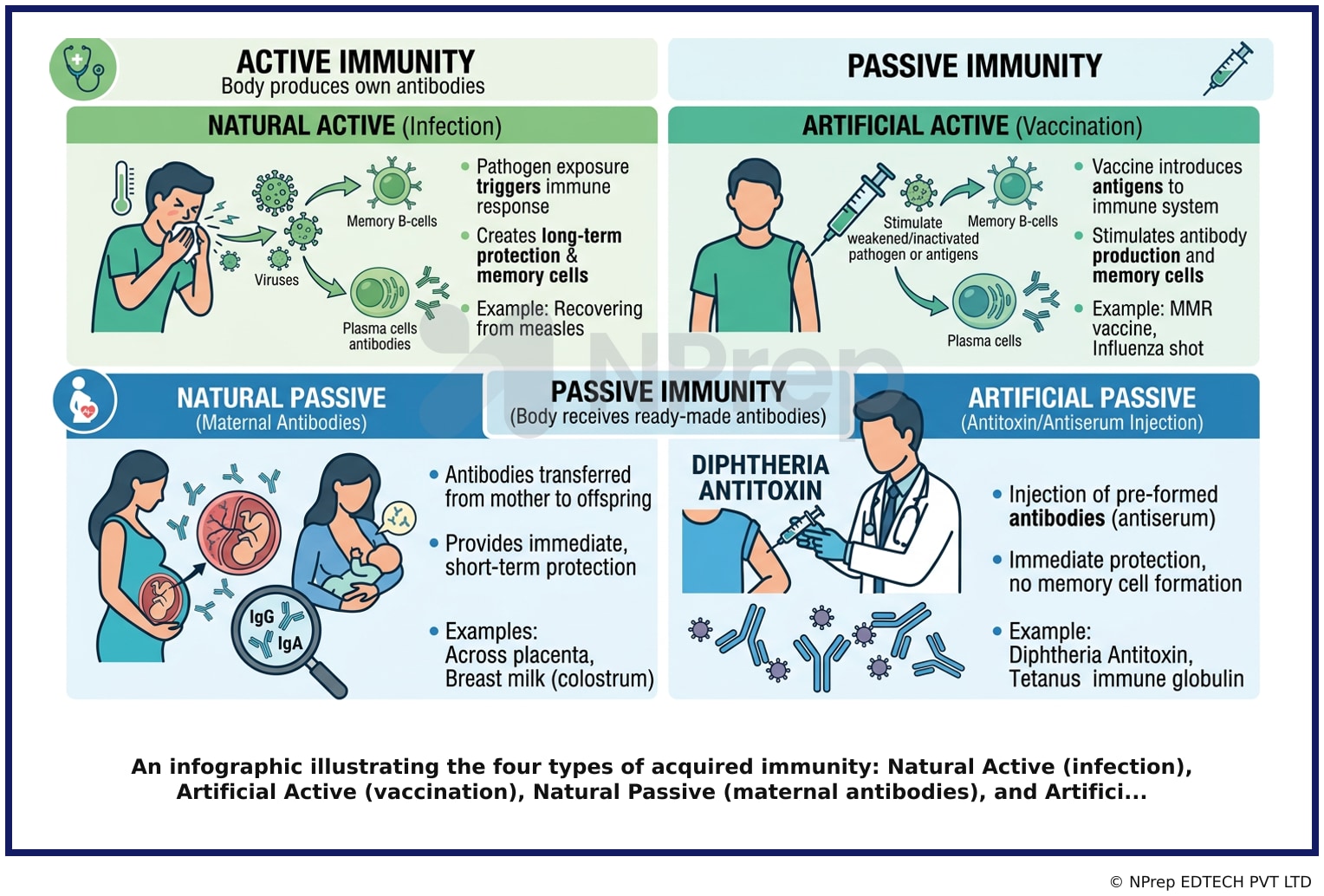
- Diphtheria antitoxin is a preparation containing pre-formed antibodies against the diphtheria toxin.
- Administering these ready-made antibodies provides immediate but temporary protection, which is characteristic of passive immunity.
- Because the antibodies are produced externally and introduced via injection, it is specifically classified as artificial passive immunity.
- The recipient's immune system is not stimulated to produce its own antibodies or memory cells, so the protection is short-lived.
Why Other Options Were Wrong
- Option A: Active immunity involves the body producing its own antibodies in response to an antigen. Antitoxin provides antibodies directly, it does not stimulate the body to make them.
- Option C: Natural immunity is acquired without medical intervention, either by contracting the disease (natural active) or from mother to baby (natural passive). Diphtheria antitoxin is a manufactured medical product.
- Option D: Cellular immunity is primarily mediated by T-lymphocytes and does not involve antibodies. Antitoxins provide humoral immunity, which is antibody-mediated.
Related Visual
Clinical Relevance
- Nursing practice connection: This is primarily an exam-oriented knowledge point with limited direct bedside application, so retain Types of Acquired Immunity as background academic context rather than a clinical decision trigger.
- Diphtheria antitoxin is used for treatment, not prevention. It neutralizes circulating toxin but does not eliminate the bacteria, so antibiotics are also required.
- A key nursing responsibility is to perform a sensitivity test before administering the full dose of antitoxin (often derived from horse serum) to check for potential hypersensitivity reactions.
- Emergency equipment and medications, such as epinephrine (adrenaline), must be readily available to manage potential anaphylaxis, a severe allergic reaction.
How to Approach the Question
- First, identify the key term in the question: 'diphtheria antitoxin'.
- Break down the term: 'Anti' means against, and 'toxin' refers to the poison produced by the bacteria. So, an antitoxin works against the toxin.
- Recall the definitions of active and passive immunity. Active immunity is when your body 'actively' makes its own antibodies. Passive immunity is when you 'passively' receive ready-made antibodies.
- Since an antitoxin is a solution of ready-made antibodies, it provides passive immunity.
- Differentiate between natural and artificial. 'Natural' happens without medical intervention. 'Artificial' involves a medical procedure like an injection. An injection of antitoxin is an artificial process.
- Combine the conclusions: The injection provides artificial passive immunity. Select the option that aligns with this, which is 'Passive immunity'.
Concept Tested & Keywords
- Concept Tested: Types of Acquired Immunity
- Stem keywords: Injection, diphtheria antitoxin
- Lead-in keywords: gives
Question ID
Qzf8dpuFi7k-3A_mnTdzfw
Reference Book
E6 Pharmacology Nursing Lilley 11e Part 3 p. 148-150
E6 Physiology Essentials Sembulingam 10e Part 1 p. 126-128
Practise the full KPSC Staff Nurse - 2018
Attempt every question from this paper in a timed mock, then review the full solution for each one.
More Immunity Questions
- Passive immunity against tetanus is obtained by the administration of:
- Vaccines and toxoids produce:
- A type of immunity that occurs when the vaccination of a portion of population provides protection to unprotected individuals is:
- For which of the following there is no vaccine available?
- Vaccination is an example of:-
- Which immunoglobulin can cross the placenta and can provide passive immunity to the newborn?
- The antigen that forms loose and cotton wooly clumps during agglutination is \ \ \ \ \ \
- The transfer of antibodies from mother's milk to the baby is called:
- The major class of immunoglobulin present in human serum is?
- The immunity that is transferred from maternal antibodies to the fetus trans-placentally and to the infant through breast milk to protect them until…
More KPSC Staff Nurse - 2018 Questions
- Which Article of Indian Constitution abolishes untouchability?
- The 73rd and 74th Amendments to the Indian Constitution were related with. $\qquad$ $?$
- Name the program launched by the Department of Women and Child Development, MHRD in 1988 to boost up women's health, education and political particip…
- Which social reformer of Kerala authored a book titled "Pracheena Malayalam"?
- "Awake, remember the Lord Almighty, Get up at once and fight injustice". Which social reform organization of 20th century Kerala put forth the above…
- ....................is considered as the "father of political movements in modern Thiruvithamkur"?
- Who among the following women social reformer and activist of 20th century Kerala actively participated in the Paliyam Satyagraha of 1947?
- Which compound is known as inorganic benzene?
- The designation of an orbital with $\mathbf{n}=4$ and $\mathbf{l}=2$ is?
- The element with highest electronegativity is?