
Combined AIIMS - 2020 (Jodhpur, Bhopal, Patna, Raipur)
Medical & Surgical Nursing
Easy
Identify the condition:
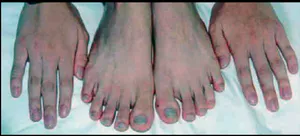
Appeared in: Combined AIIMS - 2020 (Jodhpur, Bhopal, Patna, Raipur)
Explanation
- The correct diagnosis is Differential Cyanosis, which is defined by cyanosis affecting the lower half of the body but not the upper half.
- The image clearly demonstrates this pattern, with visibly cyanotic (blue) feet and toes, while the hands appear pink and well-perfused.
- This specific presentation is a hallmark sign of a right-to-left shunt through a patent ductus arteriosus (PDA) with pulmonary hypertension.
- In this condition, deoxygenated blood from the pulmonary artery enters the descending aorta (which supplies the lower body), while oxygenated blood from the left ventricle supplies the upper body.
Why Other Options Were Wrong
- Option B: Central cyanosis involves a bluish discoloration of the entire body, including warm areas like the mucous membranes of the mouth and tongue. The image only shows cyanosis in the lower extremities.
- Option C: Peripheral cyanosis is caused by reduced blood flow to the extremities, often due to cold exposure or low cardiac output. It typically affects all four limbs, and the mucous membranes remain pink. The image shows a distinct difference between the upper and lower limbs, which is not typical for peripheral cyanosis.
- Option D: This is a non-specific, general term. While differential cyanosis is a type of cyanosis affecting the extremities, 'Differential Cyanosis' is the precise medical term for the specific pattern shown in the image.
Related Visual

Clinical Relevance
- Nursing practice connection: This is primarily an exam-oriented knowledge point with limited direct bedside application, so retain Identification and pathophysiology of different types of cyanosis based on clinical presentation as background academic context rather than a clinical decision trigger.
- Recognizing differential cyanosis is a critical nursing assessment skill, as it signals a significant underlying congenital heart defect with pulmonary hypertension.
- This finding requires immediate reporting and urgent cardiological evaluation, as it indicates severe hemodynamic compromise.
- A key nursing intervention is to perform a four-limb blood pressure and pulse oximetry check. A significant difference in oxygen saturation (typically greater than 3-5%) between the right hand (pre-ductal) and a foot (post-ductal) can confirm the diagnosis.
How to Approach the Question
- First, analyze the image carefully. Observe the color of the skin in all visible areas, specifically the hands and feet.
- Note the key finding: the feet are blue (cyanotic), but the hands are pink.
- This pattern of localized cyanosis is the central clue. The term for this is 'differential' cyanosis, meaning it differs between body parts.
- Evaluate the given options based on this observation.
- Recall the definitions: Central cyanosis is generalized (including mucous membranes), and peripheral cyanosis is usually in all extremities due to poor circulation.
- Select 'Differential Cyanosis' as it is the most precise term that describes the specific clinical sign shown in the image.
Concept Tested & Keywords
- Concept Tested: Identification and pathophysiology of different types of cyanosis based on clinical presentation.
- Stem keywords: Identify the condition, cyanosis, hands, feet
- Lead-in keywords: Identify
- Clinical cues: Bluish discoloration of feet and toes.
- Clinical cues: Normal pink color of hands and fingers.
Question ID
QNxY7ZDLggKHBD09Y4786-
Reference Book
E6 Ghai Essential Pediatrics(pp 26-904 of 913) p. 444-446
E6 Medicine Harrison 22e Part 1 p. 320-322
Practise the full Combined AIIMS - 2020 (Jodhpur, Bhopal, Patna, Raipur)
Attempt every question from this paper in a timed mock, then review the full solution for each one.
More Sensorineural Function Questions
- Which ophthalmic diagnostic test measures the Intraocular pressure?
- Identify the following instrument in image:
- What sound is heard when percussing a distended bladder?
- Which test would be done to check balance in a patient with ataxia?
- In the emergency you have 4 patients. By prioritizing your management plan, which patient's problem will you address first?:
- All of the following instructions are given to a patient before computed tomography (CT) scan, except?
- The nursing care of a patient with dengue fever includes all of the following, except?
- Which of the following equipment is used for the examination of the ear?
- An aged client with diabetes mellitus complaining of painless peripheral loss of vision is at risk for?
- Which of the following is true regarding macular degeneration?
More Combined AIIMS - 2020 (Jodhpur, Bhopal, Patna, Raipur) Questions
- The position used for most of the gynecological procedures?
- Thyroid eye disease (TED) is also known as:
- How many items are included in the WHO surgical safety checklist: SITOSO?
- In iron deficiency anemia, the fingernails become spoon shaped, this condition is referred to as:
- Which of the following code is associated with cardiac arrest during medical emergency?
- How is blood loss measured in Post-partum hemorrhage?
- The traction used for cervical spine injury:
- In operation theater during cauterization, the electric current passing from a single electrode is called:
- Tracheostomy is done in which tracheal ring?
- The instrument used for measuring fetal heart rate (FHR):