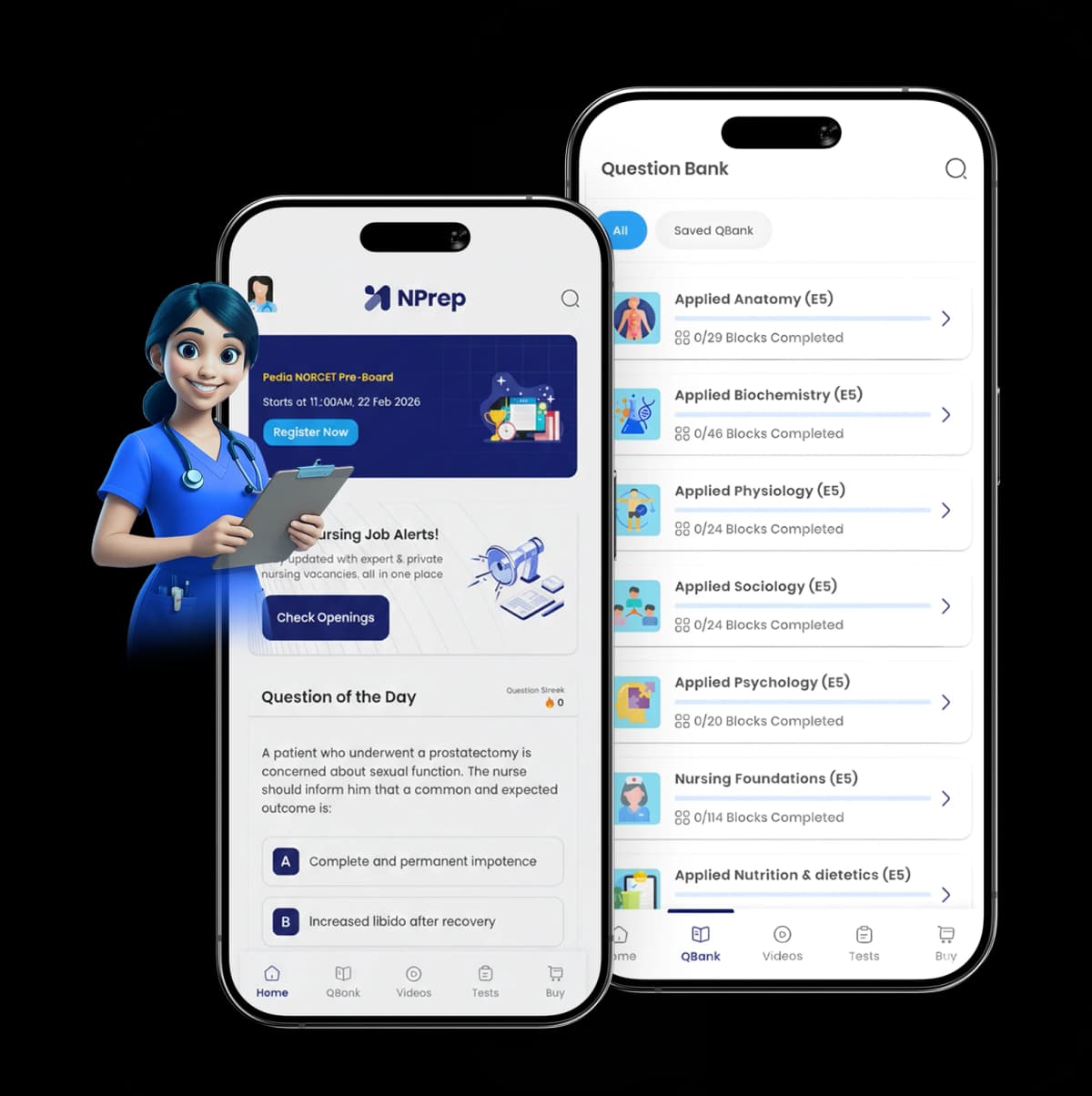

Why Should You Solve AIIMS NORCET Previous Year Papers?
AIIMS NORCET Previous Year Question Papers & Answer Keys
How to Use AIIMS NORCET PYQs Effectively
What Can You Learn from AIIMS NORCET Previous Year Papers?
Benefits of Solving Multiple NORCET Previous Year Papers
Common Mistakes Candidates Make While Using PYQs
How to Get Maximum Value from PYQ Practice
Download Free AIIMS NORCET PYQs & Start Practicing Today
Free AIIMS NORCET Previous Year Question Papers (PYQs) & Answer Keys PDF Download
Access year-wise NORCET previous year papers with solutions and boost your preparation with expert-backed strategies

Practice Smarter, Analyze Trends, and Improve Your Nursing Officer Exam Performance
Preparing for AIIMS NORCET requires more than just completing the syllabus. One of the most effective ways to understand the exam pattern, identify important topics, and improve accuracy is by solving AIIMS NORCET Previous Year Question Papers (PYQs).
Whether you're appearing for NORCET for the first time or aiming to improve your rank, previous year papers can help you understand how questions are framed, which concepts are frequently tested, and where you need to focus your preparation.
In this guide, you'll find access to AIIMS NORCET previous year question papers, answer keys, and expert strategies to use them effectively.
Visit NORCET hub for all-round preparation
Why Should You Solve AIIMS NORCET Previous Year Papers?
Previous year question papers are one of the most reliable preparation resources available to nursing aspirants.
They help you:
✅ Understand the actual exam pattern
✅ Identify frequently tested topics
✅ Improve time management skills
✅ Develop better accuracy
✅ Reduce negative marking
✅ Build confidence before the exam
Many successful candidates consider PYQ practice an essential part of their preparation strategy.
Nprep Expert Insight
While exact questions may not repeat, many nursing concepts, clinical scenarios, and subject areas frequently reappear in different forms.
Candidates who regularly solve previous year papers often find it easier to recognize patterns and answer questions more efficiently during the actual exam.
AIIMS NORCET Previous Year Question Papers & Answer Keys
All NORCET PYQs available on NPrep App
📌 AllNORCET PYQs are available through NPrep's Free Resource Hub.
How to Use AIIMS NORCET PYQs Effectively
Simply solving previous year papers is not enough. The real benefit comes from analyzing your performance and learning from mistakes.
Step 1: Start with the Latest Available Paper
Recent papers provide the best understanding of current exam trends and question framing styles.
Step 2: Attempt the Paper Under Exam Conditions
Treat each paper like an actual NORCET exam.
- Follow the official time limit
- Avoid interruptions
- Attempt questions honestly without external help
This helps build exam temperament and speed.
Step 3: Check Answers Immediately
Compare your responses with the official answer key or expert solutions.
Focus on:
- Incorrect answers
- Lucky guesses
- Time-consuming questions
Step 4: Create a Weak Topic List
After each paper, note:
- Subjects where you lost marks
- Frequently repeated mistakes
- Concepts requiring revision
This helps prioritize your study plan.
Step 5: Track Repeated Concepts
Many nursing topics appear repeatedly across recruitment examinations.
Pay special attention to:
- Medical-Surgical Nursing
- Nursing Foundations
- Pharmacology
- Child Health Nursing
- Obstetrics & Gynaecological Nursing
- Community Health Nursing
- Mental Health Nursing
Mastering these areas often leads to substantial score improvement.
What Can You Learn from AIIMS NORCET Previous Year Papers?
Previous year papers reveal much more than question patterns.
Exam Difficulty Level
You develop realistic expectations about the complexity of questions.
Subject-Wise Weightage
PYQs help identify which subjects consistently contribute more questions.
Clinical Scenario-Based Questions
Recent nursing recruitment exams increasingly emphasize application-based learning rather than memorization.
Time Management Skills
Regular practice helps you determine:
- Which questions to attempt first
- How much time to spend per question
- When to skip difficult questions
Negative Marking Management
Practicing PYQs helps candidates learn when to attempt and when to avoid risky guesses.
Understand the Negative Marking strategy
Benefits of Solving Multiple NORCET Previous Year Papers
Candidates who solve several papers often experience:
✅ Better accuracy
✅ Faster question-solving speed
✅ Improved revision efficiency
✅ Stronger conceptual understanding
✅ Increased confidence
✅ Better handling of exam pressure
Over time, you begin recognizing common patterns and high-yield topics that repeatedly appear in nursing officer recruitment exams.
Common Mistakes Candidates Make While Using PYQs
Solving Papers Without Analysis
Many candidates solve papers but never review their mistakes.
The analysis phase is often more important than the paper itself.
Memorizing Answers
The goal is not to memorize answers but to understand the concepts behind them.
Ignoring Weak Subjects
Candidates often focus only on strengths.
Use PYQs to identify and improve weaker areas.
Not Simulating Exam Conditions
Untimed practice does not accurately reflect actual exam performance.
Practice under realistic conditions whenever possible.
How to Get Maximum Value from PYQ Practice
Follow this simple formula:
Solve → Analyze → Revise → Retest
This approach helps transform previous year papers from a practice exercise into a powerful learning tool.
Candidates who consistently follow this cycle often improve both their knowledge and exam performance.
Download Free AIIMS NORCET PYQs & Start Practicing Today
At NPrep, we provide nursing aspirants with carefully organized previous year papers, answer keys, mock tests, and exam-focused preparation resources.
Get access to:
✅ AIIMS NORCET PYQs
✅ Answer Keys & Solutions
✅ Mock Tests
✅ Topic-Wise Practice Questions
✅ Nursing Officer Preparation Resources
Frequently Asked Questions
What is NORCET 10 and who can apply for it?
NORCET 10 (Nursing Officer Recruitment Common Eligibility Test) is conducted by AIIMS to recruit Nursing Officers in AIIMS and other government healthcare institutions. Candidates must have completed B.Sc. Nursing or GNM with relevant experience, as per the official notification.
Why should I solve previous year NORCET question papers?
Solving NORCET PYQs helps you understand the exam pattern, frequently repeated topics, difficulty level, and improves speed and accuracy under real exam conditions.
How many hours should I study daily for NORCET 10?
Most toppers recommend 6-8 focused study hours, including targeted PYQ practice, concept revision, and mock test analysis.
How many previous year papers should I solve for NORCET 10?
It is recommended to solve at least the last 4-5 NORCET exams, along with additional nursing officer exams like ESIC, RRB, and DSSSB for wider exposure.
Does NORCET have negative marking?
Yes, NORCET follows a negative marking system. Typically, +1 mark is awarded for every correct answer and 1/3 mark deducted for each incorrect response (as per previous patterns)."
About the Author

Dr. Gourav Khurana
Founder, NPrep
AIIMS Jodhpur | NPrep Founder Dr. Gourav Khurana is a Co-Founder of NPrep and an MBBS alumnus of AIIMS Jodhpur. He spearheads the platform's curriculum strategy and data analytics, delivering precision, exam-exact learning paths for nursing aspirants.
Similar Blogs For You

NORCET PYQs with Answer Key Free PDF Download
3 min Read • Aug 4, 2026
UPPSC Staff Nurse Previous Year Question Papers: Download PDFs & Smart Preparation Strategy
4 min Read • Mar 20, 2026

RML Nursing Officer Previous Year Question Papers (PYQs) with Solutions – Free PDF Download
5 min Read • May 18, 2026
.jpeg&w=1200&q=75)
RML Nursing Officer Previous Year Question Papers (PYQs) with Solutions – Free PDF Download
4 min Read • Apr 7, 2026

SGPGI Nursing Officer Previous Year Papers: Strategic Download and Practice Framework
10 min Read • Jun 9, 2026