
DSSSB - 29 August 2019 (Shift-1)
Reasoning
Medium
Which of the following Venn diagrams best represents the relationship between stars, planets and moons?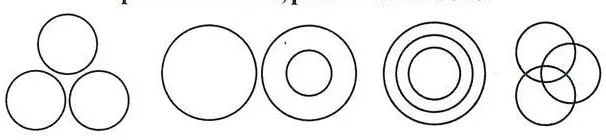
Appeared in: DSSSB - 29 August 2019 (Shift-1)
Explanation
- The question requires identifying the correct set relationship between Stars, Planets, and Moons.
- Stars, Planets, and Moons are three distinct categories of celestial objects with no overlap.
- A star generates its own light (e.g., the Sun).
- A planet orbits a star (e.g., Earth).
- A moon orbits a planet (e.g., Earth's Moon).
- Because these three sets are mutually exclusive (disjoint), they must be represented by three separate, non-overlapping circles.
Why Other Options Were Wrong
- Option B: This diagram shows two concentric circles, which represents a subset relationship between two sets. It is incorrect because there are three categories (stars, planets, moons), not two, and none is a subset of another.
- Option C: This diagram shows three concentric circles, representing a nested subset relationship (A is a subset of B, and B is a subset of C). This is incorrect because moons are not a type of planet, and planets are not a type of star.
- Option D: This diagram shows three intersecting circles, which implies that there are elements common to the sets. This is incorrect because an object cannot be a star and a planet at the same time, or any other combination.
Related Visual

Clinical Relevance
- Nursing practice connection: This is primarily an exam-oriented knowledge point with limited direct bedside application, so retain Logical reasoning using Venn diagrams to represent set relationships as background academic context rather than a clinical decision trigger.
- This question assesses logical and analytical reasoning, a critical skill for nurses.
- Nurses use logical reasoning daily to interpret patient data, understand cause-and-effect relationships between symptoms and conditions, and make sound clinical judgments.
- Strong reasoning skills help in prioritizing care, troubleshooting equipment, and applying nursing protocols correctly.
How to Approach the Question
- Step 1: Identify the distinct groups or sets mentioned in the question. Here, the sets are 'Stars', 'Planets', and 'Moons'.
- Step 2: Define each set and determine the relationship between them. Ask if one set can be part of another (subset), if they can have common members (intersection), or if they are completely separate (disjoint).
- Step 3: Analyze the definitions. A star creates light. A planet orbits a star. A moon orbits a planet. These are three mutually exclusive definitions.
- Step 4: Conclude that the sets are disjoint, meaning they have no members in common.
- Step 5: Match this relationship to the provided Venn diagrams. A diagram with three separate, non-overlapping circles is the correct representation for disjoint sets.
- Step 6: Eliminate the other options. Concentric circles represent subsets, and intersecting circles represent overlapping sets, neither of which applies here.
Concept Tested & Keywords
- Concept Tested: Logical reasoning using Venn diagrams to represent set relationships.
- Stem keywords: Venn diagram, relationship, stars, planets, moons
- Lead-in keywords: best represents
Question ID
Q3wRQc9okxCV5jSEQFKZmS
Practise the full DSSSB - 29 August 2019 (Shift-1)
Attempt every question from this paper in a timed mock, then review the full solution for each one.
More Syllogism (Basic) Questions
- Which of the following Venn diagrams best represents the relationship between horses, herbivores and domestic animals?
- In the following figure, triangle represents artists, square represents military officers, circle represents stamp collectors and rectangle represent…
- Which of the following Venn diagrams best represents the relationship between apples, mangoes and vegetables?
- दिए गए कथन (नों) और निष्कर्षों को ध्यान से पढ़ें और चुनें किसे कौनसा निष्कर्ष, तार्किक रूप से कथन का पालन करता है। कथनः 1\. सभी नींबू आम हैं। 2\. सभी…
- Which of the following Venn- diagram correctly illustrates the relationship among the classes: Electronics, Cellphone, iPhone?
- A statement is given followed by two conclusions. Find which conclusion(s) is /are true based on the given statement. Statement: M D \ U N Conclusion…
- Identify the Venn diagram that best represents relationship between Jaundice, Diseases and Leprosy:
- Based on the logic 'All cats are grey and grey is floppy,' then floppy is:
- Logic: 'All squares are rectangles, some rectangles are parallelograms.' Therefore:
- Read the following statements and conclusions carefully. Assuming that the information given in the statements is true, even if it seems to be at var…
More DSSSB - 29 August 2019 (Shift-1) Questions
- Find the missing number in the following number series. -12, -6, \ \ , 9, 18
- Which of the following cubes in the answer figures CANNOT be made based on the unfold cube in the question figure?
- Out of the given options, three are similar in a certain manner. However, one option is NOT like the other three. Select the option which is differen…
- Which two numbers should be interchanged to make the below equation mathematically correct? 7 + 16 / 4 \ 3 - 5 \= 10
- Select the option that is related to the third number on the same basis as the second number is related to the first number. 0.14 : -7.143 :: 0.17 : ?
- A person walks 6 km towards north, then turns towards west and walks 3 km. He then turns left and walks 4 km, and then again turns left and walks for…
- Which two signs should be interchanged to make the below equation mathematically correct? 7 \ 3 + 12 / 2 - 4 \= 23
- If in a certain code language AC means 'Party is amazing', DEC means 'amazing and fun', DF means 'fun loving', then what is the code for 'and'?
- Two numbers are 40% and 60% respectively more than a third number. What is the ratio of the first number to the second number?
- Read the given statement and conclusions carefully. Assuming that the information in the statement is true, even if they appear to be in variance wit…