
DSSSB - 29 August 2019 (Shift-2)
Reasoning
Hard
Which of the following Venn diagrams best represents the relationship between horses, herbivores and domestic animals?
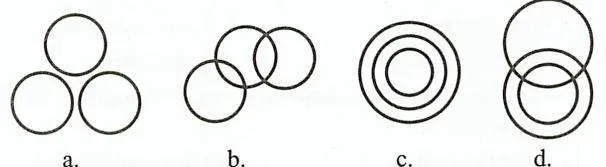
Appeared in: DSSSB - 29 August 2019 (Shift-2)
Explanation
- The question requires identifying the Venn diagram that correctly shows the relationship between three sets: Horses, Herbivores, and Domestic Animals.
- The core logical relationship is that all horses are both herbivores and domestic animals. This means the 'Horses' set is a subset of the other two sets.
- Additionally, the sets 'Herbivores' and 'Domestic Animals' have a partial overlap (intersection), as some herbivores are not domestic (like deer) and some domestic animals are not herbivores (like dogs).
- Diagram D correctly depicts this by placing a small circle (Horses) entirely within the intersection of two larger, overlapping circles (Herbivores and Domestic Animals).
Why Other Options Were Wrong
- Option A: This diagram shows three disjoint sets, implying no relationship or overlap between horses, herbivores, and domestic animals. This is factually incorrect.
- Option B: This diagram shows a chain of intersections but fails to represent that 'Horses' is a complete subset of both 'Herbivores' and 'Domestic Animals'. It only suggests partial overlaps between adjacent groups.
- Option C: This diagram shows three concentric circles, implying a full subset hierarchy (e.g., A is a subset of B, and B is a subset of C). This is wrong because not all herbivores are domestic animals.
Related Visual

Clinical Relevance
- Nursing practice connection: This is primarily an exam-oriented knowledge point with limited direct bedside application, so retain Logical relationship representation using Venn diagrams as background academic context rather than a clinical decision trigger.
- While not a clinical question, logical reasoning is a foundational skill for nurses to interpret data, identify patterns in patient symptoms, and make sound clinical judgments.
- This type of set theory problem helps develop the analytical thinking needed to understand overlapping categories, such as patient populations with multiple comorbidities (e.g., patients with both diabetes and hypertension).
- Nurses use this logic to classify patient needs and prioritize care. For example, a patient can be in the set of 'post-operative', 'diabetic', and 'at risk for falls' simultaneously, requiring integrated care planning.
How to Approach the Question
- First, identify the three distinct groups in the question: Horses, Herbivores, and Domestic Animals.
- Next, determine the logical relationship between each pair of groups. Ask questions like: 'Are all X's also Y's?' (subset), 'Are some X's also Y's?' (intersection), or 'Are no X's also Y's?' (disjoint).
- Establish the relationships: 1) All horses are herbivores. 2) All horses are domestic animals. 3) Some herbivores are domestic, and some are not.
- Synthesize these relationships into a visual structure. 'Horses' must be a subset of the intersection of 'Herbivores' and 'Domestic Animals'.
- Finally, examine each diagram (A, B, C, D) and select the one that visually matches the established logical structure.
Concept Tested & Keywords
- Concept Tested: Logical relationship representation using Venn diagrams
- Stem keywords: Venn diagrams, relationship, horses, herbivores, domestic animals
- Lead-in keywords: best represents
- Negative lead-in flag: false
Question ID
Qh18Rv7bURrUSQu1ixu1e_
Practise the full DSSSB - 29 August 2019 (Shift-2)
Attempt every question from this paper in a timed mock, then review the full solution for each one.
More Syllogism (Basic) Questions
- Which of the following Venn diagrams best represents the relationship between stars, planets and moons?
- In the following figure, triangle represents artists, square represents military officers, circle represents stamp collectors and rectangle represent…
- Which of the following Venn diagrams best represents the relationship between apples, mangoes and vegetables?
- दिए गए कथन (नों) और निष्कर्षों को ध्यान से पढ़ें और चुनें किसे कौनसा निष्कर्ष, तार्किक रूप से कथन का पालन करता है। कथनः 1\. सभी नींबू आम हैं। 2\. सभी…
- Which of the following Venn- diagram correctly illustrates the relationship among the classes: Electronics, Cellphone, iPhone?
- A statement is given followed by two conclusions. Find which conclusion(s) is /are true based on the given statement. Statement: M D \ U N Conclusion…
- Identify the Venn diagram that best represents relationship between Jaundice, Diseases and Leprosy:
- Based on the logic 'All cats are grey and grey is floppy,' then floppy is:
- Logic: 'All squares are rectangles, some rectangles are parallelograms.' Therefore:
- Read the following statements and conclusions carefully. Assuming that the information given in the statements is true, even if it seems to be at var…
More DSSSB - 29 August 2019 (Shift-2) Questions
- A person walks 5 km towards north and then turns towards east and walks 8 km. He then turns right and walks 10 km and again turns right and walk 6 km…
- Which two signs should be interchanged to make the below equation mathematically correct? 15 + 3 - 4 x 5 ./.3 \= 18
- Out of the given options three are similar in a certain manner. However one option is NOT like the other three. Select the option which is different…
- Out of the given options, three are similar in a certain manner. However, one option is NOT like the other three. Select the option which is differen…
- Some letters are numbered as 1, 2, 3, 4, 5 and 6. In the options, four possible arrangements of these numbers are given. Choose the option so that th…
- Read the given statement and conclusions carefully. Assuming that the information in the statement is true, even if they appear to be in variance wit…
- From the given answer figures, select the one in which the question figure is hidden/embedded? Question Figure: Answer Figures:
- Five friends were comparing their marks. Ranjan's marks was greater than Manish's mark but less than Geeta's. Ashish's marks was greater than Sonali'…
- Which answer figure will complete the pattern in the question figure?
- Find the missing number in the following number series? 5.69, 4.56, 3.43, \ \ \ \ , 1.17