
DSSSB - 29 August 2019 (Shift-2)
Non Nursing Subjects
Medium
From the given answer figures, select the one in which the question figure is hidden/embedded?
Question Figure: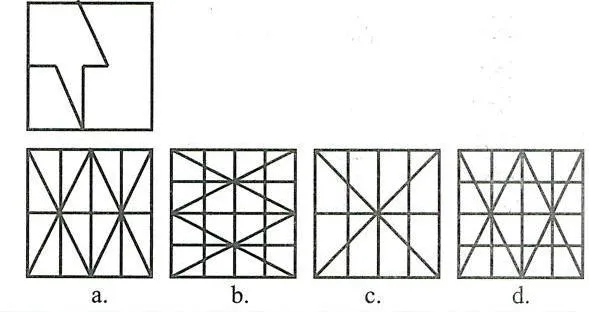
Answer Figures:
Appeared in: DSSSB - 29 August 2019 (Shift-2)
Explanation
- The core task is to find a hidden shape within a more complex image, a test of figure-ground perception.
- The question figure is an irregular, angular shape resembling a stylized 'Z'.
- This exact shape can be traced within the lines of Figure A without any rotation or resizing.
- Starting from the top-left of the shape, all its diagonal, horizontal, and vertical lines correspond directly to lines present in Figure A's grid and diagonals.
Why Other Options Were Wrong
- Option B: The diagonal lines in Figure B form a repeating 'zigzag' or 'N' pattern across the grid. This structure does not contain the specific combination of a long diagonal, a short horizontal, and other connected lines found in the question figure.
- Option C: Figure C is too simple. It consists of a 2x2 grid with two main diagonals forming an 'X'. It lacks the additional intersecting lines and smaller segments needed to construct the question figure.
- Option D: Figure D contains a complex pattern of triangles and 'X' shapes. While it has many lines, their specific arrangement and angles do not align to form the continuous outline of the question figure.
Related Visual

Clinical Relevance
- Nursing practice connection: This is primarily an exam-oriented knowledge point with limited direct bedside application, so retain Visual Reasoning: Embedded Figures as background academic context rather than a clinical decision trigger.
- While not a direct clinical skill, visual reasoning is a component of the general intelligence and aptitude sections of many nursing entrance examinations.
- These questions assess critical thinking skills, attention to detail, and the ability to identify patterns in complex information, which are valuable traits for a nurse.
- What if the question figure was rotated 90 degrees? In that case, you would need to mentally turn the shape before searching for it in the options, making the task more challenging. The correct answer might then be found in a different option.
How to Approach the Question
- First, carefully analyze the question figure. Identify its most unique features, such as sharp angles, the number of lines, and their relative orientation.
- Scan each answer option one by one, looking for these key features.
- Try to trace the entire outline of the question figure within an answer option. Don't be misled by partial matches.
- If you can't find the figure, mentally rotate it (by 90, 180, or 270 degrees) and check the options again. Also, consider if it might be a mirror image (flipped).
- Use the process of elimination. If you can definitively prove an option does not contain the figure, discard it.
- In this specific question, the figure is present in its original orientation in Figure A, making it a direct match.
Concept Tested & Keywords
- Concept Tested: Visual Reasoning: Embedded Figures
- Stem keywords: question figure, hidden, embedded, answer figures
- Lead-in keywords: select the one
Question ID
QppQ8AUIRHCHePc7hqo--V
Reference Book
E6 Psychology Morgan King 9e Part 1 p. 128-130
Practise the full DSSSB - 29 August 2019 (Shift-2)
Attempt every question from this paper in a timed mock, then review the full solution for each one.
More General Intelligence and Reasoning Questions
- 'Bull' is related to 'cow' in the same way as 'Horse' is related to?
- Identify the number of rhombus in the following figure.
- Identify the contra-positive statement of the conditional statements. If the basketball team score 60 points then the entire students section gets fr…
- Out of the given options, three are similar in a certain manner. However, one option is NOT like the other three. Select the option which is differen…
- If a paper is folded and cut according to the given diagram, how will the paper appear after unfolding it?
- Select the term from the options that has the same relation as given below.
- A and B together can do a piece of work in 10 days. A alone can do it in 30 days, the time in which B alone can do it is :
- A train is running at the speed of 100 km/hr and every 75 km train stops for 3 minutes. How much time will it take to reach 600 km?
- Free throw' is given in which of the following sports?
- A and B invest in a business in the ratio 3 : 2. If 5% of the total profit goes to charity and A's share is Rs. 855, the total profit is:
More DSSSB - 29 August 2019 (Shift-2) Questions
- A person walks 5 km towards north and then turns towards east and walks 8 km. He then turns right and walks 10 km and again turns right and walk 6 km…
- Which two signs should be interchanged to make the below equation mathematically correct? 15 + 3 - 4 x 5 ./.3 \= 18
- Out of the given options three are similar in a certain manner. However one option is NOT like the other three. Select the option which is different…
- Out of the given options, three are similar in a certain manner. However, one option is NOT like the other three. Select the option which is differen…
- Some letters are numbered as 1, 2, 3, 4, 5 and 6. In the options, four possible arrangements of these numbers are given. Choose the option so that th…
- Read the given statement and conclusions carefully. Assuming that the information in the statement is true, even if they appear to be in variance wit…
- Which of the following Venn diagrams best represents the relationship between horses, herbivores and domestic animals?
- Five friends were comparing their marks. Ranjan's marks was greater than Manish's mark but less than Geeta's. Ashish's marks was greater than Sonali'…
- Which answer figure will complete the pattern in the question figure?
- Find the missing number in the following number series? 5.69, 4.56, 3.43, \ \ \ \ , 1.17