
ESIC Nursing Officer -2019 (Shift -1)
Non Nursing Subjects
Hard
Select the term from the options that has the same relation as given below.
Appeared in: ESIC Nursing Officer -2019 (Shift -1)
Explanation
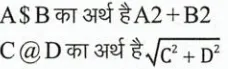
- The question requires applying the rules defined in the image to the given options.
- The rule for the '@' symbol is C @ D = √(C² + D²), which is derived from the Pythagorean theorem.
- Applying this rule to the correct option: 3 @ 4 = √(3² + 4²) = √(9 + 16) = √25 = 5.
- The result of the calculation (5) matches the value given in the option, making it the correct statement.
Why Other Options Were Wrong
- Option A: According to the rule A $ B = A² + B², the calculation is 7$24 = 7² + 24² = 49 + 576 = 625. The option incorrectly states the result is 25.
- Option B: Using the rule C @ D = √(C² + D²), the calculation is 4@5 = √(4² + 5²) = √(16 + 25) = √41. The option incorrectly states the result is 9.
- Option C: Following the rule A $ B = A² + B², the calculation is 5$12 = 5² + 12² = 25 + 144 = 169. The option incorrectly states the result is 13.
Related Visual

- Visual 1: Diagram. A right-angled triangle with its two shorter sides labeled '3' and '4', and the longest side (hypotenuse) labeled '5'. This visually represents the Pythagorean triplet (3, 4, 5) and explains the logic behind the '@' operation in the correct answer.
Clinical Relevance
- Nursing practice connection: This is primarily an exam-oriented knowledge point with limited direct bedside application, so retain Logical Reasoning: Applying given symbolic operations to find the correct equation as background academic context rather than a clinical decision trigger.
- This question tests logical and mathematical reasoning, skills that are essential for nurses in various aspects of their job, such as calculating drug dosages, interpreting lab results, and making critical decisions under pressure.
- While not a direct clinical question, the ability to follow a set of rules and perform accurate calculations is a fundamental competency in nursing.
- What if the rule for '@' was C @ D = C + D? Then option B (4@5 = 9) would have been correct, as 4 + 5 = 9.
How to Approach the Question
- Step 1: Carefully analyze the image to understand the rules assigned to each symbol. Write them down clearly: A $ B = A² + B² and C @ D = √(C² + D²).
- Step 2: Treat each option as a separate problem to be verified.
- Step 3: For each option, identify the numbers and the symbol ($ or @) used.
- Step 4: Apply the corresponding rule from Step 1 and perform the mathematical calculation.
- Step 5: Compare your calculated result with the result given in the option.
- Step 6: The option where the calculated result matches the given result is the correct answer.
Concept Tested & Keywords
- Concept Tested: Logical Reasoning: Applying given symbolic operations to find the correct equation.
- Stem keywords: symbolic operations, mathematical reasoning, logical deduction
- Lead-in keywords: Select the term, same relation
- Negative lead-in flag: false
Question ID
QHF5dVZWI618WgcgjkfCh9
Practise the full ESIC Nursing Officer -2019 (Shift -1)
Attempt every question from this paper in a timed mock, then review the full solution for each one.
More General Intelligence and Reasoning Questions
- 'Bull' is related to 'cow' in the same way as 'Horse' is related to?
- Identify the number of rhombus in the following figure.
- Identify the contra-positive statement of the conditional statements. If the basketball team score 60 points then the entire students section gets fr…
- From the given answer figures, select the one in which the question figure is hidden/embedded? Question Figure: Answer Figures:
- Out of the given options, three are similar in a certain manner. However, one option is NOT like the other three. Select the option which is differen…
- If a paper is folded and cut according to the given diagram, how will the paper appear after unfolding it?
- A and B together can do a piece of work in 10 days. A alone can do it in 30 days, the time in which B alone can do it is :
- A train is running at the speed of 100 km/hr and every 75 km train stops for 3 minutes. How much time will it take to reach 600 km?
- Free throw' is given in which of the following sports?
- A and B invest in a business in the ratio 3 : 2. If 5% of the total profit goes to charity and A's share is Rs. 855, the total profit is:
More ESIC Nursing Officer -2019 (Shift -1) Questions
- Schultze method and Matthew Duncan method describe:
- Bleeding in the first trimester with no uterine contraction or pain and no dilation of cervix indicates:
- Which of the below is an example of unintentional tort?
- The mode of inheritance of cystic fibrosis is:
- Repeated involuntary or intentional passage of feces by a child in inappropriate places, after the age when bowel control is normally expected, is ca…
- Intermittent claudication is a sign of:
- The type of assessment done to compare the client's current status to previously obtained baseline data is called:
- The full form of DALY in the context of community health is:
- The "Adam's Apple" is formed by:
- What is the document called that authorizes nurses to take specific actions under certain conditions when a doctor is not immediately available?