
DSSSB - 29 August 2019 (Shift-2)
Reasoning
Hard
Which answer figure will complete the pattern in the question figure?
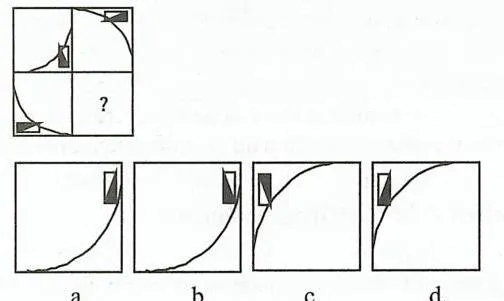
Appeared in: DSSSB - 29 August 2019 (Shift-2)
Explanation
- The overall pattern is composed of a large circle, requiring the missing piece to have an arc in its top-left corner.
- The relationship between diagonally opposite squares is a 180-degree rotation. Applying this to the top-left square (vertical rectangle, triangle down) means the missing square must have a vertical rectangle with the triangle pointing up. This narrows the choices to B and C.
- The final clue is the horizontal position of the rectangle, which follows a simple alternating pattern: Left, Right, Left, and therefore the final position must be Right.
- Option B is the only choice that features a triangle pointing up and a rectangle positioned on the right side of the square.
Why Other Options Were Wrong
- Option A: The triangle in Figure A points down. Based on the 180-degree rotation rule derived from the other diagonal, the triangle must point up.
- Option C: While the triangle in Figure C correctly points up, the rectangle is positioned on the left side of the square. This breaks the simple and consistent alternating horizontal pattern (Left-Right-Left-Right).
- Option D: The triangle in Figure D points down. The rotational symmetry pattern requires the triangle to point up.
Related Visual

Clinical Relevance
- Nursing practice connection: This is primarily an exam-oriented knowledge point with limited direct bedside application, so retain Visual Reasoning and Pattern Recognition as background academic context rather than a clinical decision trigger.
- Pattern recognition is a foundational cognitive skill tested in general intelligence sections of nursing entrance exams.
- This skill translates to clinical practice in recognizing patterns in patient symptoms, vital sign trends, and ECG readouts, which is crucial for timely diagnosis and intervention.
- What if? If the rectangle in the bottom-left square were on the right side, the positional pattern would be L-R-R. This would break the simple alternating pattern, suggesting a different rule (perhaps based on columns), which might still lead to B as the answer for the right-hand column.
How to Approach the Question
- First, identify the individual components of the pattern. In this case, it's an arc, a rectangle, and a triangle.
- Analyze the pattern for each component separately. Look for rotation, reflection, progression, or alternation.
- For the arc, notice it's completing a circle. This determines the arc's position in the missing square.
- For the rectangle and triangle, test for relationships between adjacent and diagonal squares. Here, a 180-degree diagonal rotation is the key rule for orientation and triangle direction.
- Use the established rules to eliminate incorrect options. The rotation rule narrows the choice to B and C.
- When left with multiple options, look for a secondary, simpler pattern to make the final decision. The alternating horizontal position (Left-Right-Left-Right) is the deciding factor between B and C.
Concept Tested & Keywords
- Concept Tested: Visual Reasoning and Pattern Recognition
- Stem keywords: pattern, complete, figure, grid
- Lead-in keywords: Which answer figure
Question ID
QspiEz8zNeqnc2RZGjXflZ
Practise the full DSSSB - 29 August 2019 (Shift-2)
Attempt every question from this paper in a timed mock, then review the full solution for each one.
More Non-Verbal Reasoning Questions
- If a mirror is placed on the line MN, then which of the answer figure will be the right mirror image of the given figure?
- From the following options, three figures are similar in a certain pattern and one is different from the rest. Choose the figure that is different fr…
- If a mirror is placed on the line MN, then which of the answer figures will be the right mirror image of the given figure?
- Which of the following answer figures completes the series of the question figure?
- Which answer figure will complete the pattern in the question figure?
- Study the following figures carefully and identify the similar figure from the options that has a relation of similarity with the given set of figure…
- A transparent sheet has a pattern on it as shown in the figure above. When the transparent sheet is folded along the dotted line, how will the patter…
- Select a figure from amongst the Answer Figures which will continue the same series as established by the five Problem Figures.
- If a mirror is placed on the line MN, then which of the answer figures will be the right mirror image of the given figure?
- If a mirror is placed on the line MN, then which of the answer figures will be the right mirror image of the given figure?
More DSSSB - 29 August 2019 (Shift-2) Questions
- A person walks 5 km towards north and then turns towards east and walks 8 km. He then turns right and walks 10 km and again turns right and walk 6 km…
- Which two signs should be interchanged to make the below equation mathematically correct? 15 + 3 - 4 x 5 ./.3 \= 18
- Out of the given options three are similar in a certain manner. However one option is NOT like the other three. Select the option which is different…
- Out of the given options, three are similar in a certain manner. However, one option is NOT like the other three. Select the option which is differen…
- Some letters are numbered as 1, 2, 3, 4, 5 and 6. In the options, four possible arrangements of these numbers are given. Choose the option so that th…
- Read the given statement and conclusions carefully. Assuming that the information in the statement is true, even if they appear to be in variance wit…
- From the given answer figures, select the one in which the question figure is hidden/embedded? Question Figure: Answer Figures:
- Which of the following Venn diagrams best represents the relationship between horses, herbivores and domestic animals?
- Five friends were comparing their marks. Ranjan's marks was greater than Manish's mark but less than Geeta's. Ashish's marks was greater than Sonali'…
- Find the missing number in the following number series? 5.69, 4.56, 3.43, \ \ \ \ , 1.17