
ESIC Nursing Officer -2019 (Shift -1)
Reasoning
Medium
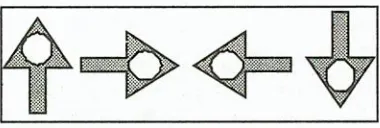 Study the following figures carefully and identify the similar figure from the options that has a relation of similarity with the given set of figures.
Appeared in: ESIC Nursing Officer -2019 (Shift -1)
Explanation
- The problem requires identifying a figure that is similar to a given set of four figures.
- Upon observation, the common feature in all four figures of the problem set is the presence of an octagonal cutout inside the arrowhead.
- The direction of the arrow is a variable feature and not the basis for similarity in this context.
- The figure in the correct option is the only one among the choices that also contains an octagonal cutout, matching the common feature of the problem set.
Why Other Options Were Wrong
- Option A: This option is incorrect because the cutout shape is a circle, not an octagon, which is the common feature in the problem set.
- Option C: This option is incorrect because the cutout shape is a hexagon (6 sides), not an octagon (8 sides).
- Option D: This option is incorrect because the cutout shape is a square, not an octagon.
Related Visual

- Visual 1: Infographic: A visual breakdown highlighting the octagonal cutout in the problem figures and comparing it with the cutout shapes in all four options (circle, octagon, hexagon, square) to clearly show why the chosen answer is correct.
Clinical Relevance
- Nursing practice connection: This is primarily an exam-oriented knowledge point with limited direct bedside application, so retain Visual Reasoning: Identifying Similarities in Figures as background academic context rather than a clinical decision trigger.
- While not a clinical question, this type of logical reasoning assesses pattern recognition skills.
- In nursing, strong pattern recognition is crucial for interpreting patient data, such as reading ECG strips, identifying trends in vital signs, or recognizing subtle changes in a patient's condition.
- What if the rule was based on rotation? If the sequence was a consistent 90-degree clockwise rotation, the next figure after 'down' would be 'left'. However, the question asks for similarity to the set, not the next in the sequence, making the common feature (octagon) the correct basis for the answer.
How to Approach the Question
- First, carefully examine all the figures in the problem set provided in the question.
- Identify the properties of the figures, such as shape, size, color/shading, orientation, and any internal components.
- Determine the single, consistent feature or rule that is common to ALL figures in the problem set. In this case, it is the octagonal cutout.
- Ignore features that change between figures, such as the direction the arrow is pointing, as these are variables, not the common rule.
- Systematically evaluate each answer option against the identified common feature.
- Select the option that perfectly matches the common feature you identified from the problem set.
Concept Tested & Keywords
- Concept Tested: Visual Reasoning: Identifying Similarities in Figures
- Stem keywords: similar figure, relation of similarity, identify
- Lead-in keywords: identify
- Negative lead-in flag: false
Question ID
QVE9_-2aH-qM61zJ4PmQCf
Practise the full ESIC Nursing Officer -2019 (Shift -1)
Attempt every question from this paper in a timed mock, then review the full solution for each one.
More Non-Verbal Reasoning Questions
- If a mirror is placed on the line MN, then which of the answer figure will be the right mirror image of the given figure?
- From the following options, three figures are similar in a certain pattern and one is different from the rest. Choose the figure that is different fr…
- If a mirror is placed on the line MN, then which of the answer figures will be the right mirror image of the given figure?
- Which of the following answer figures completes the series of the question figure?
- Which answer figure will complete the pattern in the question figure?
- Which answer figure will complete the pattern in the question figure?
- A transparent sheet has a pattern on it as shown in the figure above. When the transparent sheet is folded along the dotted line, how will the patter…
- Select a figure from amongst the Answer Figures which will continue the same series as established by the five Problem Figures.
- If a mirror is placed on the line MN, then which of the answer figures will be the right mirror image of the given figure?
- If a mirror is placed on the line MN, then which of the answer figures will be the right mirror image of the given figure?
More ESIC Nursing Officer -2019 (Shift -1) Questions
- Schultze method and Matthew Duncan method describe:
- Bleeding in the first trimester with no uterine contraction or pain and no dilation of cervix indicates:
- Which of the below is an example of unintentional tort?
- The mode of inheritance of cystic fibrosis is:
- Repeated involuntary or intentional passage of feces by a child in inappropriate places, after the age when bowel control is normally expected, is ca…
- Intermittent claudication is a sign of:
- The type of assessment done to compare the client's current status to previously obtained baseline data is called:
- The full form of DALY in the context of community health is:
- The "Adam's Apple" is formed by:
- What is the document called that authorizes nurses to take specific actions under certain conditions when a doctor is not immediately available?