
DSSSB - 28 August 2019 (Shift-1)
Reasoning
Hard
Which answer figure will complete the pattern in the question figure?
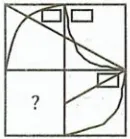
Appeared in: DSSSB - 28 August 2019 (Shift-1)
Explanation
- The correct figure is the only one that simultaneously completes all the overlapping geometric patterns established by the other three quadrants.
- It must contain a diagonal line running from the bottom-left to the top-right to complete the central 'X' shape.
- It requires a curved line in its top-right corner to complete the small, continuous loop around the center of the main square.
- The small rectangle must be positioned near the top edge of the quadrant to maintain horizontal symmetry with the figure in the bottom-right quadrant.
- Finally, it includes the outer arc needed to complete the large circle running along the perimeter of the grid.
Why Other Options Were Wrong
- Option A: This option features an incorrectly oriented diagonal line (running from top-left to bottom-right). Additionally, the central curve is misplaced in the bottom-right corner.
- Option B: Although the diagonal line is correctly oriented, the central curve is in the wrong position (bottom-left corner instead of the required top-right corner).
- Option D: This option's primary error is the incorrectly oriented diagonal line (running from top-left to bottom-right), which fails to complete the central 'X' pattern.
Related Visual

Clinical Relevance
- Nursing practice connection: This is primarily an exam-oriented knowledge point with limited direct bedside application, so retain Pattern Completion in Visual Reasoning as background academic context rather than a clinical decision trigger.
- This is a visual reasoning question, a component of general intelligence tests, and is not a clinical nursing topic.
- The underlying skill of pattern recognition is foundational for many nursing tasks, such as identifying trends in a patient's vital signs, recognizing arrhythmias on an ECG strip, or noticing subtle changes in a patient's condition.
- What if? - If the pattern was based on 90-degree rotation instead of reflection, we would look for the top-left quadrant's design to be rotated and placed in the bottom-left, which would lead to a different answer.
How to Approach the Question
- First, carefully observe the main figure and identify the distinct visual components within the given quadrants. Here, we see diagonal lines, inner curves, outer arcs, and small rectangles.
- Analyze each component separately to deduce its underlying pattern or rule. For example, notice that the diagonal lines appear to be forming a large 'X' across the entire square.
- Based on these rules, create a mental checklist of the features required for the missing piece. It must have a specific diagonal, a curve in a specific corner, etc.
- Systematically evaluate each answer option against your checklist of required features.
- Eliminate the options that fail to meet one or more of the pattern's requirements.
- Select the only option that satisfies all the rules to correctly and completely fill the missing space.
Concept Tested & Keywords
- Concept Tested: Pattern Completion in Visual Reasoning
- Stem keywords: pattern completion, question figure, answer figure, visual reasoning
- Lead-in keywords: complete the pattern
Question ID
QlXc00bNQobPjHoYmb3OCc
Practise the full DSSSB - 28 August 2019 (Shift-1)
Attempt every question from this paper in a timed mock, then review the full solution for each one.
More Non-Verbal Reasoning Questions
- If a mirror is placed on the line MN, then which of the answer figure will be the right mirror image of the given figure?
- From the following options, three figures are similar in a certain pattern and one is different from the rest. Choose the figure that is different fr…
- If a mirror is placed on the line MN, then which of the answer figures will be the right mirror image of the given figure?
- Which of the following answer figures completes the series of the question figure?
- Which answer figure will complete the pattern in the question figure?
- Study the following figures carefully and identify the similar figure from the options that has a relation of similarity with the given set of figure…
- A transparent sheet has a pattern on it as shown in the figure above. When the transparent sheet is folded along the dotted line, how will the patter…
- Select a figure from amongst the Answer Figures which will continue the same series as established by the five Problem Figures.
- If a mirror is placed on the line MN, then which of the answer figures will be the right mirror image of the given figure?
- If a mirror is placed on the line MN, then which of the answer figures will be the right mirror image of the given figure?
More DSSSB - 28 August 2019 (Shift-1) Questions
- Out of the given options, three are similar in a certain manner. However, one option is NOT like the other three. Select the option which is differen…
- If highway is sky, sky is river, river is cloud and cloud is land, then where do birds fly?
- Some letters are numbered as 1,2,3,4,5 and 6. In the options, four possible arrangements of these numbers are given. Choose the option so that the le…
- Out of the given options, three are similar in a certain manner. However, one option is NOT like the other three. Select the option which is differen…
- With which of the following states is the Kathak dance associated?
- Yaoshang, which is celebrated during the spring in the month of Phalguna, is associated with which of the following states?
- What is meant by Bank Rate?
- In which ocean is the 'Ninety East Ridge' located?
- What is the relation between Power (P), Voltage (V), and Resistance (R)?
- Jugni folk music is related to which of the following states?