
MNS 2015
Applied Microbiology & Infection control
Easy
The method used for disinfection of milk is?
Appeared in: MNS 2015
Explanation
- Pasteurization is defined as heating milk to a specific temperature for a set duration to destroy pathogens while causing minimal changes to its composition, flavor, and nutritive value.
- It is a standard public health measure that effectively kills nearly all pathogenic bacteria, including the heat-resistant organisms responsible for Tuberculosis and Q fever.
- The process is specifically designed for milk and other beverages to ensure safety without significantly degrading quality, unlike boiling.
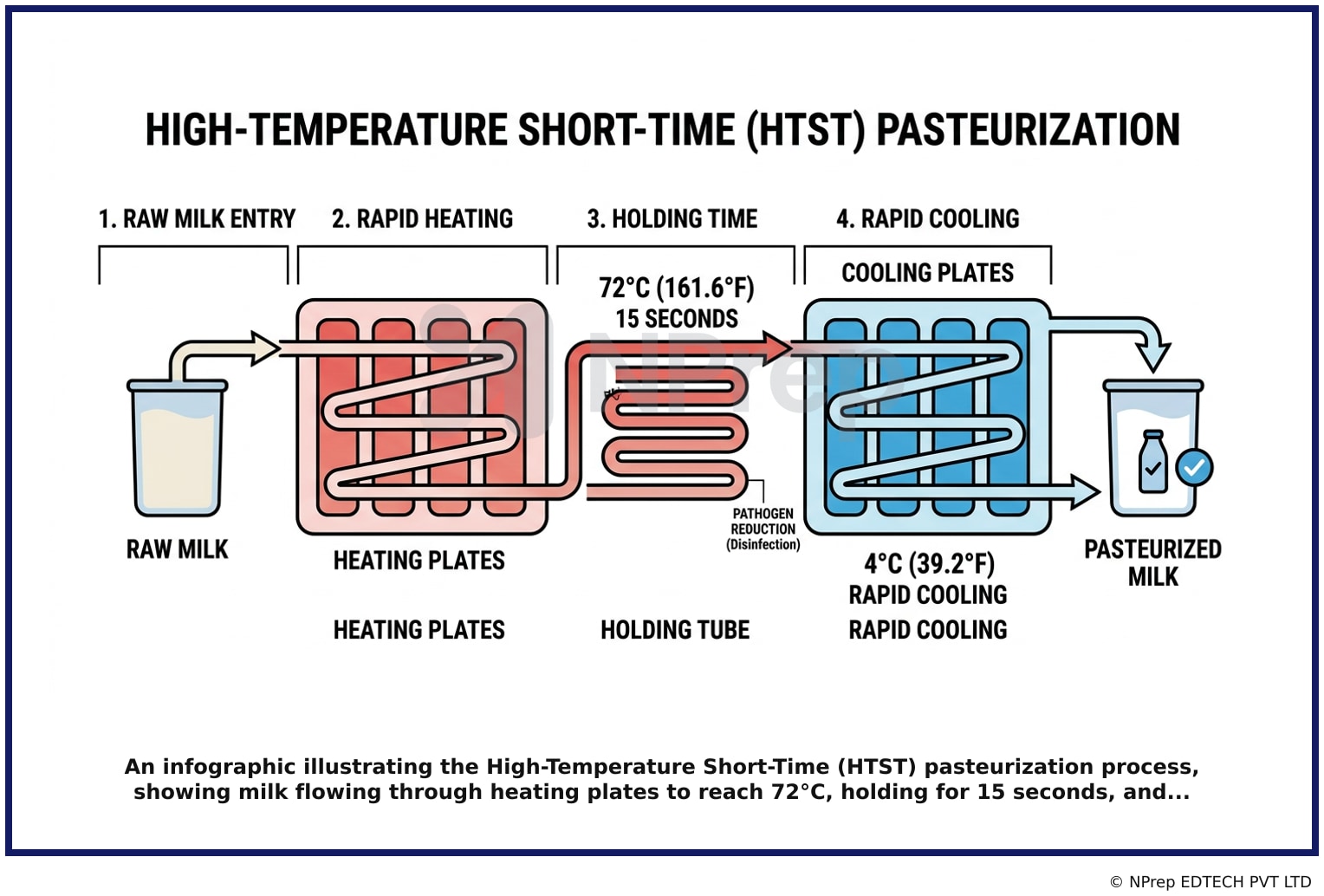
- Common methods include the Holder (vat) method, High-Temperature Short-Time (HTST), and Ultra-High Temperature (UHT), each balancing temperature and time to achieve disinfection.
Why Other Options Were Wrong
- Option B: Boiling is a form of sterilization, which is more intense than disinfection. It alters the nutritional value (destroys vitamins) and taste of milk, making it a less desirable method for routine safety treatment.
- Option C: Cooling is a method of preservation, not disinfection. It only slows down or inhibits the growth of microorganisms (bacteriostatic effect) but does not kill them.
- Option D: Freezing, like cooling, is a preservation method. It makes water unavailable for microbial growth, putting bacteria into a dormant state, but it does not effectively kill them. Pathogens can survive freezing.
Related Visual
Clinical Relevance
- Nursing practice connection: This is primarily an exam-oriented knowledge point with limited direct bedside application, so retain Milk hygiene and methods of disinfection as background academic context rather than a clinical decision trigger.
- Understanding the principles of pasteurization is fundamental for community health nurses when educating the public on food safety to prevent milk-borne diseases like brucellosis, tuberculosis, and salmonellosis.
- Nurses must be able to explain the difference between pasteurization (disinfection) and refrigeration (preservation) to ensure families handle and store milk correctly.
- What if? If a family in a rural area only has access to raw milk from their own cow, the nurse's priority advice would be to boil the milk before consumption. While pasteurization is the ideal, boiling is the most accessible and effective way to eliminate pathogens in a home setting, prioritizing safety over nutritional preservation.
How to Approach the Question
- First, identify the key terms in the question: 'method', 'disinfection', and 'milk'. The question asks for a specific process used to make milk safe.
- Next, evaluate each option based on its primary function in food science.
- Recall or deduce the definition of 'disinfection', which means to eliminate or destroy harmful microorganisms.
- Consider 'Pasteurization'. This is a term specifically associated with treating milk and other beverages with heat to kill pathogens.
- Analyze the other options. 'Boiling' is a more extreme heat treatment. 'Cooling' and 'Freezing' are primarily for preservation by slowing microbial growth, not killing microbes.
- Conclude that Pasteurization is the method specifically designed for the disinfection of milk, balancing safety and quality.
Concept Tested & Keywords
- Concept Tested: Milk hygiene and methods of disinfection
- Stem keywords: method, disinfection, milk
- Lead-in keywords: is
Question ID
QbUeyFOWIl_w6kTqNYGBi
Reference Book
E6 Parks TextBook of Preventive & Social Medicine part 2 — Subpart A (pp 1-232 of 464) p. 191-193
E6 Comprehensive Textbook of Community Health NursingShyamala D part 1 (pp 26-389 of 389) p. 223-225
Practise the full MNS 2015
Attempt every question from this paper in a timed mock, then review the full solution for each one.
More Disinfection and Sterilization Questions
- The best and safest method of sterilization is:
- This is a solution used in hospitals. After how many days will you change this solution?
- Which solution is used for management of blood spillage?
- The ratio of mixing bleaching powder and water for acting as a disinfectant is:
- Covid face shield is sterilized by?
- Best method described for the asepsis of any surgical instrument?
- One of the principles of a sterile area?
- Which one of the following methods is commonly used for sterilization of this device?
- Inoculating loops are sterilized by?
- What is the optimum temperature in an autoclave to achieve sterility?
More MNS 2015 Questions
- Which gas is produced by plants at night?
- Census in India is taken once in every ... years.
- Which mineral is abundantly contained in bones?
- What is the substrate of salivary amylase?
- World Red Cross day is celebrated on?
- The photosynthesis reaction of plants occurs in the presence of?
- Which is the chief constituent of biogas?
- Mention the specific site of damage in the body caused by poliovirus?
- Hormones are transported to all parts of human body through?
- Which vegetable has the lowest caloric value?