
AIIMS Delhi NO- 2019
Applied Microbiology & Infection control
Easy
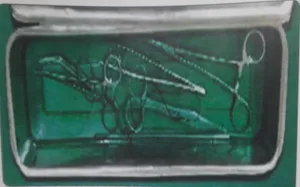
This is a solution used in hospitals. After how many days will you change this solution?
Appeared in: AIIMS Delhi NO- 2019
Explanation
- The image shows chemical sterilization using activated glutaraldehyde, a high-level disinfectant for heat-sensitive instruments.
- Once activated by adding a buffer, the solution's chemical stability is limited, and its effectiveness declines over time.
- The standard recommended reuse period for most activated 2% glutaraldehyde solutions is 14 days.
- After 14 days, polymerization significantly reduces the solution's microbicidal activity, making it unreliable for ensuring sterility or high-level disinfection.
Why Other Options Were Wrong
- Option A: This is an unnecessarily short period for standard activated glutaraldehyde, leading to increased costs and waste without a corresponding benefit in efficacy.
- Option B: While correct for some specific products, it is not the most common or traditional standard for activated 2% glutaraldehyde, which is what is generally tested in nursing exams.
- Option D: This is not a standard manufacturer-recommended or guideline-supported reuse interval for any common formulation of glutaraldehyde.
Related Visual

Clinical Relevance
- Nursing practice connection: This is primarily an exam-oriented knowledge point with limited direct bedside application, so retain Chemical Sterilization and Disinfection as background academic context rather than a clinical decision trigger.
- Adhering to the 14-day replacement schedule is critical for infection control and patient safety. Using an expired solution can lead to the transmission of pathogens via improperly disinfected instruments, causing healthcare-associated infections (HAIs).
- Nurses must be aware of the occupational hazards of glutaraldehyde, including respiratory and skin irritation. Proper use of Personal Protective Equipment (PPE) and working in a well-ventilated area are mandatory.
- What if? If a chemical test strip indicates the glutaraldehyde concentration has fallen below the minimum effective concentration (MEC) on day 10, the nurse must discard the solution immediately, regardless of the 14-day expiry date.
How to Approach the Question
- First, analyze the image to identify the clinical procedure. The image shows instruments soaking in a chemical bath, which indicates chemical disinfection or sterilization.
- Identify the likely chemical agent. The green color is a classic indicator of activated glutaraldehyde (a common brand is Cidex).
- Recall the standard infection control protocols associated with this agent. The question specifically asks for the replacement interval or reuse life.
- Access your knowledge about the shelf life of common chemical sterilants. The standard for activated 2% glutaraldehyde is 14 days.
- Compare this standard with the given options and select the one that matches. In this case, 14 days is a direct match.
Concept Tested & Keywords
- Concept Tested: Chemical Sterilization and Disinfection
- Stem keywords: solution, hospitals, change solution
- Lead-in keywords: After how many days
- Clinical cues: Image of instruments in green sterilant solution
Question ID
QCSZHCkMBIbyT0rouH6UjA
Reference Book
E6 Pharmacology Katzung 16e p. 1397-1399
Practise the full AIIMS Delhi NO- 2019
Attempt every question from this paper in a timed mock, then review the full solution for each one.
More Disinfection and Sterilization Questions
- The best and safest method of sterilization is:
- Which solution is used for management of blood spillage?
- The ratio of mixing bleaching powder and water for acting as a disinfectant is:
- Covid face shield is sterilized by?
- Best method described for the asepsis of any surgical instrument?
- One of the principles of a sterile area?
- Which one of the following methods is commonly used for sterilization of this device?
- Inoculating loops are sterilized by?
- What is the optimum temperature in an autoclave to achieve sterility?
- The process by which a medium is placed at 100°C following steam for 20 minutes each on 3 successive days is?
More AIIMS Delhi NO- 2019 Questions
- A nurse is preparing to give bath to admitted patient with perineal problem. Which of the following will help the patient?
- In the absence of nurse from floor, patient falls from bed. This type of injury belongs to:
- Patient's Medical record with all essential information is responsibility of:
- Post-partum women having bleeding within 24 hrs after delivery is called:
- In which condition, distal pulse is preferred rather than apical pulse?
- A pre-eclampsia woman's baby is lying with her mother. Neonate is born in 37 weeks. After 57 hours, when nurse is monitoring vital signs of baby, tem…
- A woman with 3rd day postpartum has complaint of engorgement in both breasts. What is cut off temperature for fever in postpartum women?
- Universal blood donor?
- WHO hand wash time with soap?
- Why it is necessary to remove dark coloured nail paint before surgery?