
Combined AIIMS - 2020 (Jodhpur, Bhopal, Patna, Raipur)
Medical & Surgical Nursing
Easy
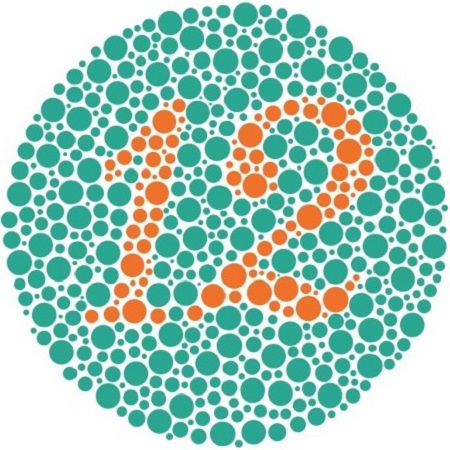
In Below given image test is used for-

Appeared in: Combined AIIMS - 2020 (Jodhpur, Bhopal, Patna, Raipur)
Explanation
- The image displays an Ishihara plate, which is the most common screening tool for color vision deficiencies.
- This test uses pseudoisochromatic plates, where numbers (like the '12' in the image) are hidden in a pattern of colored dots.
- Individuals with normal color vision can distinguish the number from the background, while those with red-green color blindness may see a different number or no number at all.
- The photoreceptor cells responsible for color vision are the cones, which are concentrated in the macula.
Why Other Options Were Wrong
- Option A: Peripheral vision refers to the ability to see objects at the edges of your field of view.
- Option B: Near vision is the ability to see objects clearly at a close distance, typically for reading.
- Option C: Far vision (distance vision) is the ability to see objects clearly from a distance.
Related Visual

Clinical Relevance
- Nursing practice connection: This is primarily an exam-oriented knowledge point with limited direct bedside application, so retain Identification of the purpose of the Ishihara test for vision assessment as background academic context rather than a clinical decision trigger.
- Screening for color blindness is crucial for certain professions where color differentiation is a safety requirement, such as for pilots, electricians, and train drivers.
- Nurses should be aware that some medications (like digitalis) or pathologies (like cataracts or optic nerve conditions) can cause acquired color vision loss.
- Patient safety can be compromised if a patient with color blindness cannot distinguish between color-coded medications, warning labels, or IV lines.
How to Approach the Question
- First, carefully analyze the image provided. Identify the specific test being shown. The image displays a circle with multi-colored dots forming a number.
- Recognize this as a classic Ishihara plate, a type of pseudoisochromatic test.
- Recall the primary purpose of the Ishihara test from your studies on sensory and ophthalmologic assessment.
- Evaluate the given options. The Ishihara test is designed specifically to assess the ability to perceive different colors.
- Eliminate the other options: Peripheral vision is tested by perimetry, near vision by a Jaeger chart, and far vision by a Snellen chart.
- Select the option that correctly matches the test's function, which is screening for color blindness.
Concept Tested & Keywords
- Concept Tested: Identification of the purpose of the Ishihara test for vision assessment.
- Stem keywords: image test, vision
- Lead-in keywords: used for
- Clinical cues: The image displays a pseudoisochromatic plate, which is the defining feature of an Ishihara test.
Question ID
QXFLl_To8-v1DT0MnYp3FT
Reference Book
E6 Nursing Brunner Adult Health 3SA Vol 2 Part 1 p. 87-89
E6 Medicine Harrison 22e Part 1 p. 263-265
Practise the full Combined AIIMS - 2020 (Jodhpur, Bhopal, Patna, Raipur)
Attempt every question from this paper in a timed mock, then review the full solution for each one.
More Sensorineural Function Questions
- Which ophthalmic diagnostic test measures the Intraocular pressure?
- Identify the following instrument in image:
- What sound is heard when percussing a distended bladder?
- Which test would be done to check balance in a patient with ataxia?
- Identify the condition:
- In the emergency you have 4 patients. By prioritizing your management plan, which patient's problem will you address first?:
- All of the following instructions are given to a patient before computed tomography (CT) scan, except?
- The nursing care of a patient with dengue fever includes all of the following, except?
- Which of the following equipment is used for the examination of the ear?
- An aged client with diabetes mellitus complaining of painless peripheral loss of vision is at risk for?
More Combined AIIMS - 2020 (Jodhpur, Bhopal, Patna, Raipur) Questions
- The position used for most of the gynecological procedures?
- Thyroid eye disease (TED) is also known as:
- How many items are included in the WHO surgical safety checklist: SITOSO?
- In iron deficiency anemia, the fingernails become spoon shaped, this condition is referred to as:
- Which of the following code is associated with cardiac arrest during medical emergency?
- How is blood loss measured in Post-partum hemorrhage?
- The traction used for cervical spine injury:
- In operation theater during cauterization, the electric current passing from a single electrode is called:
- Tracheostomy is done in which tracheal ring?
- The instrument used for measuring fetal heart rate (FHR):