
NORCET 2 -2021 (Shift-2)
Obstetrics & Gynaecology
Easy
Identify the following instrument?
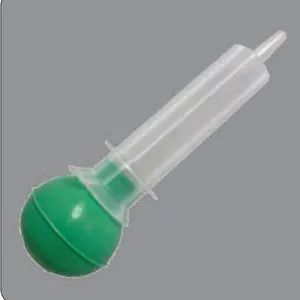
Appeared in: NORCET 2 -2021 (Shift-2)
Explanation
- The instrument in the image is an Asepto syringe.
- It is identified by its distinct structure, which consists of a large, compressible rubber bulb attached to a clear, graduated barrel with a nozzle.
- This design is specifically for irrigation and gentle aspiration of fluids from wounds or body cavities.
- The clear barrel allows the nurse to see the fluid, and the bulb provides the force for either flushing or suctioning.
Why Other Options Were Wrong
- Option A: While an Asepto syringe can be used for suction, 'Suction syringe' is a very general term. The instrument shown has a specific name and design (Asepto) primarily for irrigation.
- Option C: A mucus extractor (like a DeLee mucus trap) is a specialized device for clearing a newborn's airway. It has a different structure, typically involving a catheter, a collection chamber, and a mouthpiece for the caregiver to apply suction.
- Option D: A breast pump is used to extract milk. It has a completely different design, featuring a flange that fits over the breast, a pumping mechanism (manual or electric), and a collection bottle.
Related Visual

Clinical Relevance
- Nursing practice connection: This is primarily an exam-oriented knowledge point with limited direct bedside application, so retain Instrument Identification as background academic context rather than a clinical decision trigger.
- Using the correct instrument is crucial for patient safety. An Asepto syringe provides gentle pressure suitable for irrigating delicate tissues without causing damage.
- It is commonly found in wound care kits, catheterization trays, and operating rooms.
- Aseptic technique must be maintained when using this syringe for irrigating sterile areas like the bladder to prevent introducing infection.
How to Approach the Question
- First, carefully examine the image provided, noting the key components of the instrument: a large green bulb, a clear plastic body, and a narrow tip.
- Mentally recall the names and appearances of common medical syringes and suction devices.
- The combination of a large bulb for manual pressure and a barrel for holding fluid is characteristic of an irrigation or Asepto syringe.
- Compare this identification with the given options. 'Asepto syringe' is a direct match.
- Eliminate the other options by considering their functions and typical appearances. A mucus extractor is for newborns and looks different. A breast pump has a flange and collection bottle. 'Suction syringe' is too general.
Concept Tested & Keywords
- Concept Tested: Instrument Identification
- Stem keywords: instrument, identify
- Lead-in keywords: Identify
Question ID
QZTU-J950yavHSQi0SNeqH
Reference Book
Dutta p. 411-422
Practise the full NORCET 2 -2021 (Shift-2)
Attempt every question from this paper in a timed mock, then review the full solution for each one.
More Practical Obstetrics Questions
- Identify the following instrument:
- Identify the blade used:
- Identify the instrument used by a nurse in the following image:
- Match the following
- Identify, which of the following retractor is used in abdominal surgery?
- The instrument used for measuring fetal heart rate (FHR):
- What is the name of this retractor?
- Identify the image showing in the picture?& x20;
- Green Armytage forceps is used to arrest bleeding in?
- Identify the following instrument?
More NORCET 2 -2021 (Shift-2) Questions
- Preferred route of tranexamic acid drug administration is?
- Parts of the fallopian tube, except?
- After thyroidectomy the patient complains for hoarseness of voice that occurs due to injury in?
- Highest source of vitamin-C?
- After the RTA, a patient was brought to the emergency department. After Massive blood transfusion, which electrolyte imbalance occurs in the patient?
- A patient suffering from shock is receiving normal saline (NS). What is the normal osmolarity of Na\ in NS?
- A patient is unconscious nurse is going to take the sterile urine sample for culture from the urinary catheter. What technique is to be used by the n…
- Covid face shield is sterilized by?
- Which reflex should check when death of the brain stem occurs, except?
- Which is an example of a tocolytic agent?