
Combined AIIMS - 2020 (Jodhpur, Bhopal, Patna, Raipur)
Obstetrics & Gynaecology
Easy
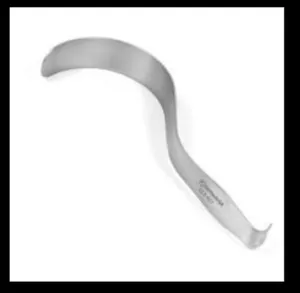
What is the name of this retractor?
Appeared in: Combined AIIMS - 2020 (Jodhpur, Bhopal, Patna, Raipur)
Explanation
- The instrument in the image is a Deaver's retractor.
- It is identified by its large size and distinctive gentle, arching 'S' shape, which is designed for deep tissue retraction.
- This retractor is handheld and commonly used in major abdominal and thoracic procedures to hold back the abdominal wall or large organs like the liver and bladder.
- Its shape allows it to conform easily to the curve of the anterior abdominal wall and retract organs without causing significant trauma.
Why Other Options Were Wrong
- Option B: A Langenbeck retractor has an L-shaped blade and is much smaller. It is used for retracting the edges of a wound in more superficial surgeries, not for deep abdominal retraction.
- Option C: A Czerny retractor is typically a double-ended instrument, often with sharp or blunt prongs on one end. The instrument in the image is single-ended and has a smooth, curved blade.
- Option D: The Thomson retractor is not a single handheld instrument but a complex, self-retaining retractor system. It consists of a frame that attaches to the operating table and multiple blades that can be positioned to hold an incision open without being held by an assistant.
Related Visual

Clinical Relevance
- Nursing practice connection: This is primarily an exam-oriented knowledge point with limited direct bedside application, so retain Identification of surgical instruments as background academic context rather than a clinical decision trigger.
- Correct identification and use of surgical instruments are critical for the efficiency and safety of any surgical procedure. A scrub nurse must be able to anticipate the surgeon's needs and provide the correct instrument promptly.
- Using the wrong retractor can lead to inadequate exposure of the surgical site, increasing the procedure time and the risk of iatrogenic injury to surrounding tissues and organs.
- The Deaver retractor's smooth, broad surface is designed to distribute pressure evenly, minimizing trauma to delicate organs like the liver or intestines during retraction.
How to Approach the Question
- This is an image-based identification question.
- First, carefully examine the instrument in the image. Note its key characteristics: size (large), shape (a distinct 'S' curve), and type (handheld).
- Next, review the options provided. Mentally recall or visualize the appearance of each named retractor.
- Compare the features of the instrument in the image with your knowledge of the retractors listed in the options.
- The instrument's S-shape is the most prominent feature and is characteristic of a Deaver's retractor.
- Eliminate the other options based on their different characteristics: Langenbeck (L-shaped), Czerny (double-ended), and Thomson (self-retaining system).
Concept Tested & Keywords
- Concept Tested: Identification of surgical instruments
- Stem keywords: retractor, name, instrument
- Lead-in keywords: What is
Question ID
QepFbX_sS0yI3UfT5j51-U
Reference Book
E6 Gynecology Williams p. 429-437
Practise the full Combined AIIMS - 2020 (Jodhpur, Bhopal, Patna, Raipur)
Attempt every question from this paper in a timed mock, then review the full solution for each one.
More Practical Obstetrics Questions
- Identify the following instrument:
- Identify the blade used:
- Identify the instrument used by a nurse in the following image:
- Match the following
- Identify, which of the following retractor is used in abdominal surgery?
- The instrument used for measuring fetal heart rate (FHR):
- Identify the following instrument?
- Identify the image showing in the picture?& x20;
- Green Armytage forceps is used to arrest bleeding in?
- Identify the following instrument?
More Combined AIIMS - 2020 (Jodhpur, Bhopal, Patna, Raipur) Questions
- The position used for most of the gynecological procedures?
- Thyroid eye disease (TED) is also known as:
- How many items are included in the WHO surgical safety checklist: SITOSO?
- In iron deficiency anemia, the fingernails become spoon shaped, this condition is referred to as:
- Which of the following code is associated with cardiac arrest during medical emergency?
- How is blood loss measured in Post-partum hemorrhage?
- The traction used for cervical spine injury:
- In operation theater during cauterization, the electric current passing from a single electrode is called:
- Tracheostomy is done in which tracheal ring?