
NORCET 7 Prelims -2024
Obstetrics & Gynaecology
Medium
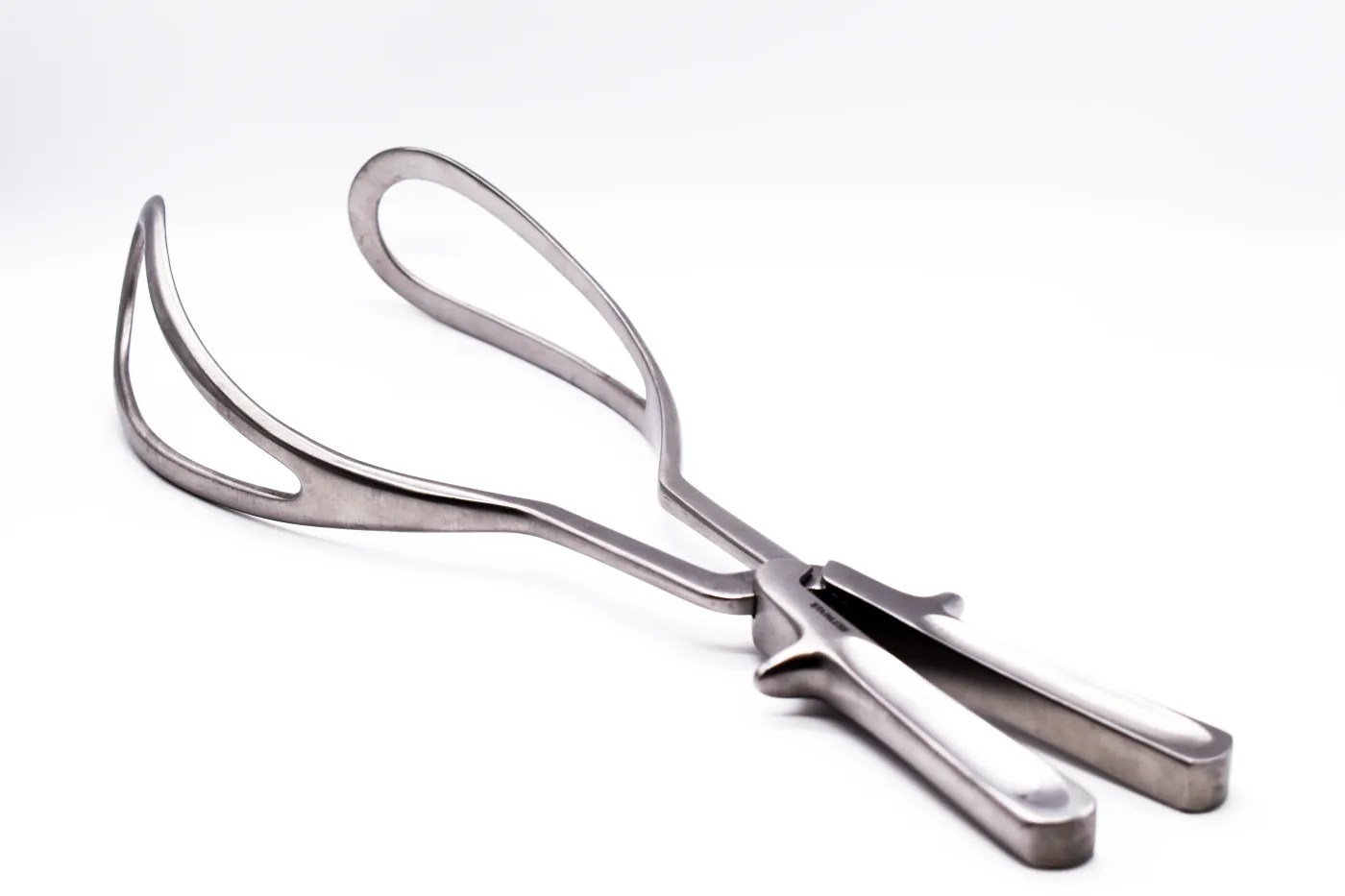
Identify the following image. Which of the following instruments is depicted in the image?
Appeared in: NORCET 7 Prelims -2024
Explanation
- The instrument in the image is identified as Simpson Forceps based on its distinct features.
- It has two curves: a cephalic curve designed to fit snugly around the fetal head and a prominent pelvic curve that aligns with the maternal birth canal.
- The blades are fenestrated (have openings), which helps to reduce compression on the fetal head.
- The shanks (the part between the blades and the lock) are separated and do not overlap, which is characteristic of traction forceps like Simpson's.
- These features indicate its primary function is for traction, to help pull the baby through the birth canal during an outlet delivery.
Why Other Options Were Wrong
- Option A: A Ventouse, or vacuum extractor, is a device that uses a suction cup attached to the fetal scalp to assist delivery. It is fundamentally different in appearance and mechanism from the metal forceps shown in the image.
- Option B: Kielland forceps have specific features for rotation of the fetal head, such as a minimal pelvic curve, overlapping shanks, and a sliding lock. The instrument in the image has a prominent pelvic curve and separated shanks, which are features of Simpson forceps used for traction.
- Option D: 'Tongs Forceps' is not a standard or recognized classification in obstetrics. It is a general descriptive term but does not refer to a specific type of medical instrument like Simpson or Kielland forceps.
Related Visual

- Visual 1: Infographic - A comparative chart showing Simpson, Kielland's, and Wrigley's forceps side-by-side. Each instrument should have its key parts labeled (blades, pelvic curve, cephalic curve, shank, lock) to highlight the differences.
- Visual 2: Diagram - An illustration showing the correct application of Simpson forceps on a fetal head within the maternal pelvis, demonstrating how the pelvic and cephalic curves work.
Clinical Relevance
- Nursing practice connection: This is primarily an exam-oriented knowledge point with limited direct bedside application, so retain Identification of Obstetric Instruments as background academic context rather than a clinical decision trigger.
- Nurses play a crucial role in assisted deliveries by preparing the correct instruments, anticipating the needs of the obstetrician, and ensuring all equipment is sterile and functional.
- Accurate identification of instruments like Simpson forceps is vital for patient safety. Handing the wrong instrument to the provider could delay the procedure or lead to incorrect application, potentially causing harm to the mother or baby.
- Post-delivery, the nurse is responsible for monitoring both mother and baby for complications related to forceps use, such as perineal trauma, hematoma, postpartum hemorrhage in the mother, and facial marks or nerve palsy in the infant.
How to Approach the Question
- First, identify the general category of the instrument shown in the image. Here, it is clearly a type of obstetric forceps.
- Next, carefully observe the specific features of the forceps. Pay close attention to the blades (fenestrated or solid), the curves (is there a prominent pelvic curve?), the shanks (do they overlap or are they separate?), and the lock mechanism.
- Systematically compare these observed features with the known characteristics of each option provided.
- For Simpson forceps, look for fenestrated blades, a prominent pelvic curve, and separated shanks.
- For Kielland forceps, look for a minimal pelvic curve and overlapping shanks with a sliding lock.
- Eliminate options that do not match the visual evidence. 'Ventouse' is a vacuum device, and 'Tongs Forceps' is not a standard term.
Concept Tested & Keywords
- Concept Tested: Identification of Obstetric Instruments
- Stem keywords: instrument, image, depicted
- Lead-in keywords: Identify, Which of the following
Question ID
QRMIBoL8l6rly7MikVanZD
Practise the full NORCET 7 Prelims -2024
Attempt every question from this paper in a timed mock, then review the full solution for each one.
More Practical Obstetrics Questions
- Identify the following instrument:
- Identify the blade used:
- Identify the instrument used by a nurse in the following image:
- Match the following
- Identify, which of the following retractor is used in abdominal surgery?
- The instrument used for measuring fetal heart rate (FHR):
- What is the name of this retractor?
- Identify the following instrument?
- Identify the image showing in the picture?& x20;
- Green Armytage forceps is used to arrest bleeding in?
More NORCET 7 Prelims -2024 Questions
- A patient with kidney failure has been found to have 4+ protein in their urine. The nurse recognizes this finding as indicating:
- Which of the following is a true statement regarding breast milk?
- Based on the image showing the placement of ECG electrodes, where should the V1 lead be placed?
- Which type of anemia is characterized by macrocytic RBCs with megaloblastic changes?
- A nurse is caring for a patient with Chronic Obstructive Pulmonary Disease (COPD) and notices that the patient is using a CPAP machine. The nurse und…
- If a tracheostomy tube becomes dislodged, the nurse should:
- A nurse is assessing an endotracheal tube and needs to press the cricoid. This technique is known as:
- Which vaccine is typically given at the 6-week immunization visit?
- A patient is being administered general anesthesia. The nurse should assess the patient for:
- A nurse is using a non-rebreather mask on a patient. The oxygen flow is set at 10–15 L/min, but the reservoir bag is not inflating. What should the n…