
Combined AIIMS - 2020 (Jodhpur, Bhopal, Patna, Raipur)
Medical Surgical Nursing
Easy
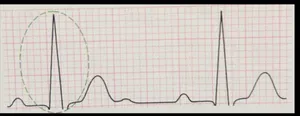
Identify the encircled part of wave form:
Appeared in: Combined AIIMS - 2020 (Jodhpur, Bhopal, Patna, Raipur)
Explanation
- The encircled waveform is the QRS complex, which represents the depolarization of the ventricles.
- Visually, it is identified by its characteristic shape: an initial downward deflection (Q wave), a large upward spike (R wave), and a subsequent downward deflection (S wave).
- The normal duration of the QRS complex is less than 0.12 seconds (or 120 ms), reflecting the rapid conduction of the electrical impulse through the ventricular conduction system.
Why Other Options Were Wrong
- Option A: 'PQR complex' is not a standard medical term. The P wave represents atrial depolarization and is a separate, distinct wave that occurs before the QRS complex.
- Option B: The 'RS wave' only describes two parts of the complex. The encircled waveform also includes the initial downward deflection, which is the Q wave. Therefore, 'RS wave' is an incomplete description.
- Option D: The T wave represents ventricular repolarization and appears as a broader, more rounded wave that follows the QRS complex. The encircled waveform is sharp and spiky, which is characteristic of the QRS complex, not the T wave.
Related Visual

Clinical Relevance
- Nursing practice connection: This is primarily an exam-oriented knowledge point with limited direct bedside application, so retain Identification of ECG Waveforms as background academic context rather than a clinical decision trigger.
- Accurate identification of the QRS complex is fundamental for nurses in interpreting ECGs to assess a patient's cardiac rhythm and function.
- Changes in the QRS complex's duration or shape can indicate serious cardiac pathologies. A wide QRS (greater than 0.12s) can suggest a bundle branch block or a ventricular arrhythmia, which may require immediate intervention.
- What if? If the QRS complexes were wide and bizarrely shaped, and there were no preceding P waves, the nurse should suspect a life-threatening ventricular tachycardia and immediately assess the patient's pulse and level of consciousness while preparing for emergency response (e.g., calling a code blue).
How to Approach the Question
- First, carefully examine the image provided, paying close attention to the part of the ECG waveform that is encircled.
- Identify the key features of the encircled wave: Is it small and rounded, sharp and spiky, or a broad, slower wave?
- Recall the standard components of an ECG waveform: P wave (atrial depolarization), QRS complex (ventricular depolarization), and T wave (ventricular repolarization).
- Compare the visual characteristics of the encircled wave with the known characteristics of each ECG component.
- The encircled wave is a sharp, multi-deflection spike. This matches the description of the QRS complex.
- Evaluate the given options to find the most accurate and complete term for the identified waveform.
Concept Tested & Keywords
- Concept Tested: Identification of ECG Waveforms
- Stem keywords: ECG, waveform, encircled part
- Lead-in keywords: Identify
- Clinical cues: The visual cue is the dashed circle highlighting a specific part of the ECG tracing.
Question ID
QMzbBzwhne2pulM3BtLSN8
Reference Book
E6 Medicine Harrison 22e Part 1 p. 1909-1911
Practise the full Combined AIIMS - 2020 (Jodhpur, Bhopal, Patna, Raipur)
Attempt every question from this paper in a timed mock, then review the full solution for each one.
More ECG Questions
- Identify the ECG given below:
- Identify the following ECG reading denoted in image?
- Diagnose the underlying medical disorder by ECG change in photograph:
- Which of the following electrocardiogram finding would be seen in a client with Hyperkalemia?
- Identify the abnormality in ECG paper in the given image?
- In ECG, the P wave represents:
- What is the normal PR interval?
- Based on the image showing the placement of ECG electrodes, where should the V1 lead be placed?
- Identify the following ECG finding which is denoting in photograph?
- Normal duration of QRS complex?
More Combined AIIMS - 2020 (Jodhpur, Bhopal, Patna, Raipur) Questions
- The position used for most of the gynecological procedures?
- Thyroid eye disease (TED) is also known as:
- How many items are included in the WHO surgical safety checklist: SITOSO?
- In iron deficiency anemia, the fingernails become spoon shaped, this condition is referred to as:
- Which of the following code is associated with cardiac arrest during medical emergency?
- How is blood loss measured in Post-partum hemorrhage?
- SCD (Sequential Compressive Device) used for treatment of DVT patients, ensures:
- The traction used for cervical spine injury:
- In operation theater during cauterization, the electric current passing from a single electrode is called:
- Tracheostomy is done in which tracheal ring?