
NORCET-11 Prelims
Medical & Surgical Nursing
Hard
Identify the ECG pattern shown in the image below.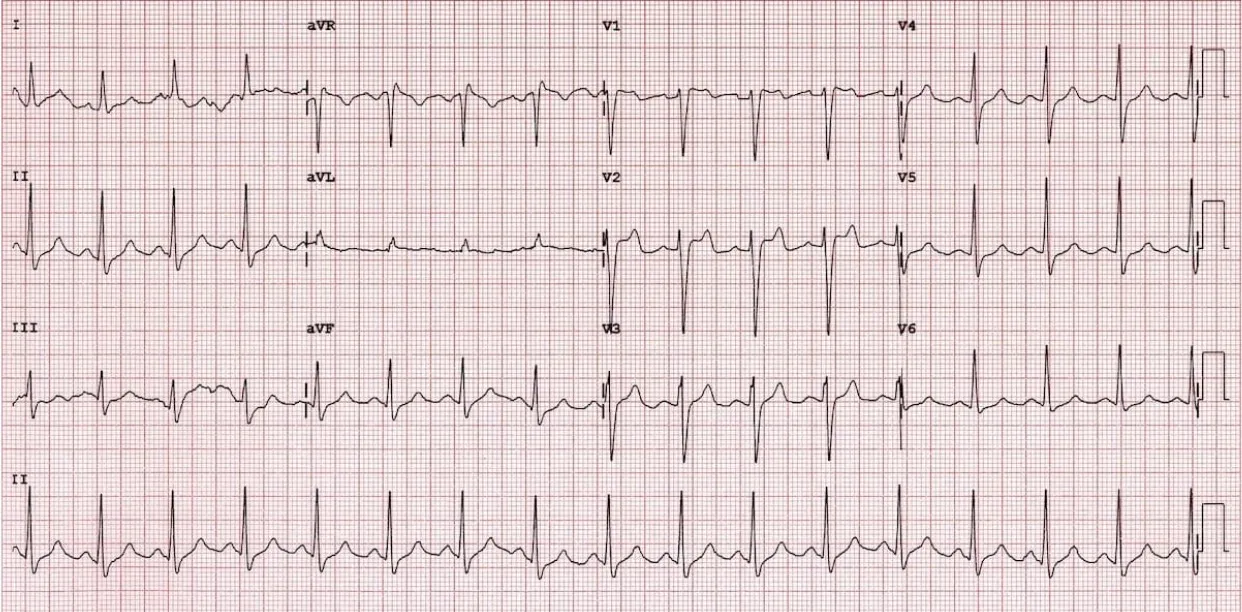
Appeared in: NORCET-11 Prelims
Explanation
- Brugada Type 2 shows a saddleback-shaped ST-segment elevation in V1-V2.
- The pattern is defined by an initial R wave, elevated ST segment, descent, and then a second rise (saddleback).
- No coved ST elevation or deep negative T wave is present, distinguishing it from Type 1.
- Correct identification is critical for risk stratification and management.
Why Other Options Were Wrong
- Option A: Brugada Type 1 shows a coved ST-segment elevation with a negative T wave in V1-V2, not a saddleback pattern.
- Option C: Brugada Type 3 has either a saddleback or coved pattern but with less than 2 mm of ST elevation, making it less specific.
- Option D: Wellens Type A is associated with deep T-wave inversions or biphasic T waves in V2-V3, seen in critical LAD stenosis, not a saddleback ST elevation.
Related Visual

Clinical Relevance
- Nursing practice connection: This is primarily an exam-oriented knowledge point with limited direct bedside application, so retain Recognition of Brugada syndrome ECG patterns, specifically Type 2 (saddleback morphology) as background academic context rather than a clinical decision trigger.
- Early identification of Brugada Type 2 can help prevent sudden cardiac death in at-risk individuals.
- Nurses should monitor for arrhythmias and educate patients about avoiding fever and certain medications that can unmask Brugada patterns.
- What if? If the ECG showed a coved ST elevation with a negative T wave, the diagnosis would shift to Brugada Type 1, which carries a higher risk of arrhythmia.
How to Approach the Question
- Carefully observe the ST-segment morphology in the right precordial leads (V1-V2).
- Identify whether the elevation is coved or saddleback in shape.
- Recall the distinguishing features of Brugada Types 1, 2, and 3.
- Eliminate options that do not match the visual pattern.
- Use clinical context and pattern recognition to select the best answer.
Concept Tested & Keywords
- Concept Tested: Recognition of Brugada syndrome ECG patterns, specifically Type 2 (saddleback morphology)
- Stem keywords: ECG pattern, Brugada syndrome, ST-segment elevation, right precordial leads
- Lead-in keywords: Identify
- Clinical cues: Saddleback ST elevation in V1-V2
Question ID
Qtn0Kb8j8UIekV86x06Suo
Reference Book
E6 Medicine Harrison 22e Part 1 p. 2011-2013
Practise the full NORCET-11 Prelims
Attempt every question from this paper in a timed mock, then review the full solution for each one.
More Cardiovascular, Circulatory, and Hematologic Function Questions
- A patient is undergoing blood transfusion and suddenly shows complaints of transfusion reaction. What will be the priority nursing intervention?
- The following all are blood transfusion complications from; EXCEPT:
- Identify the use of following machine used in pneumatic compression device:
- In iron deficiency anemia, the fingernails become spoon shaped, this condition is referred to as:
- Which gauze cannula is commonly used for blood transfusion?
- If 'P' wave is absent in ECG rhythm, it is an indication of:
- Normal compression to ventilation ratio:
- Trans-illumination procedure is done with:
- A patient in the ward experiences sudden cardiac arrest. What is the most appropriate technique for opening the airway to facilitate endotracheal int…
- A patient experiences complications after a blood transfusion. Which of the following signs and symptoms is indicative of circulatory overload?
More NORCET-11 Prelims Questions
- What is the capital of Arunachal Pradesh?
- A patient opens his eyes only when periorbital pressure is applied, makes incomprehensible sounds, and shows abnormal flexion to painful stimulus. Wh…
- Select the correctly spelt word from the options given below.
- Select the correctly spelt word from the options given below.
- Convert a patient's HbA1c value of 7% into estimated average glucose in mg/dL.
- A patient's recorded blood pressure is 150/90 mmHg. What is the calculated Mean Arterial Pressure?
- At 36 weeks of pregnancy, a woman presents for an antenatal visit with suspected rupture of membranes. A Nitrazine paper test is conducted to differe…
- What is the official currency of Iran?
- Which of the following conditions is caused by a protozoan parasite?
- The MMR vaccine provides protection against all of the following diseases, except: