
BHU NO - 12 April 2024
Applied Sociology
Easy
Given below are two statements:Statement I: Caste status is determined by birth, and it restricts social mobility.Statement II: The class system is non-secular, and a religious system is given based on its origin.Choose the correct answer:
Appeared in: BHU NO - 12 April 2024
Explanation
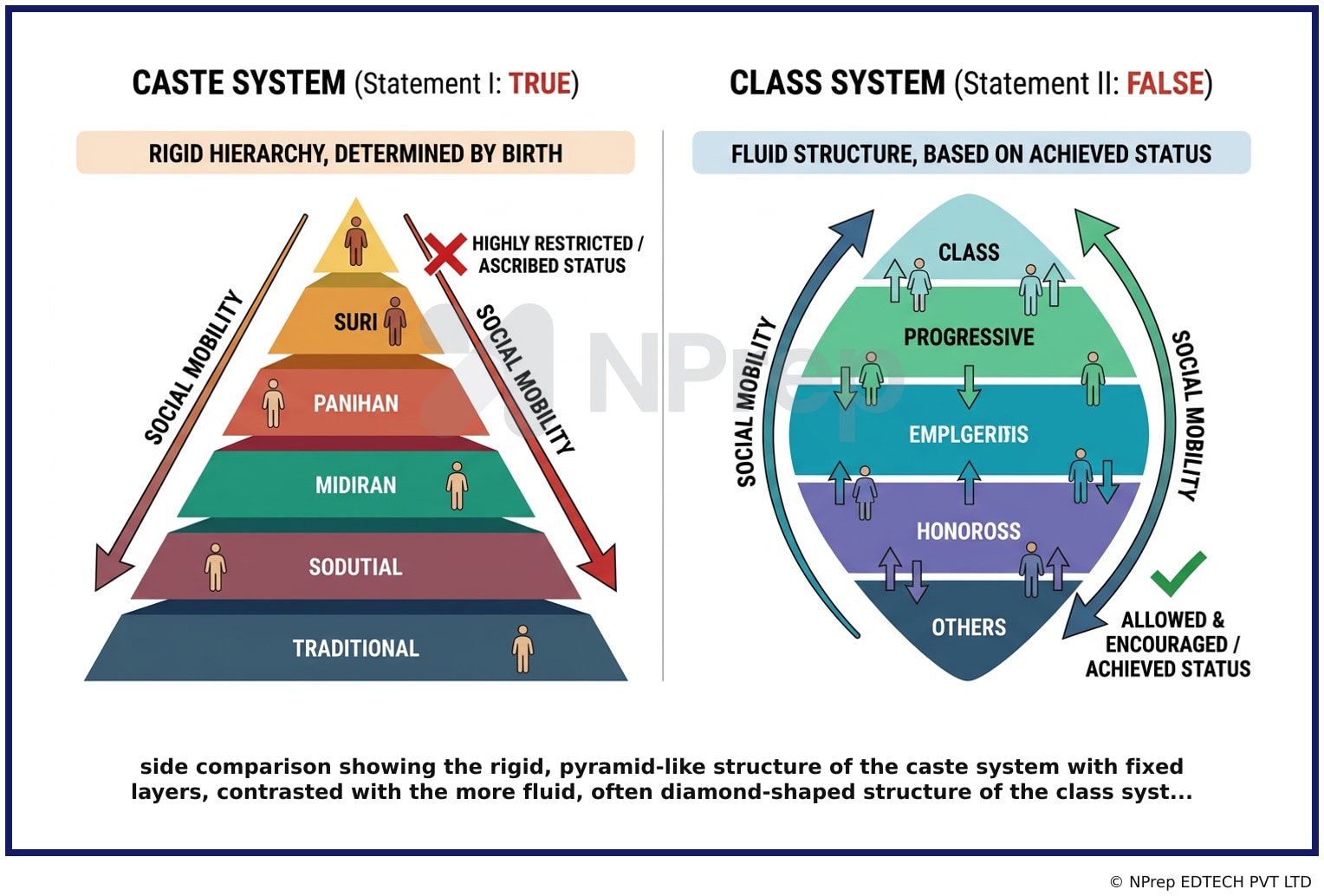
- Statement I is correct because the caste system is a rigid form of social hierarchy where an individual's status is determined by birth (ascribed status) and cannot be changed through personal achievement.
- This hereditary system severely restricts social mobility, meaning individuals are locked into their social position for life.
- Statement II is incorrect because the class system is secular, meaning it is not based on religious sanctions or beliefs.
- Social class is determined by achieved factors like economic status, wealth, education, and occupation, and it allows for individuals to move between classes (social mobility).
Why Other Options Were Wrong
- Option A: This option is incorrect because Statement II is false. The class system is secular, not non-secular.
- Option B: This option incorrectly claims Statement I is false and Statement II is true. The reality is the opposite.
- Option D: This option is incorrect because Statement I is a true and accurate description of the caste system.
Related Visual
Clinical Relevance
- Nursing practice connection: This is primarily an exam-oriented knowledge point with limited direct bedside application, so retain Distinction between Caste and Class systems of social stratification as background academic context rather than a clinical decision trigger.
- Understanding a patient's social background (caste or class) helps nurses provide culturally sensitive and competent care, as these factors can influence health beliefs, dietary practices, and family dynamics.
- A patient's socioeconomic class can directly impact their access to healthcare, ability to afford medications, and health-seeking behaviors, which are crucial considerations for discharge planning and patient education.
- What if? If a patient from a lower socioeconomic class is non-compliant with an expensive medication regimen, a nurse aware of class-based barriers would explore affordable alternatives or social support programs, rather than simply labeling the patient as 'non-compliant'.
How to Approach the Question
- First, analyze Statement I. Recall the definition of the caste system. Is it based on birth? Does it allow for social mobility? Confirm that it is an ascribed status with rigid mobility.
- Next, analyze Statement II. Recall the definition of the class system. Is it based on religion (non-secular)? Confirm that it is based on economic factors and is therefore secular.
- Evaluate the truthfulness of each statement based on your analysis. Statement I is true, and Statement II is false.
- Finally, scan the options to find the one that matches your evaluation: 'Statement I is true, but Statement II is false'.
Concept Tested & Keywords
- Concept Tested: Distinction between Caste and Class systems of social stratification.
- Stem keywords: Caste status, birth, social mobility, class system, non-secular, religious system
- Lead-in keywords: Choose the correct answer
Question ID
QX5D3HxSRry6EniIivGh8G
Reference Book
E6 Applied Sociology for Nurses TK Indrani p. 181-183
E6 Parks TextBook of Preventive & Social Medicine part 2 — Subpart A (pp 1-232 of 464) p. 225-227
Practise the full BHU NO - 12 April 2024
Attempt every question from this paper in a timed mock, then review the full solution for each one.
More Social stratification Questions
- Polyandry means?
- Identify the demerit (disadvantage) of the caste system from the given options.
- When a person changes from one position to another position of equal status, it is called?
- The maintenance provided by a husband to his divorced wife is called?
- \ \ \ \ \ \ is an endogamous group associated with traditional occupations.
- The system of differentiations which includes a hierarchy of social positions are termed as:
- Social stratification implies?
- All of the following are included in the upper class except?
- The phenomenon in society in which people move up and down and vice versa on social scale is known as?
- The process of movement of individuals or groups from one stratum to another is called?
More BHU NO - 12 April 2024 Questions
- Match List I with List II: List I (Tissue of origin of pain): List II (Site of Referred pain): & x20;(A) Heart, (I)Groin& x20; (B) Uterus, (II) Right…
- Given below are two statements:Statement I: Validity expresses the ability of a test to separate or distinguish those who have the disease from those…
- Assertion (A): Neurogenic shock is characterized by Bradycardia and dry warm skin.Reasons (R): It occurs due to vasodilation and loss of sympathetic…
- Which of the following strategies will the nurse adopt for patients with Methicillin Resistant Staphylococcus Aureus infection (MRSA)?
- Assertion (A): Infants born with Intra Uterine Rubella Infection may have cardiac malformation and deafness.Reasons (R): Rubella Infection increases…
- A school health nurse is educating a group of adolescent girls about risk factors of cervical cancer. Which of the following is the most common risk…
- A 54-year-old male patient admitted with memory impairment. His Mini-Mental State Examination (MMSE) score ranges from 10 - 18 points, which indicate…
- Control + 5 button is used to facilitate which of the following functions in a computer?
- Rearrange the following four sentences (A), (B), (C), (D) in the proper sequence to form a meaningful paragraph:(A) If you use a large bowl, the serv…
- In which of the following clinical conditions, Barrier Nursing is Mandatory?