
WCL Staff Nurse - 2019
Nursing Foundation
Easy
For intramuscular injection, the nurse should insert the needle into the muscle at an angle of? 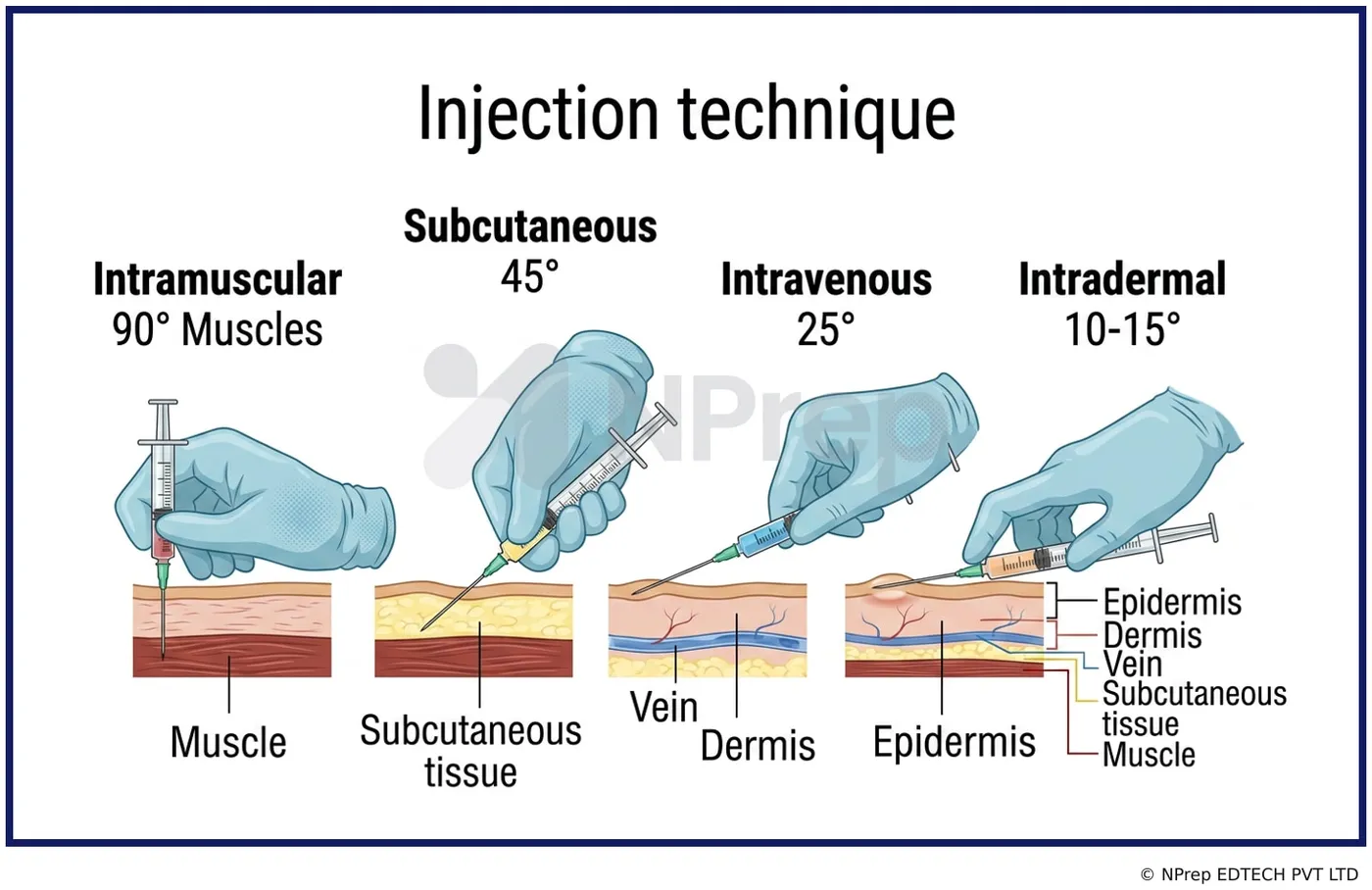
Appeared in: WCL Staff Nurse - 2019
Explanation
- The correct angle for an intramuscular (IM) injection is 90 degrees, as confirmed by the provided image and standard nursing guidelines.
- This perpendicular angle ensures the needle passes through the superficial layers (skin and subcutaneous fat) to deposit medication deep within the muscle tissue.
- Deep muscle tissue has a rich blood supply, which allows for faster and more predictable medication absorption compared to other routes like subcutaneous.
Why Other Options Were Wrong
- Option A: A 15-degree angle is too shallow for an intramuscular injection and would result in the medication being deposited in the dermis.
- Option B: A 30-degree angle is not a standard, recommended angle for any of the primary parenteral injection routes.
- Option C: A 45-degree angle would likely deposit the medication into the subcutaneous tissue rather than the muscle, leading to slower absorption and potential tissue irritation.
Related Visual

Clinical Relevance
- Nursing practice connection: Knowing Parenteral Injection Techniques helps nurses interpret findings accurately and avoid errors in routine assessment, medication administration, and patient teaching.
- Using the correct needle angle is critical for patient safety and medication efficacy. An incorrect angle can lead to injecting medication into the wrong tissue layer, causing pain, nerve damage, poor absorption, or sterile abscesses.
- For IM injections, especially with irritating medications, the Z-track method is recommended. This technique involves displacing the skin before injection to seal the medication in the muscle and prevent it from leaking into the subcutaneous tissue.
- What if? If the patient was very thin or emaciated, the IM angle would still be 90 degrees, but the nurse must use a shorter needle and carefully select the site (e.g., ventrogluteal) to avoid hitting bone. For a subcutaneous injection in the same patient, a 45-degree angle would be safer than 90 degrees.
How to Approach the Question
- First, identify the key terms in the question: "intramuscular injection" and "angle".
- This is a direct recall question about a fundamental nursing procedure. Access your knowledge of parenteral medication administration.
- Visualize or recall the different injection routes and their purposes. Intramuscular (IM) injections are intended to reach deep into the muscle.
- Associate the 90-degree (perpendicular) angle with the need to go "straight in" to penetrate the skin and fat layers to reach the muscle.
- Contrast this with other standard angles: a very shallow angle (10-15°) for intradermal and a 45° angle for subcutaneous injections.
- Evaluate the options and select the one that matches the standard for intramuscular injections.
Concept Tested & Keywords
- Concept Tested: Parenteral Injection Techniques
- Stem keywords: intramuscular injection, needle, angle
- Lead-in keywords: BEST, MOST RELEVANT CLUE
- Negative lead-in flag: false
Question ID
Q5zRKgiNrDhU7u3yrnOnDy
Reference Book
E6 Nursing Fundamentals Potter Perry 12e Part 3 p. 174-176
E6 Pharmacology Nursing Lilley 11e Part 1 p. 132-134
E6 Nursing Fundamentals Taylor p. 862-864
Practise the full WCL Staff Nurse - 2019
Attempt every question from this paper in a timed mock, then review the full solution for each one.
More Administration of medications Questions
- Which is the appropriate site to administer Intramuscular injections in children?
- The route of Mantoux skin test is:
- What is the size of needle for Intramuscular (IM) injection in adults?
- You are administering an intravenous medication to a patient, and the medication label instructs you to infuse 50 mL over 15 minutes. What is the cor…
- A physician orders a medication to be administered to a patient in a dose of 200mg twice daily (BD). The pharmacy provides tablets of the medication,…
- Desired dose of Morphine for a patient is 0.4 mg. Dose available is 1 mg/mL. The correct formulation for this patient is:
- Cefuroxime sodium, 1 g in 50 mL normal saline (NS), is to be administered over 30 minutes to a client with an infection. The drop factor is 15 drops…
- To ensure accurate medication administration and prevent errors, what is the most comprehensive method for verifying a patient's identity?
- Maximum chance of sciatic nerve injury during which site of I.M injection?
- Identify route of drug administration:
More WCL Staff Nurse - 2019 Questions
- Colour coding for nitrous oxide cylinder is?
- Tonicity of Ringer Lactate is?
- Sharp instruments should not be sterilized by?
- Systolic blood pressure slightly falls during normal inspiration due to?
- A patient is to receive 2000 ml of IV fluid in 12 hours. The Drop factor is 10gtt/ml. At how many drops per minute should the flow rate be set?
- Endoscopic catheters are sterilized by?
- Blood vessel which connects artery and vein?
- The technique of administering BCG vaccine is?
- During ABG analysis blood is collected from?
- Which of the following medication order is administered immediately and only once?