
NORCET 6 Prelims -2024
Nursing Foundation
Medium
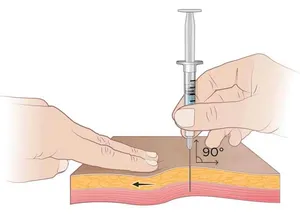
Identify route of drug administration:
Appeared in: NORCET 6 Prelims -2024
Explanation
- The image displays the Z-track method, where the skin and subcutaneous tissue are pulled laterally before injection.
- The needle is inserted at a 90-degree angle, which is characteristic of an intramuscular (IM) injection, ensuring the medication is delivered deep into the muscle.
- This combination of skin displacement and deep muscle injection is known as an IM injection with the Z-track technique.
- The purpose of this technique is to seal the medication within the muscle, preventing leakage into the subcutaneous tissue, which minimizes irritation and pain.
Why Other Options Were Wrong
- Option A: A subcutaneous injection is administered into the fatty tissue layer, which is more superficial than the muscle layer shown in the image. Although a Z-track can be used, the depth of injection in the diagram is clearly into the muscle.
- Option C: An intravenous (IV) injection delivers medication directly into a vein. The image shows the needle in muscle tissue, not a blood vessel.
- Option D: An intradermal injection is the shallowest type, administered just beneath the epidermis at a 10 to 15-degree angle, forming a small bubble or 'bleb'. The image shows a deep injection at a 90-degree angle.
Related Visual

- Visual 1: Diagram - A comparative chart showing the different angles of insertion (10-15°, 45°, 90°) and corresponding tissue layers (dermis, subcutaneous, muscle) for intradermal, subcutaneous, and intramuscular injections.
- Visual 2: Step-by-step infographic of the Z-track method, showing (1) skin displacement, (2) injection, (3) waiting 10 seconds, and (4) needle withdrawal followed by skin release.
Clinical Relevance
- Nursing practice connection: Knowing Parenteral drug administration techniques helps nurses interpret findings accurately and avoid errors in routine assessment, medication administration, and patient teaching.
- The Z-track method is a critical nursing skill to reduce patient discomfort and prevent complications like skin staining (e.g., with iron injections) and tissue irritation from certain medications.
- Proper site selection and landmarking (e.g., ventrogluteal, vastus lateralis) are crucial when performing IM injections to avoid injury to nerves and blood vessels.
- What if the medication was insulin? The route would change to subcutaneous. The nurse would typically pinch the skin (not pull it sideways) and inject at a 45 or 90-degree angle into the adipose tissue, not the muscle.
How to Approach the Question
- First, carefully analyze the image provided. Pay close attention to the angle of the needle, the depth of penetration, and how the nurse's hands are interacting with the patient's skin.
- Identify the key actions shown: the skin is being pulled to the side (laterally), and the needle is inserted at a 90-degree angle deep into the tissue.
- Recall the different parenteral routes of administration (Intradermal, Subcutaneous, Intramuscular, Intravenous) and their defining characteristics (angle, tissue layer).
- Recognize that pulling the skin laterally is the specific technique known as the 'Z-track' method.
- Combine the observations: a 90-degree injection into muscle + the Z-track technique points directly to 'IM with Z track'.
- Evaluate the given options to find the one that accurately describes this combination of actions.
Concept Tested & Keywords
- Concept Tested: Parenteral drug administration techniques
- Stem keywords: drug administration, injection, Z-track
- Lead-in keywords: Identify
- Clinical cues: Image shows skin being pulled laterally
- Clinical cues: Needle inserted at a 90-degree angle
Question ID
QGIE1_jZsIL82zcX-3H5w7
Practise the full NORCET 6 Prelims -2024
Attempt every question from this paper in a timed mock, then review the full solution for each one.
More Administration of medications Questions
- Which is the appropriate site to administer Intramuscular injections in children?
- The route of Mantoux skin test is:
- What is the size of needle for Intramuscular (IM) injection in adults?
- You are administering an intravenous medication to a patient, and the medication label instructs you to infuse 50 mL over 15 minutes. What is the cor…
- A physician orders a medication to be administered to a patient in a dose of 200mg twice daily (BD). The pharmacy provides tablets of the medication,…
- Desired dose of Morphine for a patient is 0.4 mg. Dose available is 1 mg/mL. The correct formulation for this patient is:
- Cefuroxime sodium, 1 g in 50 mL normal saline (NS), is to be administered over 30 minutes to a client with an infection. The drop factor is 15 drops…
- To ensure accurate medication administration and prevent errors, what is the most comprehensive method for verifying a patient's identity?
- Maximum chance of sciatic nerve injury during which site of I.M injection?
- A doctor ordered 0.45% normal saline with 50 ml/hr by microdrip set then what is drop per minute?
More NORCET 6 Prelims -2024 Questions
- Normal compression to ventilation ratio:
- A 45-year-old patient presents with a severe head injury. Which of the following is a contraindication for the insertion of a nasopharyngeal airway i…
- A mechanically ventilated patient is placed on high-flow ventilation to manage acute respiratory distress. Suddenly, the patient's oxygen saturation…
- A patient presents to the emergency department with a serum pH of 7.25, pCO2 of 40 mmHg, HCO3 of 22 mEq/L, sodium of 150 mEq/L, and chloride of 100 m…
- A 75-year-old patient, intubated and mechanically ventilated, becomes acutely distressed during a routine suctioning procedure. The patient's oxygen…
- A 65-year-old patient is admitted to the hospital with a serum sodium level of 132 mmol/L. Despite being asymptomatic at admission, the patient begin…
- A 45-year-old patient undergoes a total thyroidectomy and is admitted to the post-anesthesia care unit (PACU) for monitoring. Shortly after arrival,…
- A patient presents to the emergency department with the following vital signs: blood pressure 120/66 mmHg, pulse rate 88 beats per minute, respirator…
- A 30-year-old patient presents to the emergency department with a body temperature of 104°F (40°C). The patient’s additional vital signs are as follo…
- During a routine assessment, you notice that a 60-year-old patient's radial pulse is weak and difficult to palpate. The patient's other vital signs a…