
WCL Staff Nurse - 2019
Pharmacology
Easy
Tonicity of Ringer Lactate is?
Appeared in: WCL Staff Nurse - 2019
Explanation
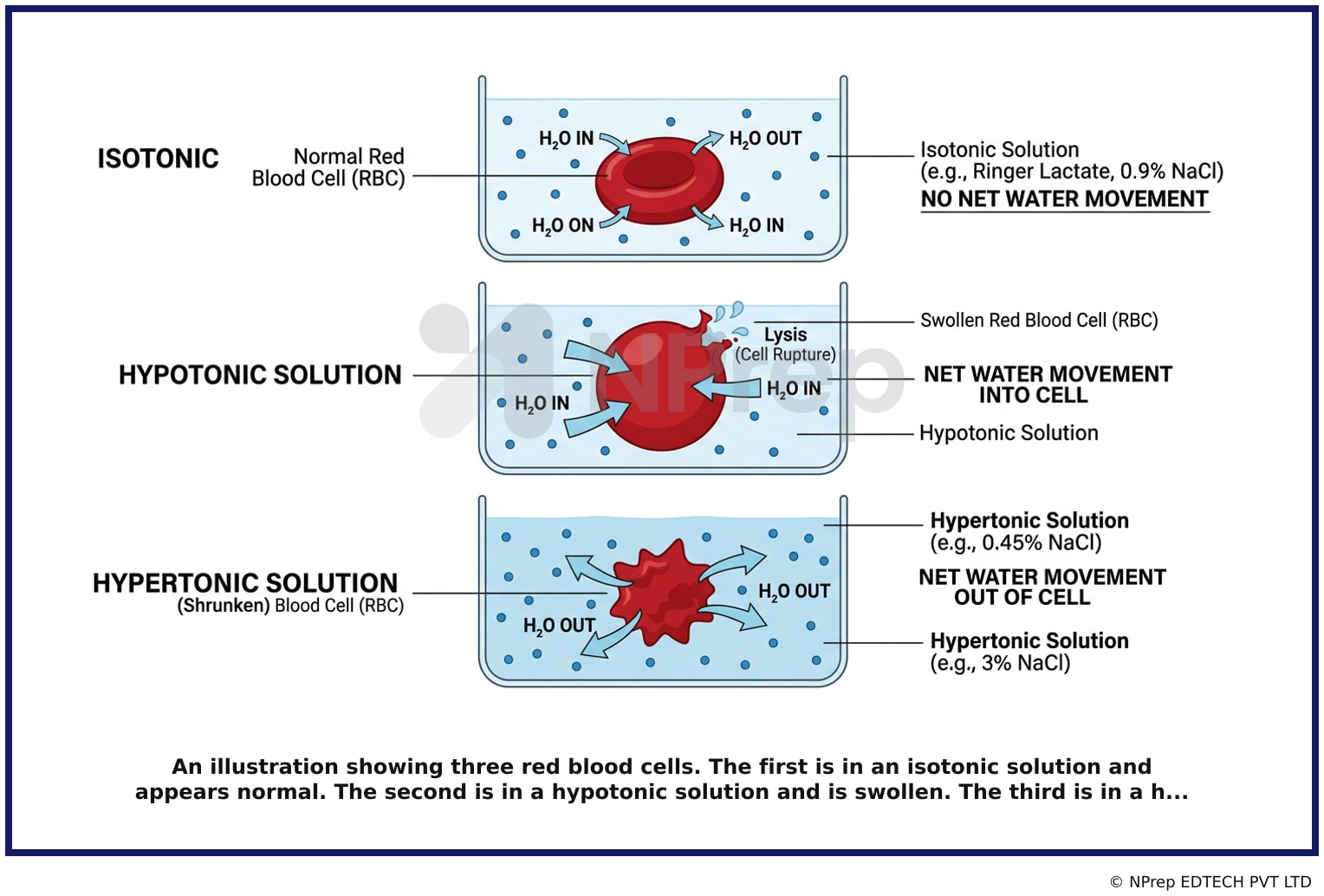
- Ringer's Lactate is classified as an isotonic solution because its osmolality (approximately 274 mOsm/L) is very close to that of blood plasma (275-295 mOsm/kg).
- Due to this similar concentration, it expands the extracellular fluid volume without causing a significant net movement of water into or out of the body's cells.
- It is frequently used for fluid resuscitation in situations like dehydration, burns, and surgery because it closely mimics the electrolyte composition of plasma.
Why Other Options Were Wrong
- Option A: A hypertonic solution has a higher solute concentration than plasma (e.g., 3% NaCl). Administering a hypertonic solution would draw water out of cells, causing them to shrink. Ringer's Lactate does not have this effect.
- Option B: A hypotonic solution has a lower solute concentration than plasma (e.g., 0.45% NaCl). It causes water to move into cells, leading to cellular swelling. Ringer's Lactate has a concentration similar to plasma, not lower.
- Option D: This option is incorrect because Ringer's Lactate has a well-defined tonicity. It is classified as an isotonic solution based on its osmolality compared to blood plasma.
Related Visual
Clinical Relevance
- Nursing practice connection: This is primarily an exam-oriented knowledge point with limited direct bedside application, so retain Tonicity of Intravenous Fluids as background academic context rather than a clinical decision trigger.
- Choosing the correct IV fluid is a critical nursing responsibility. Administering an isotonic fluid like Ringer's Lactate is standard for volume replacement in many clinical scenarios, including surgery, trauma, and dehydration.
- Using a fluid with the wrong tonicity can have severe consequences. For example, giving a large volume of hypotonic fluid can lead to cerebral edema, while hypertonic fluids can cause intravascular fluid overload and cellular dehydration.
- The lactate in Ringer's Lactate is converted to bicarbonate by the liver, which can help correct mild metabolic acidosis. This makes it a preferred fluid in certain situations over Normal Saline.
How to Approach the Question
- First, identify the core of the question. It asks for the 'tonicity' of 'Ringer Lactate'.
- This is a factual recall question. Access your knowledge about common intravenous (IV) fluids.
- Recall the three main categories of fluid tonicity: isotonic, hypotonic, and hypertonic.
- Remember the definition of each: Isotonic has a similar solute concentration to blood, hypotonic has less, and hypertonic has more.
- Place Ringer's Lactate into the correct category. It is a balanced, multi-electrolyte solution with an osmolality very close to plasma, making it isotonic.
- Evaluate the given options and select 'Isotonic' as the correct answer.
Concept Tested & Keywords
- Concept Tested: Tonicity of Intravenous Fluids
- Stem keywords: Tonicity, Ringer Lactate
- Lead-in keywords: is
Question ID
QElIHPFupVYpSQz6CY93--
Reference Book
E6 Nursing Brunner Adult Health 3SA Vol 1 Part 1 p. 142-144
E6 Pharmacology Nursing Lilley 11e Part 2 p. 160-162
Practise the full WCL Staff Nurse - 2019
Attempt every question from this paper in a timed mock, then review the full solution for each one.
More Miscellaneous Questions
- These agents decreases intestinal muscle tone to slow passage of feces:
- Lactated Ringer's solution is contraindicated in:
- When designing a web page that should appeal to both males and females, a good choice of background color is:
- Adrenaline dose in anaphylactic shock is:
- A patient came to ED unconscious with pinpoint pupil, lacrimation and history of substance abuse. Which of the drug will be administered?
- In rehabilitation center, which of the following drug is used as opioid substitute in substance abuse patient?
- 0.45% NS is?
- Which of the following component is not present in normal saline?
- What is the antidote of narcotics?
- Antidote for heparin is:
More WCL Staff Nurse - 2019 Questions
- Colour coding for nitrous oxide cylinder is?
- Sharp instruments should not be sterilized by?
- Systolic blood pressure slightly falls during normal inspiration due to?
- A patient is to receive 2000 ml of IV fluid in 12 hours. The Drop factor is 10gtt/ml. At how many drops per minute should the flow rate be set?
- Endoscopic catheters are sterilized by?
- Blood vessel which connects artery and vein?
- The technique of administering BCG vaccine is?
- During ABG analysis blood is collected from?
- Which of the following medication order is administered immediately and only once?
- For intramuscular injection, the nurse should insert the needle into the muscle at an angle of?