
NORCET-5 mains
Child Health Nursing (Pediatrics)
Hard
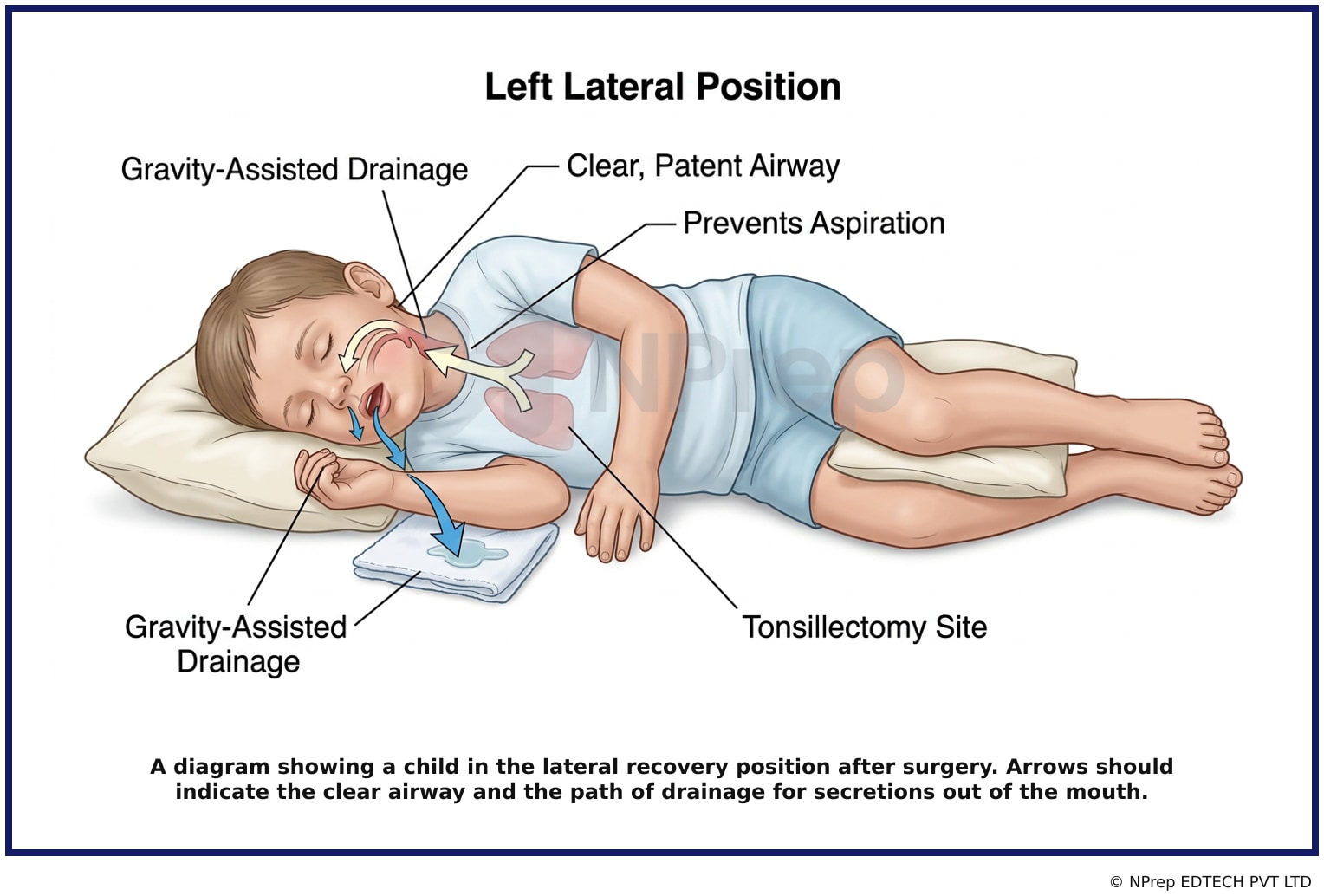
A child received from the recovery room after tonsillectomy and adenoidectomy. Which position should the nurse provide to the child?
Appeared in: NORCET-5 mains
Explanation
- The left lateral (side-lying) position is correct because it uses gravity to promote the drainage of blood and secretions from the mouth and pharynx.
- This position prevents the tongue from falling back and obstructing the airway while the child is recovering from anesthesia.
- By facilitating drainage, the lateral position significantly reduces the risk of aspiration, a major postoperative complication.
- It allows for effective monitoring of the child's breathing, airway, and any signs of bleeding.
Why Other Options Were Wrong
- Option A: The supine (on the back) position is dangerous as it allows blood and secretions to pool at the back of the throat, creating a high risk of aspiration and airway obstruction.
- Option C: While the prone position also facilitates drainage, the lateral position is often preferred because it allows for easier direct observation of the child's face, airway, and breathing.
- Option D: Sims' position is a specific type of lateral position with the patient's weight shifted forward. It is not the standard recovery position for post-tonsillectomy care.
Related Visual
Clinical Relevance
- Nursing practice connection: Safe nursing care depends on performing Postoperative positioning to ensure airway patency and prevent complications in the correct sequence, documenting the action clearly, and monitoring for the expected response.
- A nurse's primary responsibility in the immediate post-tonsillectomy period is to maintain a patent airway and prevent aspiration. Correct positioning is the first and most crucial step.
- Nurses must vigilantly monitor for signs of hemorrhage. A key, subtle sign in children is frequent swallowing, as they may be swallowing blood. Other signs include restlessness, increased heart rate, and pallor.
- What if? If the child shows signs of active bleeding (e.g., vomiting bright red blood, frequent swallowing), the nurse should immediately place the child on their side, notify the surgeon, and prepare for potential emergency intervention. The priority shifts from routine recovery to managing hemorrhage.
How to Approach the Question
- First, identify the core of the question: It asks for the correct position after a tonsillectomy.
- Next, recall the primary risks associated with this specific surgery. For tonsillectomy, the main dangers are bleeding, airway obstruction, and aspiration of blood/secretions.
- Evaluate each option based on how it addresses these risks. Ask yourself: 'Does this position protect the airway and prevent aspiration?'
- The supine position increases aspiration risk, so eliminate it.
- Both lateral and prone positions promote drainage. Consider which is better for overall patient monitoring.
- The lateral (side-lying) position allows for both drainage and easy observation of the patient's breathing and face, making it an optimal choice.
Concept Tested & Keywords
- Concept Tested: Postoperative positioning to ensure airway patency and prevent complications.
- Stem keywords: child, recovery room, tonsillectomy, adenoidectomy, position
- Lead-in keywords: Which position
- Clinical cues: The procedure (tonsillectomy) is key, as it creates a risk of bleeding and aspiration in the airway.
Question ID
Q0AybWo0TSu_3vkCsxM2Ts
Reference Book
E6 Nursing Fundamentals Potter Perry 12e Part 6 p. 193-195
E6 Nursing Brunner Adult Health 3SA Vol 2 Part 1 p. 37-39
Practise the full NORCET-5 mains
Attempt every question from this paper in a timed mock, then review the full solution for each one.
More Otolaryngology Questions
- You are assessing the nutrition of a 3-year-old child in your pediatric clinic. The child is developmentally normal and has no known food allergies o…
- What is choanal atresia?
- While administering ear drops in a 2 years old child. Which of the following is done by the nursing officer while giving ear drops ear pinna is?(Imag…
- A child undergoes heart surgery to repair the defects associated with Tetralogy of Fallot. What behavior is essential for the nurse to prevent postop…
- What is the nurse's priority intervention when preparing for admission of a child with acute laryngotracheobronchitis?
- Following tonsillectomy an infant is swallowing frequently and looking like restlessness, which is a priority nursing action?
- When feeding an 18-month-old child two days after he underwent a cleft palate repair, a nurse would offer liquid nutrition using a?
- A five-year-old child gets admitted to the hospital with the diagnosis of Bronchopulmonary Dysplasia (BPD). If the child is at the third stage, what…
- How should you instruct the student nurse to modify the examination for a 7-year-old child?
- What is the most appropriate way to assess the effectiveness of nebulization therapy in a 4-year-old child?
More NORCET-5 mains Questions
- Identify the following instrument?
- Maximum level of alcoholism legally allowed for driving in India?
- When evaluating the therapeutic response for a client receiving a heparin infusion, which laboratory results should the nurse monitor?
- A nurse should carefully monitor a client for the following side effect of MgSO4?
- Hypoxia is the primary problem related to near-drowning victims. The first organ that sustains irreversible damage after submersion in water is the?
- Iron dextran (Imferon) is a parenteral iron preparation. The nurse should know that it:
- A 56-year-old patient is admitted to the psychiatric unit in a state of total despair. She feels hopeless and worthless, has a flat affect and very s…
- A client is admitted to the hospital for an induction of labor owing to a gestation of 42 weeks confirmed by dates and ultrasound. When she is dilate…
- A 3-year-old child is hospitalized with burns covering her trunk and lower extremities. Which of the following would the nurse use to assess adequacy…
- Under National Family Welfare Program, IUCD 380 copper T would be effective for?