
NORCET 5 Prelims - Sept 2023 (Shift-1)
Pharmacology
Hard
Which of the following medications requires close observation for bronchospasm in the client with chronic obstructive pulmonary disease or asthma?
Appeared in: NORCET 5 Prelims - Sept 2023 (Shift-1)
Explanation
- Propranolol is a non-selective beta-adrenergic blocker.
- It blocks both beta-1 (heart) and beta-2 (lung) receptors.
- Blockade of beta-2 receptors in the lungs inhibits bronchodilation and can lead to bronchoconstriction or bronchospasm.
- This effect is particularly dangerous in individuals with pre-existing reactive airway diseases like asthma or COPD.
- Therefore, non-selective beta-blockers are generally contraindicated in this patient population.
Why Other Options Were Wrong
- Option A: Verapamil is a calcium channel blocker. It works by relaxing blood vessels and reducing the heart's workload. It does not act on beta-2 receptors in the lungs and therefore does not cause bronchospasm.
- Option B: Amrinone is a phosphodiesterase inhibitor used for short-term management of severe heart failure. Its primary action is to increase cardiac contractility and cause vasodilation; it does not induce bronchospasm.
- Option C: Epinephrine is an adrenergic agonist that stimulates beta-2 receptors, causing potent bronchodilation. It is the drug of choice for treating acute, severe bronchospasm and anaphylaxis.
Related Visual
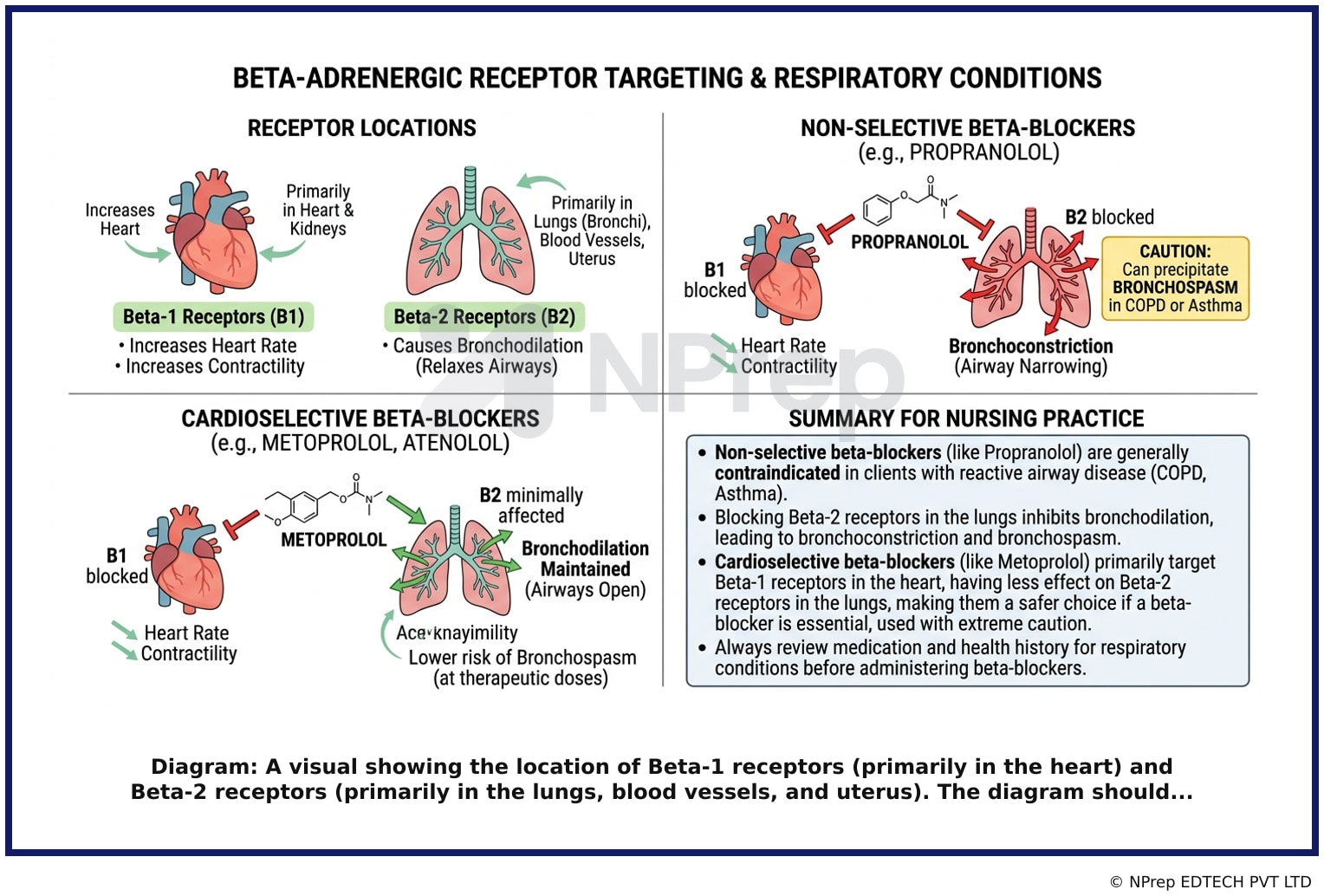
- Visual 1: Diagram: A visual showing the location of Beta-1 receptors (primarily in the heart) and Beta-2 receptors (primarily in the lungs, blood vessels, and uterus). The diagram should illustrate how a non-selective blocker like Propranolol affects both, while a cardioselective blocker primarily targets Beta-1.
- Visual 2: Flowchart: A decision-making flowchart for prescribing beta-blockers, showing the first question as 'Does the patient have asthma or COPD?'. If yes, it should lead to 'Avoid non-selective beta-blockers' and 'Use cardioselective beta-blockers with caution'.
Clinical Relevance
- Nursing practice connection: Use the key finding related to Pharmacological side effects and contraindications in patients with respiratory conditions to guide bedside assessment, documentation, and the next nursing action.
- A thorough medication and health history review is a critical nursing responsibility before administering any new drug, especially beta-blockers.
- Nurses must educate patients on the signs of bronchospasm (wheezing, shortness of breath, coughing, chest tightness) and instruct them to seek immediate medical help if they occur.
- What if? If the patient had hypertension but no asthma, Propranolol could be a suitable treatment. However, if a beta-blocker is essential for a cardiac condition in an asthma patient, a cardioselective beta-blocker (like Metoprolol or Atenolol) would be chosen and used with extreme caution, starting at a very low dose.
How to Approach the Question
- First, identify the core of the question: which drug can worsen breathing in a patient with asthma or COPD?
- This requires understanding the pathophysiology of bronchospasm (airway constriction).
- Review the mechanism of action for each medication listed.
- Verapamil is a calcium channel blocker; its primary effects are on the cardiovascular system.
- Amrinone is a phosphodiesterase inhibitor for heart failure.
- Epinephrine is a beta-agonist; it opens the airways.
Concept Tested & Keywords
- Concept Tested: Pharmacological side effects and contraindications in patients with respiratory conditions.
- Stem keywords: medications, bronchospasm, chronic obstructive pulmonary disease, COPD, asthma
- Lead-in keywords: requires close observation
- Clinical cues: The patient has a pre-existing respiratory condition (COPD or asthma), which makes them vulnerable to specific drug side effects.
Question ID
QOCgMo6sMo2x54esvxoI0W
Practise the full NORCET 5 Prelims - Sept 2023 (Shift-1)
Attempt every question from this paper in a timed mock, then review the full solution for each one.
More Respiratory System Drugs Questions
- Injection Morphine is given intrathecal during procedure for pain relief after the procedure. After procedure which of following analgesic you will n…
- How to check if a freeze-sensitive vaccine is damaged or not?
- A nurse receives an order to give a patient two puffs of salmeterol and two puffs of beclomethasone dipropionate, by a metered dose inhaler. The nurs…
- A patient receiving continuous salbutamol nebulization therapy. Nurse should assess for?
- Which of the following vaccines should not be kept in a freezer?
- Which of the following are the advantages of Dry powdered Inhalers (DPIs) over Metered Dose inhalers (MDIs)? 1. It requires less manual dexterity 2.…
- A client is being discharged with albuterol and beclomethasone dipropionate to be administered via inhalation three times a day and at bedtime. Clien…
- In a patient, the physician prescribes to inhale beclomethasone and Albuterol (Ventolin HFA) for the treatment of asthma. As a Nursing Officer, how w…
- In a COPD patient aminophyline has given the mode of action of this drug?
- Which among the following vaccines is stored in the freezer compartment?
More NORCET 5 Prelims - Sept 2023 (Shift-1) Questions
- Which of the following electrocardiogram finding would be seen in a client with Hyperkalemia?
- Identify the following ECG finding in the depicted image?
- Which of the following is not used in management of orthostatic hypotension?
- Which of the following clinical features is not seen in shock?
- Which position is best to identify left pleural effusion?
- A male patient comes in casualty who has a lacerated untidy wound after 4 hours. What would be the priority nursing action?
- A client who underwent abdominal surgery earlier in the day has a small amount of bright red blood on the surgical dressing. How should the nurse doc…
- A nurse entered a nursery unit and observed that a newborn shows jerky movement of the lower limbs. Which of the following is the priority nursing ac…
- The nurse should be concerned for which while a child is on chemotherapy?
- Following a head injury, a person comes into the emergency department with personality changes and loss of voluntary control. Which lobe of the brain…