
AIIMS Raipur - 2017 (Shift-3)
Mental Health Nursing
Easy
Which of the following is the most lethal method of Suicide?
Appeared in: AIIMS Raipur - 2017 (Shift-3)
Explanation
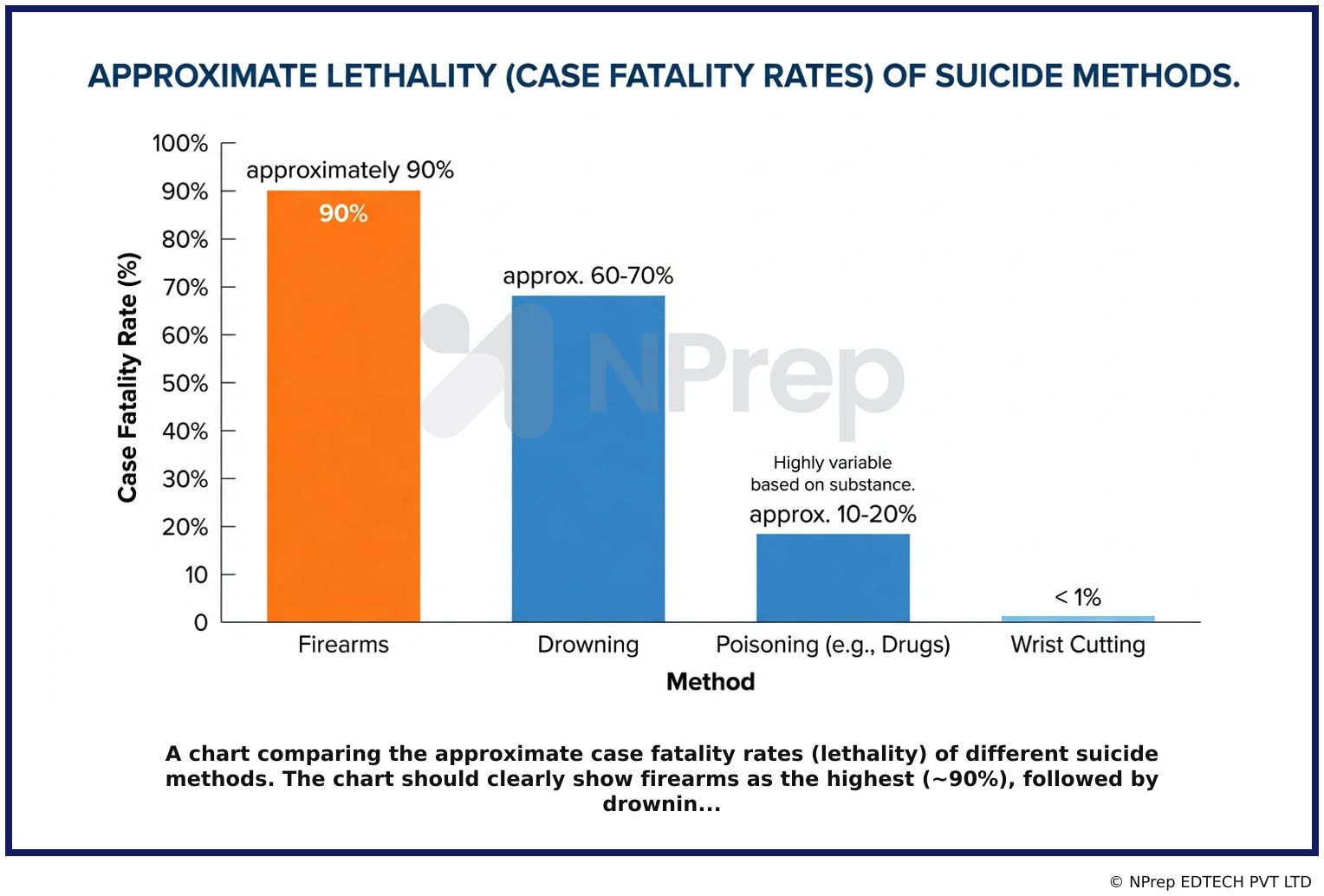
- The use of firearms is the most lethal method of suicide among the choices.
- According to the Nelson Textbook of Pediatrics, suicide attempts involving firearms have a case fatality rate of approximately 90%.
- The high lethality is due to the severe and immediate damage inflicted on vital organs, which minimizes the chance for any medical intervention or survival.
Why Other Options Were Wrong
- Option A: Wrist cutting has a very low lethality rate, often under 1%. It is difficult to cause fatal blood loss this way, and the slow progression allows ample time for discovery and medical help.
- Option B: The lethality of taking poison is highly variable and depends on the substance, amount, and speed of medical treatment. Overall, its fatality rate is significantly lower than that of firearms, as it often allows a window for intervention.
- Option D: While drowning is a very effective method of suicide if the act is completed, its overall case-fatality rate is lower than that of firearms. There remains a possibility, however small, of rescue and successful resuscitation.
Related Visual
Clinical Relevance
- Nursing practice connection: This is primarily an exam-oriented knowledge point with limited direct bedside application, so retain Lethality of suicide methods and suicide risk assessment as background academic context rather than a clinical decision trigger.
- A nurse's suicide risk assessment must include questions about the chosen method, its lethality, and the patient's access to the means.
- A patient with a plan involving a firearm is at the highest level of risk and requires immediate, decisive safety interventions, such as constant observation and/or involuntary hospitalization.
- What if? If a patient has a vague plan of 'taking pills' but no access to lethal quantities, the risk is still serious and requires a safety plan. However, if that same patient discloses they have access to a family member's handgun, the risk level escalates to critical, and the priority becomes immediate removal from that environment and securing the weapon.
How to Approach the Question
- First, identify the core of the question, which is to find the 'most lethal' method of suicide.
- Define 'lethal' in this context: it means the method with the highest probability of causing death per attempt (i.e., the highest case-fatality rate).
- Analyze the options by comparing their potential for immediate, irreversible harm.
- A gunshot often causes catastrophic damage to the brain or heart, leaving no time for rescue.
- Wrist cutting and poisoning are typically slower processes, which creates a window of opportunity for the person to be found and for medical intervention to be successful.
- Drowning is highly lethal but can be interrupted. Therefore, firearms have the highest certainty of death.
Concept Tested & Keywords
- Concept Tested: Lethality of suicide methods and suicide risk assessment.
- Stem keywords: lethal method, Suicide
- Lead-in keywords: most
Question ID
QanydmDgdgOQs1KfK_SBXs
Reference Book
E6 Nelson Textbook of Pediatrics(2024) — Volume 1 p. 140-142
E6 Parks TextBook of Preventive & Social Medicine part 1 — Subpart C (pp 404-604 of 604) p. 87-89
Practise the full AIIMS Raipur - 2017 (Shift-3)
Attempt every question from this paper in a timed mock, then review the full solution for each one.
More Psychiatric Emergencies Questions
- Priority action of patient agitation management?
- A patient has tried to commit suicide with drug overdose. Which of the situation depicts that the patient has high risk of suicide?
- Patient is taking haloperidol and at home Patient is not able to sit quietly, during the clinic visit Patient has the urge to walk. What is suffering…
- A client is admitted to the emergency room with symptoms of delirium tremens. After admitting the client to a private room, the priority nursing inte…
- A 38-year-old female client with a history of chronic schizophrenia, paranoid type, is currently an outpatient at the local mental health and mental…
- Which of the following would be a priority nursing intervention for a patient who has suicidal behaviour?
- During ward rounds, you find that a 24-year-old patient with mania is very abusive and aggressive; there is imminent danger of his becoming physicall…
- A patient says to a nurse, "Everyone would be better off if I wasn't alive." Which nursing diagnosis would be made based on this statement?
- A patient receiving haloperidol for schizophrenia reports an inner feeling of motor restlessness, stating, "I can't stop moving my legs, I feel like…
- A patient who was admitted after a suicide attempt following a job loss now appears cheerful, energetic, and states, "I've figured everything out and…
More AIIMS Raipur - 2017 (Shift-3) Questions
- Name of the tissue which is widely and abundantly distributed in the human body?
- Eight Bits make up a?
- What is the recommended flow rate of oxygen via nasal cannula?
- Which of the following items is NOT sterilized by antiseptic solution?
- Which is the most common occupational hazard of a computer worker?
- All the food items cause color to the urine EXCEPT?
- Which of the following is used for passive immunization?
- Which among the following bacteria lack a cell wall?
- Why is EDTA not suitable for calcium estimation?
- Among the following, identify the long-term effect of steroid therapy?