
WCL Staff Nurse - 2022
Community Health Nursing
Easy
Which of the following health care system is one of the indigenous systems of medicine?
Appeared in: WCL Staff Nurse - 2022
Explanation
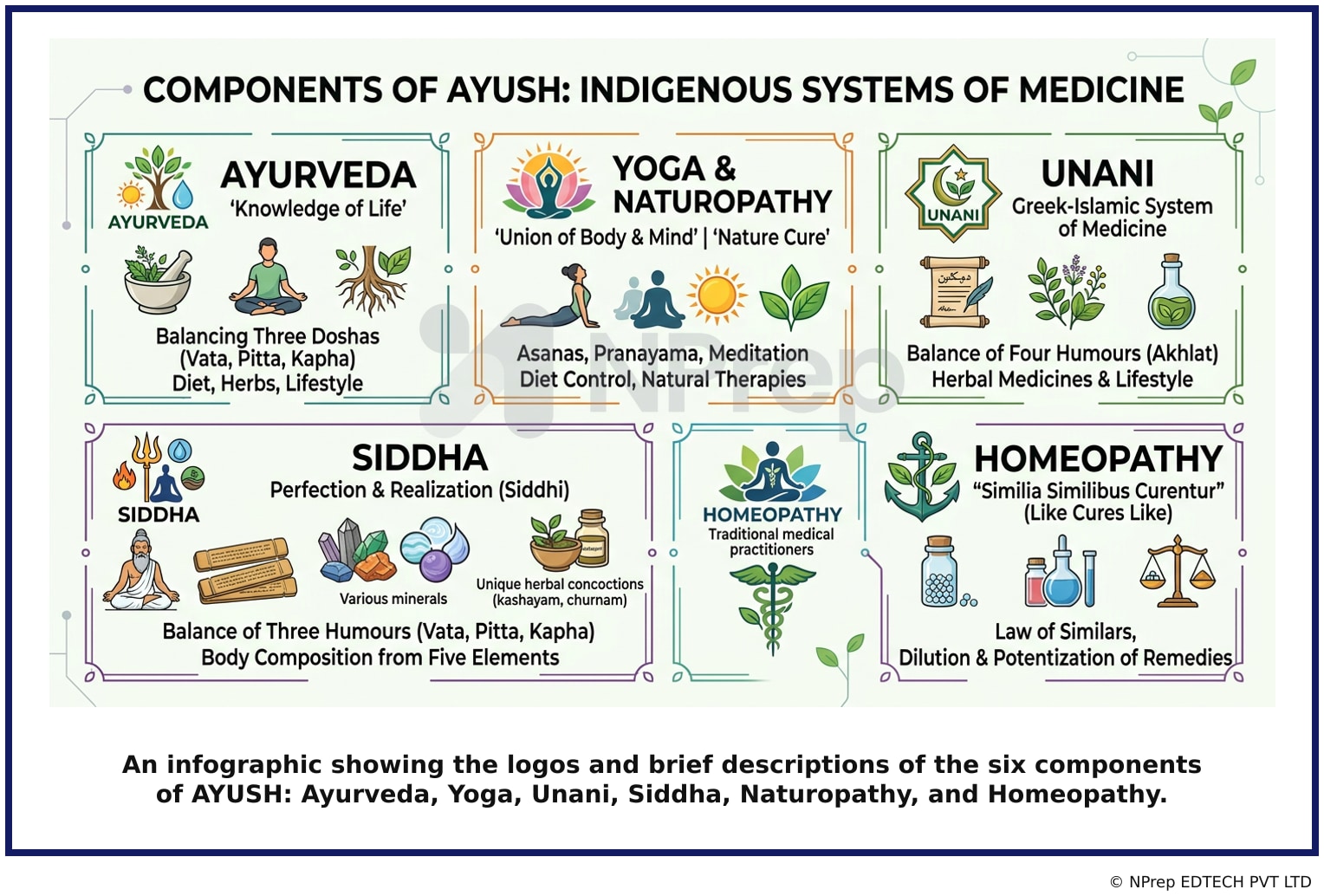
- Siddha is a traditional system of medicine that originated in the ancient Tamil land of Southern India.
- It is officially recognized by the Government of India as one of the indigenous systems of medicine under the acronym AYUSH.
- The fundamental principle of the Siddha system is based on the concept that the human body is composed of five primordial elements and three humors (Vatha, Pitta, Kapha).
- Health is considered a state of equilibrium of these humors, and disease is a state of disequilibrium.
Why Other Options Were Wrong
- Option A: Hospitals are physical institutions where healthcare is delivered. They are part of the infrastructure of any health system (Allopathic or AYUSH), not a system of medicine itself.
- Option B: Polyclinics are outpatient facilities that provide a variety of medical services. Like hospitals, they are a setting for healthcare delivery, not a philosophical or theoretical system of medicine.
- Option C: General practitioners are primary care physicians within the modern (Allopathic) medical system. They are healthcare providers, not a system of medicine.
Related Visual
Clinical Relevance
- Nursing practice connection: Knowing Indigenous Systems of Medicine in India (AYUSH) helps nurses interpret findings accurately and avoid errors in routine assessment, medication administration, and patient teaching.
- Understanding AYUSH is crucial for nurses in India as these systems are integrated into the national healthcare delivery system, especially under programs like the National Health Mission (NHM).
- Patients may use both Allopathic and AYUSH treatments (medical pluralism). Nurses should be aware of this to provide holistic care and avoid potential drug-herb interactions.
- What if? If a patient mentions they are taking a 'kashayam' for their cough, a nurse aware of AYUSH would recognize this as a herbal decoction (likely Ayurvedic or Siddha) and would inquire further about its ingredients and dosage instead of dismissing it. This allows for better patient assessment and education.
How to Approach the Question
- First, identify the key phrase in the question: 'indigenous systems of medicine'. This directs you to think about traditional, native medical practices.
- Analyze each option to determine its category. Ask yourself: 'Is this a philosophy/system of healing, a place, a type of facility, or a person's job title?'
- Evaluate 'Hospitals', 'Polyclinics', and 'General practitioners'. Recognize that these are all components of modern healthcare delivery infrastructure, not traditional systems of medicine.
- Evaluate 'Siddha'. Recall or recognize that Siddha, along with Ayurveda, Unani, etc., is part of India's traditional medical heritage, known collectively as AYUSH.
- Conclude that Siddha is the only option that fits the definition of an indigenous system of medicine.
Concept Tested & Keywords
- Concept Tested: Indigenous Systems of Medicine in India (AYUSH)
- Stem keywords: health care system, indigenous systems of medicine
- Lead-in keywords: Which of the following
Question ID
QdaX9m39ZVUkcpJ63VuaVu
Reference Book
E6 Comprehensive Textbook of Community Health Nursing for BSc Nursing Students Part 2 — Subpart B (pp 276-535 of 550) pp. 127-129, 128-130
E6 Textbook of Nursing Management and Leadership I. Clemen — Subpart A (pp 26-327 of 982) p. 24-26
Practise the full WCL Staff Nurse - 2022
Attempt every question from this paper in a timed mock, then review the full solution for each one.
More Alternative System of Medicine Questions
- During adana kala, bala:
- The number of marmas according to Susrutha:
- Trimarmas are:
- Specific sthana for vata:
- The main treatment for tamaka swasa is:
- During Siravyadha (venesection), what is the maximum amount of blood that can be removed?
- The system of medicine which is originated from Tamil Nadu State is:
- Which of the following therapies is an Ayurvedic treatment?
More WCL Staff Nurse - 2022 Questions
- What is the biological function of copper?
- Which are the risk factors for hearing loss?
- What provides the framework of synthesis of the cancellous bone tissue within metaphysis?
- Which muscle turns the palm upward or anteriorly?
- Why is hand washing a very important step in the procedure for care of a wound?
- Which among the following drug is obtained from leaves?
- Which of the following is NOT one of the national health programs in India?
- Identify an incorrect activity during first aid for serious burns?
- What is an example of Monera microorganisms?
- What is the most common cause of malaria in India?